Grassroots and Coalitions: Exploring the Possibilities of Black Politics by Michael Mitchell & David Covin
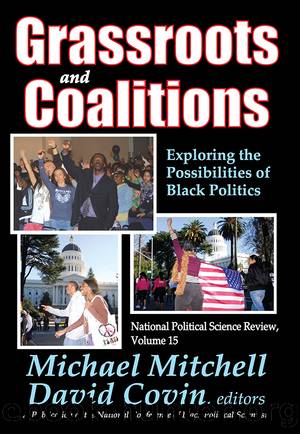
Author:Michael Mitchell & David Covin [Mitchell, Michael & Covin, David]
Language: eng
Format: epub
Tags: Political Science, General, American Government, Social Science, Ethnic Studies, African American Studies, American, African American & Black Studies
ISBN: 9781412852616
Google: cLRGmwEACAAJ
Goodreads: 17845908
Publisher: Routledge
Published: 2013-01-15T09:44:52+00:00
Reflections on the Presidential Election of 2012
Voter Identification Laws and Other Election Mechanisms in a Multiracial America
Christopher Stout
Southern Illinois University
Katherine Tate
University of California-Irvine
Following a wave of Republican victories, a number of state legislatures promoted and, in some cases, passed voter identification laws. In 2011, according to data published by the National Conference of State Legislatures (NCSL) (www.ncsl.org), seven states have strict photo identification requirements for voting. In many cases, these laws require potential voters to present state issued photo identification cards to prove their identities. While other states ask for photo identification but permit voting if other requirements are met, the strict photo states only count ballots if the voters provide photo identification at the polling station or to an election official several days after the election. Proponents of these laws argue that voter identification laws will prevent rampant fraud and corruption in American elections. In their book, Whoâs Counting: How Fraudsters and Bureaucrats Put Your Vote at Risk, John Fund and Hans von Spakovsky argue that fraud and bureaucratic failings make it easy for individuals to impersonate voters. They argue that voter identification laws will end these practices and improve the integrity of our democracy. And in 2008, a six-member majority on the Supreme Court upheld strict photo identification laws as constitutional, arguing that states had the right to protect the âintegrity and reliability of the electoral process.â
Opponents of voter identification laws argue that they are a solution in search of a problem, because voter fraud is not as rampant as some suggest. They point to a number of studies including a 2007 New York Times analysis which shows that in the over one hundred million ballots casts between 2002 and 2007 fewer than one hundred individuals were convicted of voter fraud (Lipton and Urbina 2007). Instead, opponents of the law argue that voter identification laws are a subtle way to disenfranchise young, old, and minority voters who disproportionately support the Democratic Party. To bolster their claims, opponents of the laws argue that it is not a coincidence that strict photo identification laws tend to come from conservative southern states and have all been promoted by Republican-controlled legislatures. Moreover, they cite a number of studies including one by the Brennan Center for Justice (Weiser and Kasdan 2012), and another conducted by University of Chicago Political Scientist Cathy Cohen and Washington University of St. Louis Professor Jon Rogowski. These studies demonstrate that voter identification laws will disenfranchise a substantial portion of the eligible electorate (about 11 percent) and will have particularly negative consequences for young minority voters (Rogowski and Cohen 2012). To defend itself in litigation, Indiana passed a law providing free photo IDs to the poor. But, generally, a photo identification adds a costly burden to the process of voting, and can be seen as a modern-day poll tax (which was outlawed by the Twenty-fourth Amendment in 1964).
This note examines the impact of the 2012 presidential election on the future of voter identification and other election laws in the United States.
Download
This site does not store any files on its server. We only index and link to content provided by other sites. Please contact the content providers to delete copyright contents if any and email us, we'll remove relevant links or contents immediately.
| Anthropology | Archaeology |
| Philosophy | Politics & Government |
| Social Sciences | Sociology |
| Women's Studies |
Born to Run: by Christopher McDougall(7120)
The Leavers by Lisa Ko(6945)
iGen by Jean M. Twenge(5408)
Sapiens by Yuval Noah Harari(5366)
Spare by Prince Harry The Duke of Sussex(5176)
The Kite Runner by Khaled Hosseini(5170)
Machine Learning at Scale with H2O by Gregory Keys | David Whiting(4292)
Bullshit Jobs by David Graeber(4179)
Never by Ken Follett(3937)
Goodbye Paradise(3799)
Livewired by David Eagleman(3764)
Fairy Tale by Stephen King(3370)
A Dictionary of Sociology by Unknown(3073)
Harry Potter 4 - Harry Potter and The Goblet of Fire by J.K.Rowling(3060)
The Social Psychology of Inequality by Unknown(3018)
The Club by A.L. Brooks(2919)
Will by Will Smith(2908)
0041152001443424520 .pdf by Unknown(2843)
People of the Earth: An Introduction to World Prehistory by Dr. Brian Fagan & Nadia Durrani(2727)
