Governomics by McAuley Ian;Lyons Miriam;
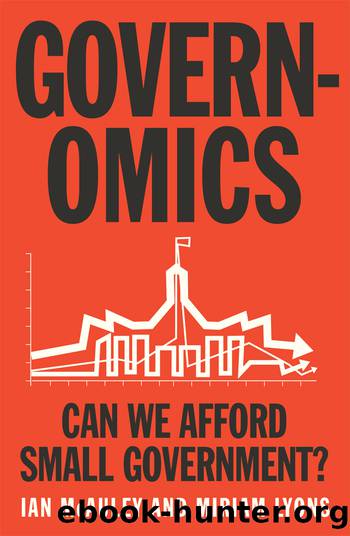
Author:McAuley, Ian;Lyons, Miriam;
Language: eng
Format: epub
Publisher: Melbourne University Publishing
Networks: When Only a Crowd Is Enough
No discussion of the government role in natural monopolies is complete without a discussion of network goods. Imagine, perhaps, that you are living in the early part of the twentieth century, and are thinking of getting a telephoneâin its time a very expensive piece of equipment, and subject to ridicule. âThis âtelephoneâ has too many shortcomings to be seriously considered as a means of communicationâ, a Western Union executive is reputed to have written in 1876.24
Your main consideration in making such an outlay would be to think about the number of your friends and business associates who might also be thinking of getting such a newfangled device. Clearly all would be reluctant to be the first mover, and it could take many years until there is a critical mass encouraging everyone to take it up.
Similarly for transport networks. A fast train connecting Sydney and Newcastle would cost somewhere between $10 and $20 billion, but it is probable that, given the number of passengers who would use it, the return would be too low for a commercial investor. A line connecting the main east-coast cities would cost five times that, and may provide a reasonable return, but it would take many years to complete, and in any case there are few firms willing to invest in such a huge undertaking, particularly when there may be major technological, demographic or market changes before the network is up and running. The airlines might enter into a prolonged price war, for example.
What railroads and telephones have in common is that they are networks, and it is not until networks reach a reasonable critical mass that they yield their benefits, which can be considerable. After all, railroads and telephones were the engines of growth in the late nineteenth century and the early twentieth century respectively. But getting to that critical mass can take a large amount of investment, generally beyond the capacity or risk-tolerance of a private financier.
A network like a national broadband system, with its reach into lightly populated regions requiring cross-subsidies, would be even more problematic for the private sector. The private sector may have an incentive to provide fast broadband between urban CBDs and densely settled inner city areas, but not to build a national network.
Just because a project is unattractive to the private sector, however, does not mean it is uneconomic. The original vision behind the National Broadband Network was that when complete its returns would have made it very attractive to private investors, and that, to avoid the waste of duplication, it would have remained as a monopoly for the foreseeable future. People want competition in content, but they donât want to have to choose between two identical cables and to have their streets dug up twice. The government proposed to regulate it so that it would be obliged to provide services for high-cost users in remote locations, just like Australia Post.
Governments are often the best agencies to get networks established. Because many networks
Download
This site does not store any files on its server. We only index and link to content provided by other sites. Please contact the content providers to delete copyright contents if any and email us, we'll remove relevant links or contents immediately.
| Anthropology | Archaeology |
| Philosophy | Politics & Government |
| Social Sciences | Sociology |
| Women's Studies |
The Secret History by Donna Tartt(19088)
The Social Justice Warrior Handbook by Lisa De Pasquale(12190)
Thirteen Reasons Why by Jay Asher(8909)
This Is How You Lose Her by Junot Diaz(6886)
Weapons of Math Destruction by Cathy O'Neil(6279)
Zero to One by Peter Thiel(5802)
Beartown by Fredrik Backman(5754)
The Myth of the Strong Leader by Archie Brown(5507)
The Fire Next Time by James Baldwin(5444)
How Democracies Die by Steven Levitsky & Daniel Ziblatt(5218)
Promise Me, Dad by Joe Biden(5153)
Stone's Rules by Roger Stone(5087)
A Higher Loyalty: Truth, Lies, and Leadership by James Comey(4963)
100 Deadly Skills by Clint Emerson(4925)
Rise and Kill First by Ronen Bergman(4788)
Secrecy World by Jake Bernstein(4753)
The David Icke Guide to the Global Conspiracy (and how to end it) by David Icke(4718)
The Farm by Tom Rob Smith(4509)
The Doomsday Machine by Daniel Ellsberg(4490)
