General Idea of the Revolution in the Nineteenth Century by Proudhon P.-J.;
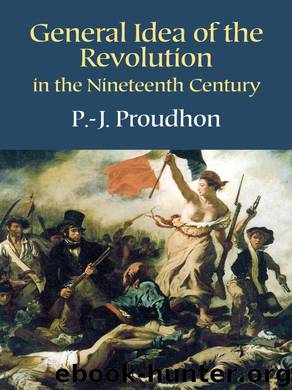
Author:Proudhon, P.-J.; [Proudhon, P.-J.]
Language: eng
Format: epub
ISBN: 1890360
Publisher: Dover Publications
Published: 2012-10-12T04:00:00+00:00
FIFTH STUDY.
Social Liquidation.
THE preceding studies, as much upon contemporaneous society as upon the reforms which it suggests, have taught us several things which it is well to recount here summarily.
1. The fall of the monarchy of July and the proclamation of the Republic were the signal for a social revolution.
2. This Revolution, at first not understood, little by little became defined, determined and settled, under the influence of the very same Reaction which was displayed against it, from the first days of the Provisional Government.
3. This Revolution consists in substituting the economic, or industrial, system, for the governmental, feudal and military system, in the same way that the present system was substituted, by a previous revolution, for a theocratic or sacerdotal system.
4. By an industrial system, we understand, not a form of government, in which men devoted to agriculture and industry, promoters, proprietors, workmen, become in their turn a dominant caste, as were formerly the nobility and clergy, but a constitution of society having for its basis the organization of economic forces, in place of the hierarchy of political powers.
5. And to explain that this organization must result from the nature of things, that there is nothing arbitrary about it, that it finds its law in established practice, we have said that, in order to bring it about, the question was of one thing only: To change the course of things, the tendency of society.
Passing then to the examination of the chief ideas that offer themselves as principles for guidance, and that serve as banners to parties, we have recognized:
6. That the principle of association, invoked by most Schools, is an essentially sterile principle; that it is neither an industrial force nor an economic law; that it would involve both government and obedience, two words which the Revolution bars.
7. That the political principle revived recently, under the names of direct legislation, direct government, etc., is but a false application of the principle of authority, whereof the sphere is in the family, but which cannot legitimately be extended to the city or the nation.
At the same time we have established:
8. That in place of the idea of association, there was a tendency to substitute in the workmen’s societies a new idea, reciprocity, in which we have seen both an economic force and a law.
9. That to the idea of government there was opposed, even in the political tradition itself, the idea of contract, the only moral bond which free and equal beings can accept.
Thus we come to recognize the essential factors of the Revolution.
Its cause: the economic chaos which the Revolution of 1789 left after it.
Its occasion: a progressive, systematic poverty, of which the government finds itself, willy-nilly, the promoter and supporter.
Its organic principle: reciprocity; in law terms, contract.
Its aim: the guaranty of work and wages, and thence the indefinite increase of wealth and of liberty.
Its parties, which we divide into two groups: the Socialist schools, which invoke the principle of Association; and the democratic factions, which are still devoted to the principles of centralization and of the State.
Download
This site does not store any files on its server. We only index and link to content provided by other sites. Please contact the content providers to delete copyright contents if any and email us, we'll remove relevant links or contents immediately.
| Anthropology | Archaeology |
| Philosophy | Politics & Government |
| Social Sciences | Sociology |
| Women's Studies |
The Secret History by Donna Tartt(19105)
The Social Justice Warrior Handbook by Lisa De Pasquale(12197)
Thirteen Reasons Why by Jay Asher(8921)
This Is How You Lose Her by Junot Diaz(6894)
Weapons of Math Destruction by Cathy O'Neil(6285)
Zero to One by Peter Thiel(5808)
Beartown by Fredrik Backman(5769)
The Myth of the Strong Leader by Archie Brown(5513)
The Fire Next Time by James Baldwin(5454)
How Democracies Die by Steven Levitsky & Daniel Ziblatt(5225)
Promise Me, Dad by Joe Biden(5157)
Stone's Rules by Roger Stone(5091)
A Higher Loyalty: Truth, Lies, and Leadership by James Comey(4967)
100 Deadly Skills by Clint Emerson(4932)
Rise and Kill First by Ronen Bergman(4797)
Secrecy World by Jake Bernstein(4756)
The David Icke Guide to the Global Conspiracy (and how to end it) by David Icke(4724)
The Farm by Tom Rob Smith(4517)
The Doomsday Machine by Daniel Ellsberg(4493)
