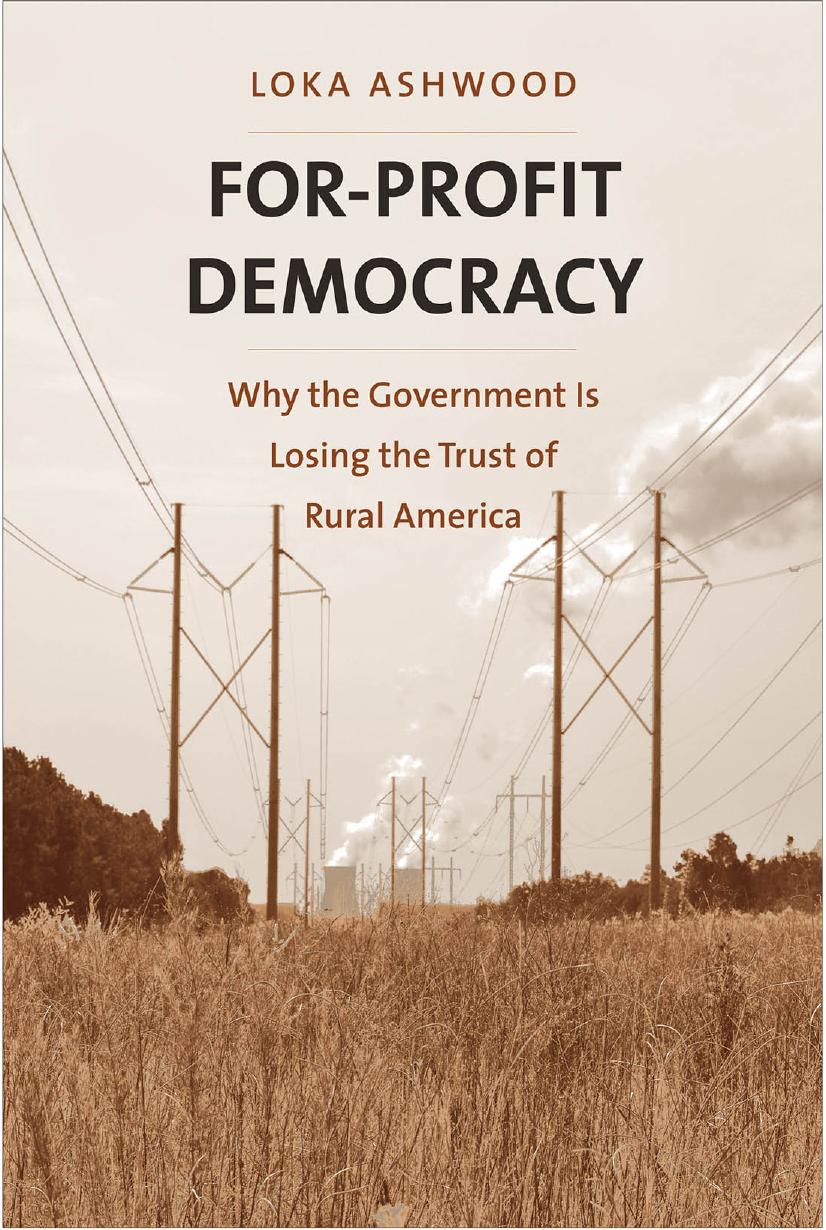
For-Profit Democracy by Loka Ashwood
Author:Loka Ashwood
Language: eng
Format: epub, pdf
Publisher: Yale University Press
Published: 2018-08-14T16:00:00+00:00
Then the LORD said,
“I have observed the misery of my people who are in Egypt;
I have heard their cry on account of their taskmasters.
Indeed, I know their sufferings,
and I have come down to deliver them from the Egyptians,
and to bring them up out of that land to a good and broad land,
a land flowing with milk and honey.”
—Exodus 3:7–8
“The walk is by faith,” Samuel said. To understand his walk required more than a simple documentation of him stepping forward. He did a great deal of that. I saw him at Nuclear Regulatory Commission meetings, usually flanked by one or two fellow black reverends. There he appeared as an organized representative of Shell Bluff Concerned Citizens, a small group of mostly preachers and a few churchgoers—all black—that kept tabs on Vogtle. Dressed in a sharp suit, he would take to the microphone to ask questions about domination and oppression that were sometimes particular but usually more overarching. At meetings hosted by white out-of-town activists, I saw him show his support but make it clear that he had little hope in the efficacy of their go-through-the-government ways. Still, he worked to improve disaster plans for those in the evacuation zone by talking to Southern Company. By all appearances, he seemed committed to democratic reform by engaging in processes that the state sanctioned. That is often the sign that scholars look for in documenting a democratic protest: showing up and standing up.1 Protest is supposed to be a cornerstone of a healthy democracy, reforming and reshaping the government when it goes astray.
Reckoning with the full fallout of majority tyranny in for-profit democracy requires rethinking the assumption that people showing up or standing up signals faith in the state they seek to reform. For Samuel, showing up didn’t signal faith in the democratic state, a part of the corrupt system. It signaled faith in God.
“What the system has done is gotten very sophisticated,” Samuel explained to me, folding one long leg over the other and leaning back with ease in his rolling desk chair. “Most of my people do not understand the system. They think I’m one of the worst black men they’ve ever seen in their life. Black folk and white folk. Because I understand the system. You’ve millions of people who are at the lowest on the totem pole, lowest economic status, who could wreck havoc on the system. So what’s your best method? You’ve got to maintain racism. That’s the mission. We have to learn, you do not look at a person by the color content of their skin, but the spirit that possess them.”
The scholars C. Eric Lincoln and Lawrence H. Mamiya write that the black Baptist church has traditionally stood as the “most important and dominant institutional phenomenon in African American communities.” Samuel preached to those accustomed to a rich regional history of black Baptists. Just up the Savannah River, on the South Carolina side, rested Silver Bluff Baptist Church, one of the first known black churches in America, which dates back to the mid-eighteenth century.
Download
This site does not store any files on its server. We only index and link to content provided by other sites. Please contact the content providers to delete copyright contents if any and email us, we'll remove relevant links or contents immediately.
| Anthropology | Archaeology |
| Philosophy | Politics & Government |
| Social Sciences | Sociology |
| Women's Studies |
The Secret History by Donna Tartt(19484)
The Social Justice Warrior Handbook by Lisa De Pasquale(12302)
Thirteen Reasons Why by Jay Asher(9136)
This Is How You Lose Her by Junot Diaz(7078)
Weapons of Math Destruction by Cathy O'Neil(6489)
Zero to One by Peter Thiel(5957)
Beartown by Fredrik Backman(5954)
The Myth of the Strong Leader by Archie Brown(5633)
The Fire Next Time by James Baldwin(5599)
How Democracies Die by Steven Levitsky & Daniel Ziblatt(5340)
Promise Me, Dad by Joe Biden(5240)
Stone's Rules by Roger Stone(5198)
A Higher Loyalty: Truth, Lies, and Leadership by James Comey(5092)
100 Deadly Skills by Clint Emerson(5036)
Rise and Kill First by Ronen Bergman(4914)
Secrecy World by Jake Bernstein(4900)
The David Icke Guide to the Global Conspiracy (and how to end it) by David Icke(4858)
The Doomsday Machine by Daniel Ellsberg(4634)
The Farm by Tom Rob Smith(4614)
