Fiction Agonistes by Jusdanis Gregory;
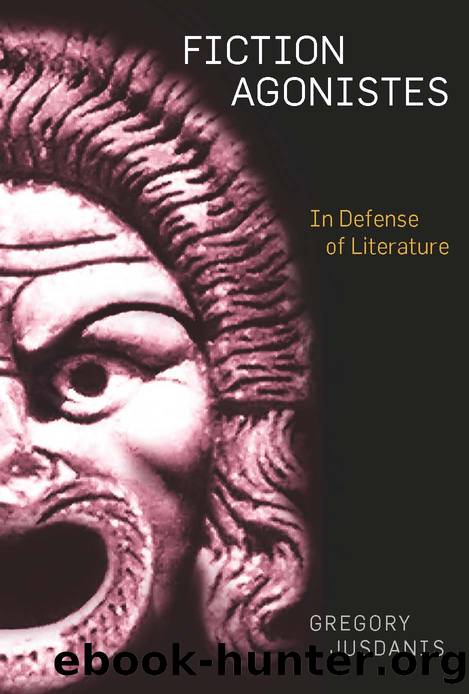
Author:Jusdanis, Gregory;
Language: eng
Format: epub
Publisher: Stanford University Press
Published: 2011-08-15T16:00:00+00:00
Dicaiopolis proclaims the ability of comedy to deliver the unvarnished truth about the war between Athens and Sparta that erupted in 431 BCE and did not end until 404 with some intervals of peace in between. Here he refers openly to Cleon, the politician who most favored the continued conflict with Sparta and scuttled an opportunity in 425 for an honorable peace. He had also prosecuted Aristophanes a year earlier on the grounds of slandering the state with his production of “The Babylonians.” Dicaiopolis, speaking as Aristophanes himself, affirms the capacity of art to undertake political criticism because it is art, that is, not political discourse. To be sure, he feels safe to conduct his diatribe against the city’s leaders only in the guise of a theatrical character—art’s secret weapon to avoid censorship through the ages. In so doing, he brings attention to the overlap between aesthetic form and civic life.
Then it is the Acharnians’ turn to speak. They remove their masks and, now no longer spectators to Dicaiopolis’s performance, address the Athenian public in the Theater of Dionysus, which was not far from the Pnyx itself. They begin their parabasis by referring to the link between literature and politics:
He has won the debate and converted the State
(At least, so we hope) to his view.
Now let’s strip for the dance and make use of our chance
To convey our opinions to you. (77)
They remind the audience that since Aristophanes had started writing comedies, he has never used his parabasis to say that he is “clever.” But now that he has been charged with slandering the state, “he wants to find / If, true to your tradition, you since then have changed your mind” (77). But all he did was tell the Athenians the truth (78). The chorus leader lashes out at Creon:
So, though Cleon may itch
For another big fight,
He will never prevail,
For justice and right
Are my allies. (79)
It is impossible to disentangle art from society, theater from politics. The parabasis here functions as a metaphor, suggesting that art dramatizes the tension between illusion and the empirical world without at all separating one from another.
This is hysterically demonstrated in “The Frogs,” first staged in 405 BCE and Aristophanes’ last surviving work. As a whole, the play concerns the waning of Athenian drama and the weakening of the Athenian city-state. While the parabasis enacts the political function of poetry, the play explores the place of poetry in society. The play begins with Dionysus, the god in whose honor the dramatic festivals were held, announcing that he is searching for a good poet to help the city in its political crisis (Aristophanes 1962: 486). He finally decides to descend to Hades, along with his slave, Xanthias, to bring back the recently deceased Euripides as the city’s savior, reenacting here in comic form the mythological nekyia that I spoke of earlier. At the end, he returns with Aeschylus after witnessing a dramatic agon between the two tragedians over who was the most accomplished artist.
Although the
Download
This site does not store any files on its server. We only index and link to content provided by other sites. Please contact the content providers to delete copyright contents if any and email us, we'll remove relevant links or contents immediately.
4 3 2 1: A Novel by Paul Auster(12517)
The handmaid's tale by Margaret Atwood(7835)
Giovanni's Room by James Baldwin(7441)
Big Magic: Creative Living Beyond Fear by Elizabeth Gilbert(5836)
Asking the Right Questions: A Guide to Critical Thinking by M. Neil Browne & Stuart M. Keeley(5834)
Ego Is the Enemy by Ryan Holiday(5530)
The Body: A Guide for Occupants by Bill Bryson(5181)
On Writing A Memoir of the Craft by Stephen King(5000)
Ken Follett - World without end by Ken Follett(4790)
Adulting by Kelly Williams Brown(4623)
Bluets by Maggie Nelson(4606)
Eat That Frog! by Brian Tracy(4601)
Guilty Pleasures by Laurell K Hamilton(4507)
The Poetry of Pablo Neruda by Pablo Neruda(4172)
Alive: The Story of the Andes Survivors by Piers Paul Read(4079)
Fingerprints of the Gods by Graham Hancock(4050)
White Noise - A Novel by Don DeLillo(4047)
The Book of Joy by Dalai Lama(4045)
The Bookshop by Penelope Fitzgerald(3902)
