Fichte's Addresses to the German Nation Reconsidered by Daniel Breazeale Tom Rockmore
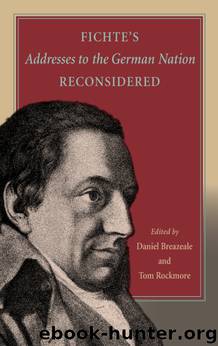
Author:Daniel Breazeale,Tom Rockmore
Language: eng
Format: epub
Publisher: State University of New York Press
Published: 2016-04-09T04:00:00+00:00
Notes
1. Fichte viewed his addresses as a continuation of the discussion he had begun in the Characteristics of the Present Age, originally delivered as a series of seventeen lectures in the winter of 1804–05 (AGN, 3, 9.) This already provides a framework in which the Addresses should be read. In the Characteristics, Fichte outlines a speculative philosophy of history, analyzing the Enlightenment and defining its existing place in the historical evolution of humanity and human spirit. Yet he acknowledges that what he earlier “described as present is now past” and the current task—which he considers as “the purpose of these addresses”—is to reveal “a world thus constituted as a means of creating a new self and a new age” (AGN, 9, 10). Although I will provide page references to the above translation, I have modified it in some cases.
2. Johann Gottlieb Fichte, The Popular Works of Johann Gottlieb Fichte (1848–49), trans. William Smith, 4th ed., vol. 2 (London: Trübner, Ludgate Hill: 1889), 252 (SW, 7, 222).
3. Ibid, 255 (SW, 7, 224).
4. Cf. Ernst Bergmann, Fichte und der Nationalsizialismus (Breslau: F. Hirt, 1933). Primarily a work of propaganda, the volume, which is a perfect example of the historical misappropriation and misuse of Fichte and his writings for political motives, blatantly portrays Fichte as the forefather of National Socialism.
5. Some scholars claim that as a philosopher Fichte was close to National Socialism in tone and spirit. In his recent book, Hitler’s Private Library (New York: Alfred A. Knopf, 2008), Timothy Ryback draws some parallels between Fichte and Hitler, which the author sees in calling for an overthrow of the political elite, drumming up support for a people’s war, and dreaming of the unity of the German people (esp. p. 107). Attempts to demonstrate a connection between Fichte’s ideas and Nazism are also undertaken by some other authors. See, for example: Micha Brumlik, Deutscher Geist und Judenhass (München: Luchterhand Literaturverlag, 2000); Emiliano Acosta, “Is It Still Possible to Recover Fichte’s Reflections about Education? Notes on Fichte’s Aphorisms on Education (1804),” in Institutions of Educations, Then and Today: The Legacy of German Idealism, ed. Paul Cobben (Leiden/Boston: Brill, 2010), 151–60.
6. AGN, 17.
7. Ibid., 38.
8. Ibid., 17.
9. Ibid., 19.
10. Ibid., 16.
11. Ibid., 103.
12. Ibid., 15.
13. Ibid., 118, cf. also 178.
14. The German tern Erziehung is often inaccurately translated as “education.” However, Erziehung has a strong connotation toward learning social norms as well as basic rules and principles of life. As such it can be appropriately rendered as “nurturing” or “upbringing.” While the task of bringing up and nurturing a child necessarily includes a process of learning, it is not synonymous with education. The German word for education is Ausbildung. It refers to a more specific kind of learning related to gaining a special knowledge or a set of skills needed in order to have some kind of ability or knowhow (to operate a certain machine, to do computer programming, etc.). This term is usually used in relation to formal schooling or training (= education) that allows one to qualify for a specific job or position.
Download
This site does not store any files on its server. We only index and link to content provided by other sites. Please contact the content providers to delete copyright contents if any and email us, we'll remove relevant links or contents immediately.
| Anthropology | Archaeology |
| Philosophy | Politics & Government |
| Social Sciences | Sociology |
| Women's Studies |
The Secret History by Donna Tartt(19104)
The Social Justice Warrior Handbook by Lisa De Pasquale(12197)
Thirteen Reasons Why by Jay Asher(8919)
This Is How You Lose Her by Junot Diaz(6894)
Weapons of Math Destruction by Cathy O'Neil(6285)
Zero to One by Peter Thiel(5808)
Beartown by Fredrik Backman(5768)
The Myth of the Strong Leader by Archie Brown(5513)
The Fire Next Time by James Baldwin(5454)
How Democracies Die by Steven Levitsky & Daniel Ziblatt(5225)
Promise Me, Dad by Joe Biden(5157)
Stone's Rules by Roger Stone(5091)
A Higher Loyalty: Truth, Lies, and Leadership by James Comey(4967)
100 Deadly Skills by Clint Emerson(4932)
Rise and Kill First by Ronen Bergman(4797)
Secrecy World by Jake Bernstein(4756)
The David Icke Guide to the Global Conspiracy (and how to end it) by David Icke(4724)
The Farm by Tom Rob Smith(4517)
The Doomsday Machine by Daniel Ellsberg(4493)
