Fear, Power, and Politics by Cardaras Mary;
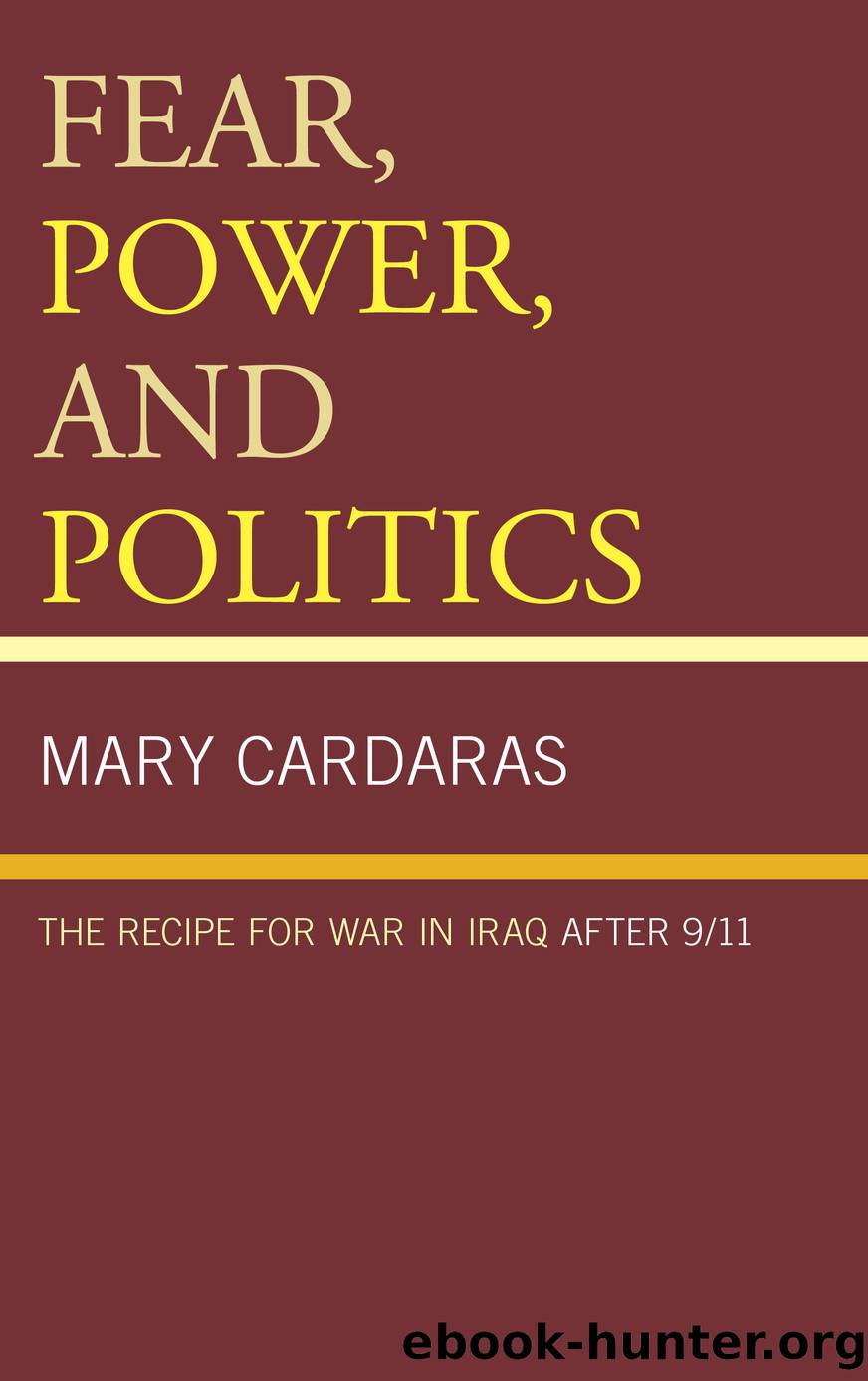
Author:Cardaras, Mary;
Language: eng
Format: epub
Tags: undefined
Publisher: Lexington Books
Published: 2012-08-15T00:00:00+00:00
We are not dealing with a conventional war. We cannot respond in a conventional manner. I do not want to see this spiral out of control. This crisis involves issues of national security, foreign policy, public safety, intelligence gathering, economics and murder. Our response must be equally multifaceted.[36]
As Congresswoman Lee concluded her remarks, she reminded the chamber of another time in American history when Congress gave President Lyndon Johnson the power in 1964 to authorize further and deeper military involvement in Vietnam. She harkened back to Senator Wayne Morse of Oregon, a Republican turned Democrat, who stood with democratic Senator Ernest Gruening of Alaska, mavericks in their time, voting in opposition to the Gulf of Tonkin Resolution. Morse said the vote was a mistake because the president alone could not be in charge of Americaâs foreign policy, certainly not when sending troops to fight without an official declaration of war by Congress.[37] Lee agreed with those sentiments expressed thirty-seven years earlier, saying we should heed the lessons of history, and concluded, âas we act, let us not become the evil that we deplore.ââ
The same day, the president issued this brief two-line statement regarding the vote: âI am gratified that the Congress has united so powerfully by taking this action. It sends a clear messageâour people are together, and we will prevail.â[38] Would this vote set a tone for a future military engagement in Iraq? Was the authority granted to the president too broad, too sweeping? Just days later the New York Times published an article reporting that the resolution was broad and cautioned that it could not limit the president in any significant way. The article quoted Professor Harold H. Koh of Yale Law School: âI think it is extremely broad because no nations are named, the nations are to be determined by the president and the president could theoretically name lots of nations. There is also no time limit.â[39]
The newspaper also reported that Congress âseemed eager to show unity in the face of the attacksâ and that discussions with members of Congress âwere largely over whether to include a reference to the War Powers Resolution (it was retained) and whether to delete a reference authorizing the president to deter âfuture actsâ of terrorism (it remained).â Representative Peter A DeFazio, a Democrat of Oregon, was quoted in the same article, expressing concerns that âearlier drafts âauthorized the use of force in an unprecedented open-ended manner,ââ but that he was ultimately satisfied that the authority of Congress would be recognized and respected.[40]
On October 7, 2001, the president addressed the nation in a televised address to announce âOperation Enduring Freedom.â The initiative would target âal Qaeda training camps and military installations of the Taliban regimeâ in Afghanistan. The president said in part:
Today we focus on Afghanistan, but the battle is broader. Every nation has a choice to make. In this conflict, there is no neutral ground. If any government sponsors the outlaws and killers of innocents, they have become outlaws and murderers themselves.
Download
This site does not store any files on its server. We only index and link to content provided by other sites. Please contact the content providers to delete copyright contents if any and email us, we'll remove relevant links or contents immediately.
| Anthropology | Archaeology |
| Philosophy | Politics & Government |
| Social Sciences | Sociology |
| Women's Studies |
The Secret History by Donna Tartt(19103)
The Social Justice Warrior Handbook by Lisa De Pasquale(12197)
Thirteen Reasons Why by Jay Asher(8919)
This Is How You Lose Her by Junot Diaz(6894)
Weapons of Math Destruction by Cathy O'Neil(6284)
Zero to One by Peter Thiel(5808)
Beartown by Fredrik Backman(5767)
The Myth of the Strong Leader by Archie Brown(5513)
The Fire Next Time by James Baldwin(5454)
How Democracies Die by Steven Levitsky & Daniel Ziblatt(5225)
Promise Me, Dad by Joe Biden(5157)
Stone's Rules by Roger Stone(5091)
A Higher Loyalty: Truth, Lies, and Leadership by James Comey(4966)
100 Deadly Skills by Clint Emerson(4932)
Rise and Kill First by Ronen Bergman(4797)
Secrecy World by Jake Bernstein(4756)
The David Icke Guide to the Global Conspiracy (and how to end it) by David Icke(4723)
The Farm by Tom Rob Smith(4517)
The Doomsday Machine by Daniel Ellsberg(4493)
