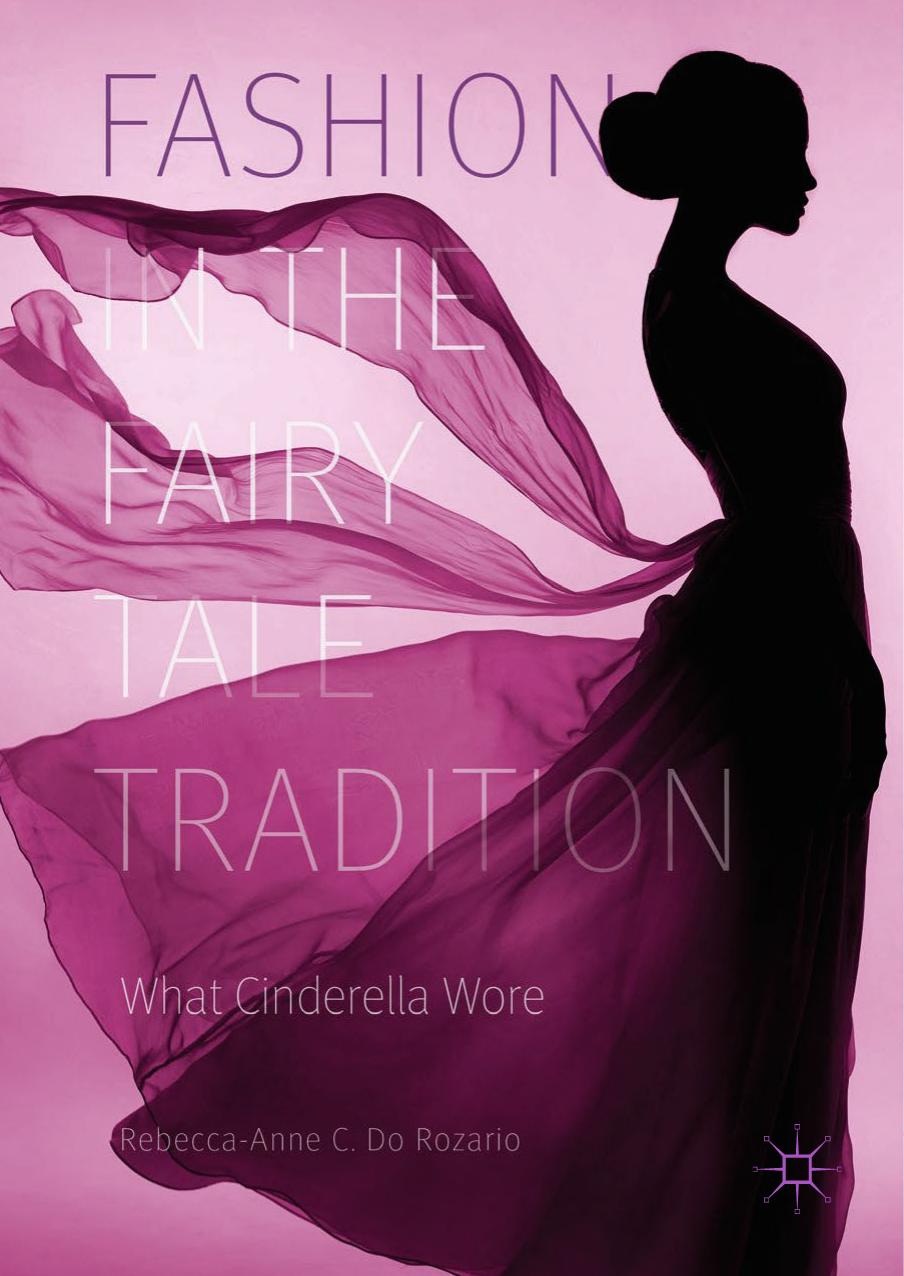
Fashion in the Fairy Tale Tradition by Rebecca-Anne C. Do Rozario
Author:Rebecca-Anne C. Do Rozario
Language: eng
Format: epub, pdf
Publisher: Springer International Publishing, Cham
Modern Cinderellas
From the mid-nineteenth century, modern Cinderellas picked up the thread of their working-class forebears in Basile’s collections. As fashionable clothing became more accessible to women from all walks of life, Cinderella came to embody transformation, social mobility, and fashion for a wider range of women. Gender and class have always underscored the Cinderella narrative but, in the twentieth century, working- and middle-class Cinderellas laid claim to their right to their own fairy tale—and nowhere was this more obvious than in America, where the story resonated with the mythology of the American Dream. Jane Yolen argues that these Cinderellas are not the princesses of early modern tales, but “a spun-sugar caricature of her hardier European and Oriental forbears, who made their own way in the world,” 120 and that, particularly since Disney’s Cinderella , the hero “has been a coy, helpless dreamer, a ‘nice’ girl who awaits her rescue with patience and a song.” 121 She often has a needle or other sewing tool in her hand, too, embodying useful domesticity. Sarah A. Gordon reflects that “[s]ewing is laden with understandings of femininity, family, and social class. It evokes ideas about thrift, housekeeping, wifely duty, motherly love, and sexual attraction.” 122 Femininity, thrift, and sexual attraction are particular markers of how sewing shaped the destinies of the modern Cinderellas.
“Modern Cinderella” literature appeared regularly, including Amanda Minni Douglas’s juvenile novel, A Modern Cinderella (1913), Anna Alice Chapin’s story, “A Modern Cinderella,” in the Los Angeles Herald (1907), Charlotte M. Braeme’s novel, A Modern Cinderella (1888), and Harriet Childe-Pemberton’s “Lilian Lane” from Fairy Tales for Every Day (1882). The tale was popular in magazines such as Harper’s New Monthly and The Atlantic Monthly, where the heroes were validated for their domesticity and materialism. 123 The ability to sew with a needle came to stand in lieu of the fairy godmother’s wand, enabling Cinderellas to help themselves. Authors did sentimentalise the lower-class Cinderellas, but their usefulness was unquestioned. Carol Hanbery MacKay observes, “The Cinderella tale-type presents the reader or listener with a plotline and set of archetypal figures that cry out for feminist critique, from within and/or outside the text.” 124 Rather than simply accept these as creatures of spun-sugar, it is worth examining their skill with spinning and applying thread.
The most notable of the modern Cinderellas is Louisa May Alcott’s short story, “A Modern Cinderella, or, The Little Old Shoe,” first published in The Atlantic (1860). In Alcott’s story, one of the self-proclaimed “wicked sisters,” Di, attempts to knit “as a sort of penance for past sins,” but “soon originated a somewhat remarkable pattern” with her dropped stitches. 125 With a knitting needle poked into her hair, she is “like a sarcastic unicorn.” 126 Like her predecessors, she lacks the talents of Cinderella and has a caustic tongue, although in this case she is supportive rather than obstructive. Nan, the Cinderella, is sweet and docile, and “sat diligently ornamenting with microscopic stitches a great patch.” 127 Nan is useful and highly skilled, and will achieve her happily ever after.
Download
Fashion in the Fairy Tale Tradition by Rebecca-Anne C. Do Rozario.pdf
This site does not store any files on its server. We only index and link to content provided by other sites. Please contact the content providers to delete copyright contents if any and email us, we'll remove relevant links or contents immediately.
4 3 2 1: A Novel by Paul Auster(12377)
The handmaid's tale by Margaret Atwood(7757)
Giovanni's Room by James Baldwin(7330)
Asking the Right Questions: A Guide to Critical Thinking by M. Neil Browne & Stuart M. Keeley(5761)
Big Magic: Creative Living Beyond Fear by Elizabeth Gilbert(5756)
Ego Is the Enemy by Ryan Holiday(5415)
The Body: A Guide for Occupants by Bill Bryson(5082)
On Writing A Memoir of the Craft by Stephen King(4935)
Ken Follett - World without end by Ken Follett(4723)
Adulting by Kelly Williams Brown(4566)
Bluets by Maggie Nelson(4548)
Eat That Frog! by Brian Tracy(4526)
Guilty Pleasures by Laurell K Hamilton(4439)
The Poetry of Pablo Neruda by Pablo Neruda(4098)
Alive: The Story of the Andes Survivors by Piers Paul Read(4023)
White Noise - A Novel by Don DeLillo(4006)
Fingerprints of the Gods by Graham Hancock(3996)
The Book of Joy by Dalai Lama(3976)
The Bookshop by Penelope Fitzgerald(3844)
