Fascism, Power, and Individual Rights by Erich Fromm
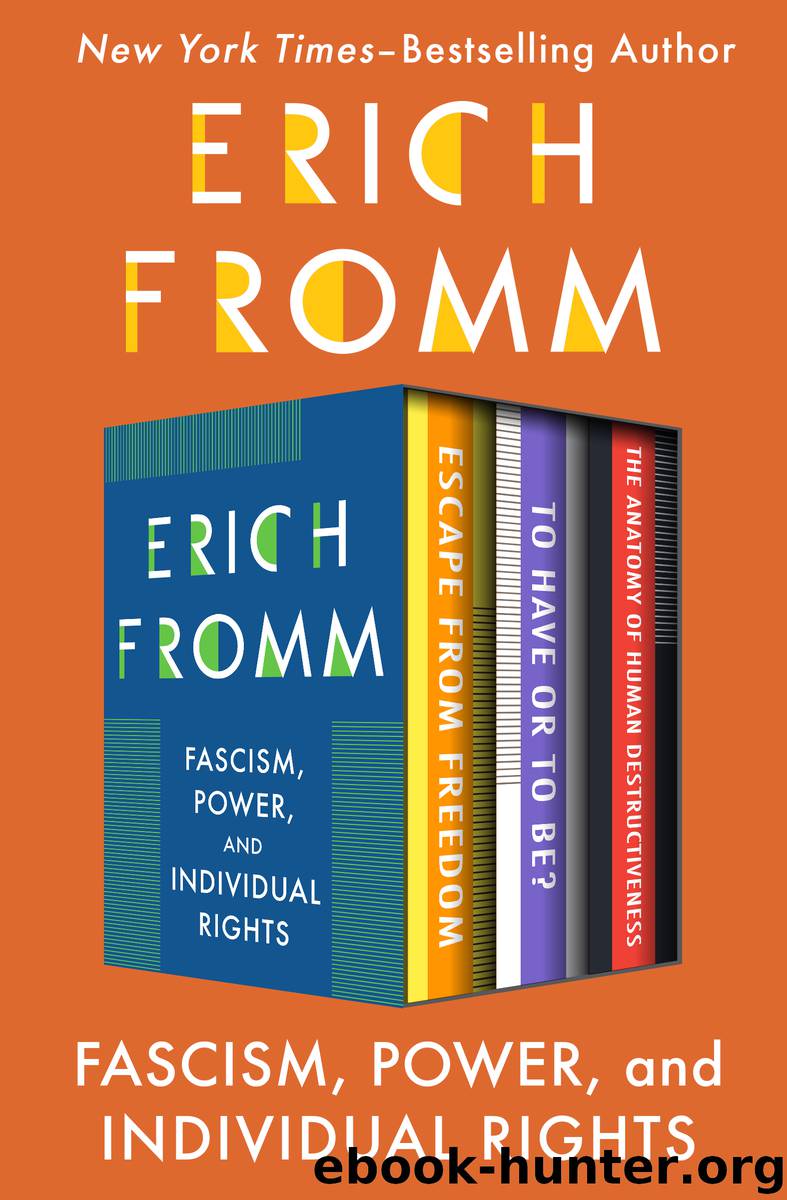
Author:Erich Fromm [Butler, Octavia E.]
Language: eng
Format: epub
ISBN: 978-1-5040-4550-6
Publisher: Open Road Media
Published: 2012-06-28T16:38:00+00:00
To sum up
What was epoch-making in Freud’s findings was that he found the key to the understanding of the system of forces which make up man’s character system and to the contradictions within the system. The discovery of unconscious processes of the dynamic concept of character was radical because it went to the roots of human behavior; it was disquieting because nobody can hide any longer behind his good intentions; they were dangerous, because if everybody were to know what he could know about himself and others, society would be shaken to its very foundations.
As psychoanalysis became successful and respectable it shed its radical core and emphasized that which is generally acceptable. It kept that part of the unconscious which Freud had emphasized, the sexual strivings. The consumer society did away with many of the Victorian taboos (not because of the influence of psychoanalysis but for a number of reasons inherent in its structure). To discover one’s incestuous wishes, “castration fear,” “penis envy,” was no longer upsetting. But to discover repressed character traits such as narcissism, sadism, omnipotence, submission, alienation, indifference, the unconscious betrayal of one’s integrity, the illusory nature of one’s concept of reality, to discover all this in oneself, in the social fabric, in the leaders one follows—this indeed is “social dynamite.” Freud only dealt with an instinctual id; that was quite satisfactory at a time when he did not see any other way to explain human passion except in terms of instincts. But what was revolutionary then is conventional today. The instinct theory instead of being considered a hypothesis, needed at a certain period, became the straitjacket of orthodox psychoanalytic theory and slowed down the further development of the understanding of man’s passions, which had been Freud’s central interest.
It is for these reasons that I propose that the classification of psychoanalysis as “instinctivistic” theory, which is correct in a formal sense, does not really refer to the substance of psychoanalysis. Psychoanalysis is essentially a theory of unconscious strivings, of resistance, of falsification of reality according to one’s subjective needs and expectations (“transference”), of character, and of conflicts between passionate strivings embodied in character traits and the demands for self-preservation. In this revised sense (although based on the core of Freud’s discoveries) the approach of this book to the problem of human aggression and destructiveness is psychoanalytic—and neither instinctivistic nor behavioristic,
An increasing number of psychoanalysts have given up Freud’s libido theory, but frequently they have not replaced it by an equally precise and systematic theoretical system; the “drives” they employ are not sufficiently grounded, either in physiology or in the conditions of human existence or in an adequate concept of society. They often use somewhat superficial categories—for instance Karen Horney’s “competition”—which are not too different from the “cultural patterns” of American anthropology. In contrast, a number of psychoanalysts—most of them influenced by Adolf Meyer—have given up Freud’s libido theory and have constructed what seems to me one of the most promising and creative developments in psychoanalytic theory. Mainly
Download
This site does not store any files on its server. We only index and link to content provided by other sites. Please contact the content providers to delete copyright contents if any and email us, we'll remove relevant links or contents immediately.
| Anthropology | Archaeology |
| Philosophy | Politics & Government |
| Social Sciences | Sociology |
| Women's Studies |
The Secret History by Donna Tartt(19357)
The Social Justice Warrior Handbook by Lisa De Pasquale(12258)
Thirteen Reasons Why by Jay Asher(9042)
This Is How You Lose Her by Junot Diaz(6991)
Weapons of Math Destruction by Cathy O'Neil(6392)
Zero to One by Peter Thiel(5892)
Beartown by Fredrik Backman(5872)
The Myth of the Strong Leader by Archie Brown(5573)
The Fire Next Time by James Baldwin(5538)
How Democracies Die by Steven Levitsky & Daniel Ziblatt(5290)
Promise Me, Dad by Joe Biden(5204)
Stone's Rules by Roger Stone(5148)
A Higher Loyalty: Truth, Lies, and Leadership by James Comey(5031)
100 Deadly Skills by Clint Emerson(4984)
Rise and Kill First by Ronen Bergman(4859)
Secrecy World by Jake Bernstein(4821)
The David Icke Guide to the Global Conspiracy (and how to end it) by David Icke(4790)
The Doomsday Machine by Daniel Ellsberg(4578)
The Farm by Tom Rob Smith(4570)
