Famine in North Korea by Haggard Stephan; Noland Marcus; Sen Amartya
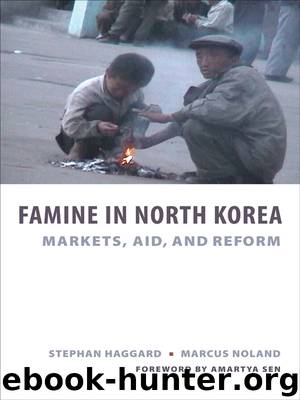
Author:Haggard, Stephan; Noland, Marcus; Sen, Amartya
Language: eng
Format: epub
Tags: History/Asia/General
Publisher: Columbia University Press
Published: 2012-01-04T05:00:00+00:00
China
China’s relations with North Korea are shrouded in patron-client privilege. Information on such basic issues as the prices that North Korea pays for imports from China are unavailable, and as a result it is difficult to distinguish among commercial imports, barter, and outright grants.36 The data we have on trade are subject to a fairly wide range of estimates, compounded by a border trade that exploded in the early 2000s. Furthermore, we have only indirect evidence of China’s political motives with respect to North Korea and of the extent—if any—to which Beijing might have sought to exercise leverage over Pyongyang by economic means. The centralized nature of the Chinese system leads us to believe that large fluctuations in trade almost certainly reflected political decisions by the top leadership, and that is no doubt true for core commodities such as food and fuel. But decentralized interactions between the two countries have grown dramatically in recent years as trade restrictions have been lifted in China and North Korea has tolerated a much denser bilateral relationship. By our estimate, such decentralized trade accounted for fully 80 percent of all Chinese exports by 2005, providing critical impetus to the marketization process we describe in the next chapter.
It is possible to get some sense of the evolution of the relationship by triangulating trade, aid, and the high-level political exchanges and statements that are in the public record. Several points are relevant for our purposes here. First, despite the shock of normalizing relations with South Korea in 1992, China emerged as North Korea’s primary benefactor following the collapse of the Soviet Union. In 1993–94, however, particularly following the death of Kim Il-sŏng, bilateral relations became increasingly strained. Trade fell sharply at this time, contributing to the famine that subsequently developed.
After the devastating loss of food imports from China in 1994, bilateral trade relations rebounded, and China became a mainstay of economic support. China lifted some restrictions on small border trade in 1996, and North Korean companies even enjoyed selective tariff exemptions. North Korea apparently even benefited from tariff reductions undertaken when China joined the World Trade Organization, even though China had no obligation to extend its concessions to North Korea, which is not a member of the WTO. As relations improved, China was willing to maintain trade relations with North Korea in critical commodities, including not only food but also oil delivered by pipeline from the Daqing field in the northeast. These core commodities were almost certainly shipped at “friendship prices” or on deferred payment terms and were quite possibly altogether gratis. Whatever food North Korea did import from China was also not subject to any of the monitoring and targeting requirements, however porous, that characterized aid channeled through the WFP or from South Korea. We can only speculate on the end use of these grain shipments, but there would appear to be no constraint on the North Korean leadership using them to supply core groups, including the military.
China’s overall economic support for North Korea can be demonstrated by examining the two countries’ bilateral trade since 1981 (figure 6.
Download
This site does not store any files on its server. We only index and link to content provided by other sites. Please contact the content providers to delete copyright contents if any and email us, we'll remove relevant links or contents immediately.
| Anthropology | Archaeology |
| Philosophy | Politics & Government |
| Social Sciences | Sociology |
| Women's Studies |
The Secret History by Donna Tartt(19351)
The Social Justice Warrior Handbook by Lisa De Pasquale(12249)
Thirteen Reasons Why by Jay Asher(9032)
This Is How You Lose Her by Junot Diaz(6982)
Weapons of Math Destruction by Cathy O'Neil(6381)
Zero to One by Peter Thiel(5888)
Beartown by Fredrik Backman(5870)
The Myth of the Strong Leader by Archie Brown(5568)
The Fire Next Time by James Baldwin(5534)
How Democracies Die by Steven Levitsky & Daniel Ziblatt(5284)
Promise Me, Dad by Joe Biden(5200)
Stone's Rules by Roger Stone(5143)
A Higher Loyalty: Truth, Lies, and Leadership by James Comey(5028)
100 Deadly Skills by Clint Emerson(4981)
Rise and Kill First by Ronen Bergman(4852)
Secrecy World by Jake Bernstein(4816)
The David Icke Guide to the Global Conspiracy (and how to end it) by David Icke(4787)
The Doomsday Machine by Daniel Ellsberg(4572)
The Farm by Tom Rob Smith(4566)
