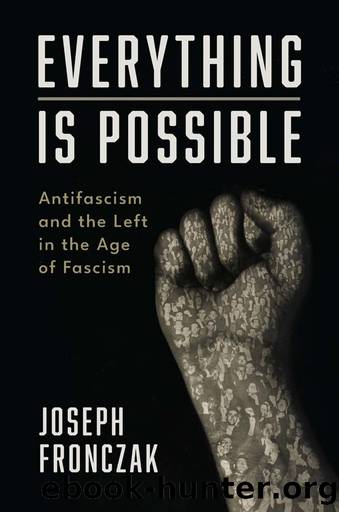
Everything Is Possible by Joseph Fronczak;
Author:Joseph Fronczak;
Language: eng
Format: epub
Publisher: Yale University Press
Published: 2022-06-15T00:00:00+00:00
CHAPTER 6
TODAY THE STRUGGLE
Now, at last, the forces of the left began to coalesce.
âDOROTHY THOMPSON, âPattern of a Revolution,â 1936*
As 1936 came to an end, students at the City College of New York lit another effigy. This one had three heads: Mussolini, Hitler, Franco. It was a monstrous-looking thing, each of its faces grotesque and misshapen as if it were contorted into a premonitory rage over what the students were about to do to it. One arm was raised in a fascist salute, and the entire creation stood about six or seven feet in height.1 Fascism had grown.
It was a December afternoon and the students were at least several hundred in number when they paraded their three-headed creation through campus. On their minds was the war in Spain. They went to the field where the effigy with the two heads had been burned a little over two years before, but a park worker insisted that they not start a fire there, so they crossed the street to Lewisohn Stadium and hung the effigy from a fence along Convent Avenue, just above 136th Street. Someone poured gasoline, the effigy was set afire, and then it deflagrated as the crowd roared.2
The spectacleâs organizers took donations. They were raising funds for antifascist forces in the war. They were doing so even though the college dean had forbidden them from collecting anythingâmoney, food, clothingâto send to Spain.3 But the students paid him no mind. A handful of City College students themselves went to Spain.
One was Wilfred Mendelson. He had been raised in the Bronx by Jewish working-class parents from the Ukraine and Poland who had met in night school (and named their son after the hero of a book theyâd read together for class, Walter Scottâs Ivanhoe). By the time of the three-headed effigyâs immolation in December 1936, Wilfred had dropped out of City College to focus on his local organizing work for the Young Communist League. Given that he had dropped out and yet was still around, he may or may not have taken part in the demonstration. He had, however, been the primary organizer behind the November 1934 rally that had seen the burning of the two-headed effigy. It had been Mendelson who had first rushed over to a lamppost and wrapped his arms around it when the police tried to break up the rally, leading to the chant of âCops off the campus!â Mendelson had been on probation at the time because a month earlier he had also played a role in the brawl in the Great Hallâthe one involving the fascist Italian visitorsâand in the antifascist demonstrations on campus that had followed. A year later, when hundreds of City College students had gathered in Lewisohn Stadium on the day that Mussoliniâs forces invaded Ethiopia, it had been Mendelson who spoke and introduced the studentsâ resolution to condemn the war. Within weeks, he had written an essay for a student magazine in which he declared that with the invasion fascism had
Download
This site does not store any files on its server. We only index and link to content provided by other sites. Please contact the content providers to delete copyright contents if any and email us, we'll remove relevant links or contents immediately.
| Anthropology | Archaeology |
| Philosophy | Politics & Government |
| Social Sciences | Sociology |
| Women's Studies |
The Secret History by Donna Tartt(19103)
The Social Justice Warrior Handbook by Lisa De Pasquale(12197)
Thirteen Reasons Why by Jay Asher(8919)
This Is How You Lose Her by Junot Diaz(6894)
Weapons of Math Destruction by Cathy O'Neil(6284)
Zero to One by Peter Thiel(5808)
Beartown by Fredrik Backman(5768)
The Myth of the Strong Leader by Archie Brown(5513)
The Fire Next Time by James Baldwin(5454)
How Democracies Die by Steven Levitsky & Daniel Ziblatt(5225)
Promise Me, Dad by Joe Biden(5157)
Stone's Rules by Roger Stone(5091)
A Higher Loyalty: Truth, Lies, and Leadership by James Comey(4967)
100 Deadly Skills by Clint Emerson(4932)
Rise and Kill First by Ronen Bergman(4797)
Secrecy World by Jake Bernstein(4756)
The David Icke Guide to the Global Conspiracy (and how to end it) by David Icke(4723)
The Farm by Tom Rob Smith(4517)
The Doomsday Machine by Daniel Ellsberg(4493)
