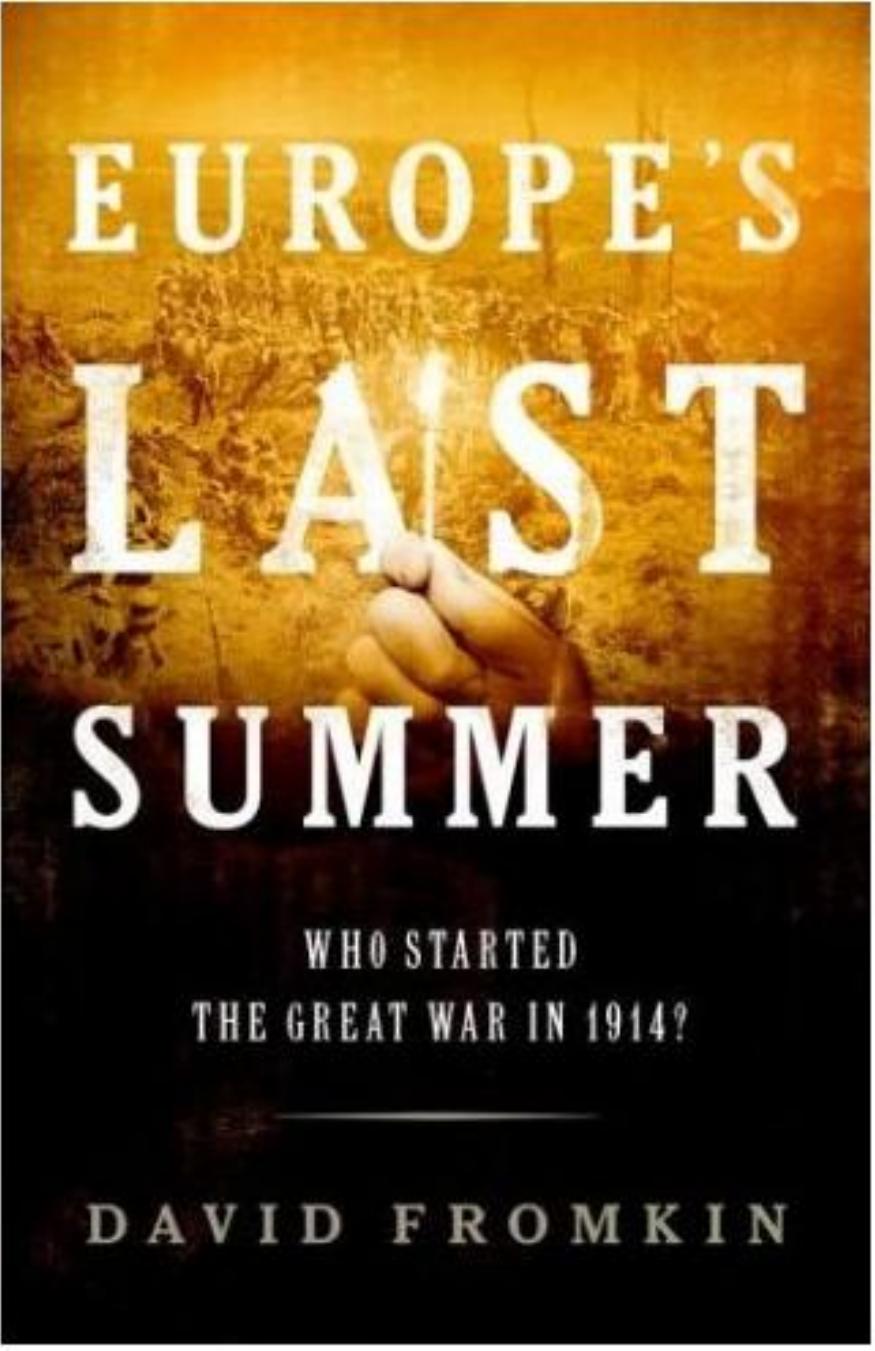
Europe's Last Summer: Who Started the Great War in 1914? by David Fromkin
Author:David Fromkin
Language: eng
Format: mobi, epub, pdf
Tags: Nonfiction
ISBN: 0375411569
Publisher: Random House
Published: 2007-12-18T07:00:00+00:00
PART SIX
CRISIS !
CHAPTER 29: THE FAIT IS NOT ACCOMPLI
On July 16 the Russian ambassador in Vienna cabled his government: “Information reaches me that the Austro-Hungarian Government at the conclusion of the inquiry intends to make certain demands on Belgrade. . . . It would seem to me desirable that at the present moment, before a final decision on the matter, the Vienna Cabinet should be informed how Russia would react to the fact of Austria’s presenting demands to Serbia such as would be unacceptable to the dignity of that state.”
This, and similar intimations of Austrian designs, disturbed Russia’s foreign minister. But Vienna’s ambassador hastened to reassure. He told the Russian foreign minister that Austria-Hungary wanted peace. So Russia did nothing.
On July 18, Pasic, the Prime Minister of Serbia, cabled Serbian missions abroad (other than in Vienna) that he was determined not to accept any demands by Austria-Hungary that would infringe on Serbian sovereignty.
The hidden plot that the Austrian and German leaders were in the process of executing was outlined clearly—but in confidence—for the government of Bavaria at the time. The kingdom of Bavaria was the largest and most populous state in the Prussian-led German Empire. In joining Germany, it had “reserved a larger measure of sovereign independence than any of the other constituent states” including a separate diplomatic service, military administration, and postal, telegraph, and railway services.
On July 18, Hans Schoen, a Bavarian diplomat who had been briefed by officials in Berlin, explained at length to his Prime Minister, Count Georg Hertling, the Dual Monarchy’s pretense “of being peacefully inclined” and why an Austrian ultimatum could not be delivered to Belgrade until mid-July. Summarizing the demands that would be made in the ultimatum, Schoen observed: “It is perfectly plain that Serbia can not accept any such demands, which are incompatible with her dignity as a sovereign state. Thus the result would be war.” That is, there would be war if Vienna actually went through with the plan. Jagow and Zimmermann, respectively number one and two ranking officials at the German foreign office, had their doubts. They “made the statement that Austria-Hungary, thanks to her indecision and her desultoriness, had really become the Sick Man of Europe as Turkey had once been.”
“A powerful and successful move against Serbia,” Zimmermann had continued, would bring the Dual Monarchy back from the brink. Schoen reported that German leaders “are of the opinion . . . that Austria is face to face with an hour of fate.” That, they told Schoen, was why on July 5–6 they had given the Austrians a “blank power of full authority” “even at the risk of war with Russia.” In their view the Austrians were surprised by such unconditional support, and might have felt more comfortable if they had been told instead to restrain themselves.
Germany, Schoen made clear, wished that Vienna had not waited so long before doing anything. The Germans were awaiting presentation of the Austrian ultimatum to Serbia. Berlin then would embark upon a diplomatic effort to localize the conflict.
Download
Europe's Last Summer: Who Started the Great War in 1914? by David Fromkin.epub
Europe's Last Summer: Who Started the Great War in 1914? by David Fromkin.pdf
This site does not store any files on its server. We only index and link to content provided by other sites. Please contact the content providers to delete copyright contents if any and email us, we'll remove relevant links or contents immediately.
| Anthropology | Archaeology |
| Philosophy | Politics & Government |
| Social Sciences | Sociology |
| Women's Studies |
The Secret History by Donna Tartt(19375)
The Social Justice Warrior Handbook by Lisa De Pasquale(12265)
Thirteen Reasons Why by Jay Asher(9054)
This Is How You Lose Her by Junot Diaz(7004)
Weapons of Math Destruction by Cathy O'Neil(6407)
Zero to One by Peter Thiel(5897)
Beartown by Fredrik Backman(5878)
The Myth of the Strong Leader by Archie Brown(5586)
The Fire Next Time by James Baldwin(5541)
How Democracies Die by Steven Levitsky & Daniel Ziblatt(5295)
Promise Me, Dad by Joe Biden(5208)
Stone's Rules by Roger Stone(5154)
A Higher Loyalty: Truth, Lies, and Leadership by James Comey(5042)
100 Deadly Skills by Clint Emerson(4993)
Rise and Kill First by Ronen Bergman(4862)
Secrecy World by Jake Bernstein(4825)
The David Icke Guide to the Global Conspiracy (and how to end it) by David Icke(4794)
The Doomsday Machine by Daniel Ellsberg(4583)
The Farm by Tom Rob Smith(4574)
