Ethnicity and Democracy in Africa by Bruce Berman Dickson Eyoh Will Kymlicka
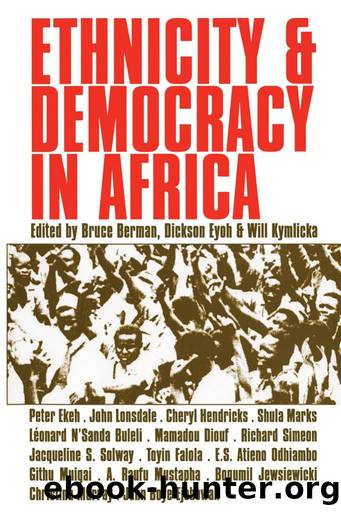
Author:Bruce Berman, Dickson Eyoh, Will Kymlicka [Bruce Berman, Dickson Eyoh, Will Kymlicka]
Language: eng
Format: epub
Tags: Nonfiction, Social & Cultural Studies, Social Science, Sociology, Political Science, History
ISBN: 9780821442678
Google: v_v_twEACAAJ
Publisher: Ohio University Press
Published: 2004-09-30T04:00:00+00:00
III
Ethnicity & the Politics of Democratization
10
Hegemonic Enterprises & Instrumentalities of Survival: Ethnicity & Democracy in Kenya
E. S. ATIENO ODHIAMBO
Now the concept of âsocial changeâ is more than a mere umbrella for several parallel, probably somehow related changes in diverse aspects of social life; it denotes the systematic transformation of a particular society. But at what level do we set âsocietyâ? . . . It was much easier as late as the 1940s, to speak of local social systems like those of the Asante or the Luo as being societies [rather] than whole colonies like the Gold Coast or Kenya. (Peel, 1984: 142)
We all come from one womb, the common womb of one Kenya. The blood shed for our freedom has washed away the differences between that clan and this one. Today there is no Luo, Gikuyu, Kamba, Giriama, Luhya, Maasai, Meru, Kalenjin or Turkana. We are all children of one mother. Our mother is Kenya, the mother of all Kenya people.
(Ngugi wa Thiongâo, 1983: 234â5)
Democracy for Africa?
Thinking about a possible African variant of democracy is sometimes reminiscent of the âdiscoveryâ of the okapi by Sir Harry Johnston in central Africa a century ago. As Richard Sklar re-tells the story, the okapi was an animal resembling a giraffe, a deer and a zebra. It was unknown to the European zoologists of the time, but they were nevertheless reluctant to acknowledge its existence as a distinct genus (Sklar, 1996: 708â9). Likewise, the genealogies of liberal democracy in the West have been multiple, as have been the prescriptions for its attainment. Its historiography is of relevance to African discourses to underscore its peculiarity in the Atlantic tradition, as well as to assert the possibility of uniqueness in Africa (Ake, 1993). Alexis de Tocqueville early on observed its oddity even within the Atlantic world. Democracy, he observed, had been a truly revolutionary impulse in France, overthrowing the existing feudal-aristocratic order and setting up a whole new stratum of bourgeois class rule, whereas the contrary had happened in America, where democracy had been appropriated by the Republican Party for the pursuit of essentially conservative goals.
In the middle of the nineteenth century Lord Acton and John Stuart Mill advanced rival theories about the relationship of democracy and culture. âActon thought that a civilized state should contain as many different cultural groups as possible to prevent egalitarian democracy from creating an intolerant nationalism; Mill, that where two national groups of roughly the same size exist within a single state, free institutions are unlikely to flourish because the ballot box will be used to capture the state for the majority group â therefore, in such circumstances, partition along national lines will best serve the democratic causeâ (Mayall, 1997: 571). The Kenyan scholar Michael Chege has often invoked a third mantra on the political culture of democracy originally asserted by Barrington Moore III, to wit, âNo bourgeois, no democracyâ (1994: 74). I understand this to mean that historically it has been the bourgeois stratum of society that has elaborated the idea of a political nation of citizens.
Download
This site does not store any files on its server. We only index and link to content provided by other sites. Please contact the content providers to delete copyright contents if any and email us, we'll remove relevant links or contents immediately.
| Anthropology | Archaeology |
| Philosophy | Politics & Government |
| Social Sciences | Sociology |
| Women's Studies |
The Secret History by Donna Tartt(19048)
The Social Justice Warrior Handbook by Lisa De Pasquale(12187)
Thirteen Reasons Why by Jay Asher(8893)
This Is How You Lose Her by Junot Diaz(6877)
Weapons of Math Destruction by Cathy O'Neil(6264)
Zero to One by Peter Thiel(5786)
Beartown by Fredrik Backman(5737)
The Myth of the Strong Leader by Archie Brown(5498)
The Fire Next Time by James Baldwin(5431)
How Democracies Die by Steven Levitsky & Daniel Ziblatt(5213)
Promise Me, Dad by Joe Biden(5141)
Stone's Rules by Roger Stone(5081)
A Higher Loyalty: Truth, Lies, and Leadership by James Comey(4951)
100 Deadly Skills by Clint Emerson(4920)
Rise and Kill First by Ronen Bergman(4778)
Secrecy World by Jake Bernstein(4740)
The David Icke Guide to the Global Conspiracy (and how to end it) by David Icke(4701)
The Farm by Tom Rob Smith(4502)
The Doomsday Machine by Daniel Ellsberg(4484)
