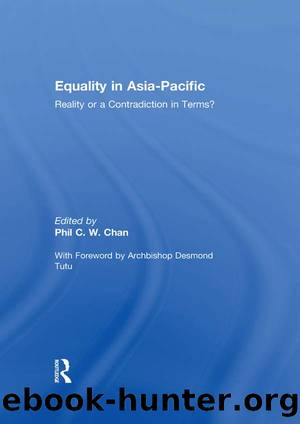
Equality in Asia-Pacific: Reality or a Contradiction in Terms? by Phil Chan
Author:Phil Chan [Chan, Phil]
Language: eng
Format: epub
Tags: Social Science, Ethnic Studies, General
ISBN: 9780415373296
Google: EA7AHAAACAAJ
Goodreads: 2588701
Publisher: Routledge
Published: 2007-01-15T08:36:09+00:00
Non-Governmental Organising for Gender Equality in China â Joining a Global Emancipatory Epistemic Community
CECILIA MILWERTZ AND WEI BU
At the United Nations World Conference on Human Rights held in Vienna in 1993, feminists succeeded in reconstructing the dominant human rights discourse and in so doing they brought womenâs human rights concerns into the framework of international human rights.1 The international emphasis on womenâs rights as human rights was further developed at the United Nations Fourth World Womenâs Conference in 1995. The convening of this conference and the accompanying NGO (non-governmental organisation) Forum in Beijing provided a unique opportunity for both newly established feminist NGOs and the older party-state All-China Womenâs Federation to link their work to internationally defined gender equality issues and to adopt modes of action applied by womenâs movements globally.2 Of the three major groups under the direct control of the Communist Party through their respective organisations â youth, workers and women â only women have formed independent organisations and had this kind of direct contact with organisations outside China.3 In fact, the âunintended consequenceâ of the Womenâs Conference being held in China was that external influences became an integral part of the Chinese womenâs movement.4 One subsequent result has been a recasting of gender inequality issues as human rights issues by some Chinese activists.
Not only the conference held in China, but also earlier womenâs conferences under the auspices of the United Nations and NGO forums have played an important role in mobilising womenâs movement participants in many countries. They have achieved this by providing alternative structures for networking and organising and they have focused the efforts of both organised and non-institutionalised marginalised groups upon changing national and international political processes.5 However, the 1995 conference has also been criticised. Gayatri Spivak, for example, regards it as a ârepressive ideological apparatusâ that fails to consider the poorest women of the South as self-conscious critical agents.6 Spivak, who is not against United Nations conferences in principle but believes less time and effort should be spent on them, notes that more and more serious activists are staying away from such events. Recognising that not only the Womenâs Conference but also projects funded by non-Chinese donor organisations have played a significant role in facilitating the interactions between the emerging Chinese womenâs NGOs and womenâs movements in other parts of the world, Tani Barlow has criticised the inclusion of the Chinese womenâs movement into what she calls âinternational U.S. feminismâ.7Barlow defines this version of feminism as an ideological package comprising a âwell-financed, resurgent, neo-liberal, United States-focused effort to establish common ground for feminismâ, and she contends that this comes hand in hand with institutions that have the economic power to enforce their agendas.8 Similarly, Nicola Spakowski has argued that the financial power and discursive dominance of Western donor organizations has shaped the development of womenâs and gender studies in China.9
We do not contest these critical interpretations of the objectives and power of a neo-liberal elitist feminism as one of several global feminisms. In an
Download
This site does not store any files on its server. We only index and link to content provided by other sites. Please contact the content providers to delete copyright contents if any and email us, we'll remove relevant links or contents immediately.
| Anthropology | Archaeology |
| Philosophy | Politics & Government |
| Social Sciences | Sociology |
| Women's Studies |
The Secret History by Donna Tartt(19046)
The Social Justice Warrior Handbook by Lisa De Pasquale(12186)
Thirteen Reasons Why by Jay Asher(8892)
This Is How You Lose Her by Junot Diaz(6875)
Weapons of Math Destruction by Cathy O'Neil(6264)
Zero to One by Peter Thiel(5786)
Beartown by Fredrik Backman(5737)
The Myth of the Strong Leader by Archie Brown(5496)
The Fire Next Time by James Baldwin(5429)
How Democracies Die by Steven Levitsky & Daniel Ziblatt(5213)
Promise Me, Dad by Joe Biden(5141)
Stone's Rules by Roger Stone(5080)
A Higher Loyalty: Truth, Lies, and Leadership by James Comey(4950)
100 Deadly Skills by Clint Emerson(4919)
Rise and Kill First by Ronen Bergman(4778)
Secrecy World by Jake Bernstein(4740)
The David Icke Guide to the Global Conspiracy (and how to end it) by David Icke(4699)
The Farm by Tom Rob Smith(4502)
The Doomsday Machine by Daniel Ellsberg(4484)
