Enlightenment and Secularism by Nadon Christopher; Arkush Allan; Bailey Jeremy D
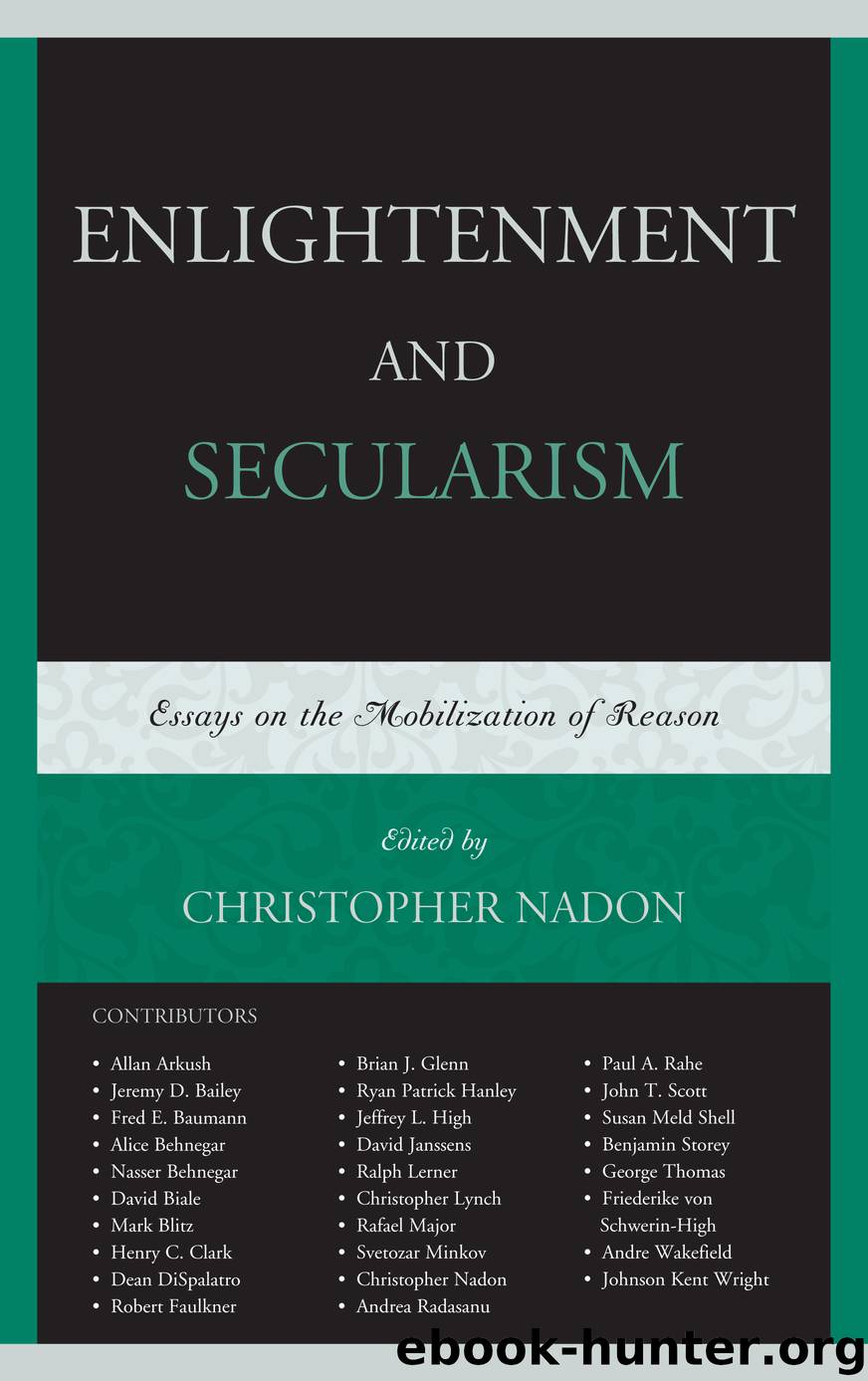
Author:Nadon, Christopher; Arkush, Allan; Bailey , Jeremy D.
Language: eng
Format: epub
Tags: undefined
Publisher: Lexington Books
Published: 2012-05-13T04:00:00+00:00
Chapter 15
Between Religious Fanaticism and Philosophical Fanaticism: Rousseau’s “Profession of Faith of the Savoyard Vicar”
John T. Scott
Jean-Jacques Rousseau (1712-1778) occupies a uniquely ambivalent position in the Enlightenment as the most powerful critic of Enlightenment secular thought within the secular Enlightenment itself. Jonathan Israel therefore characterizes him as a “hybrid” thinker who “combined elements of radicalism with the moderate Enlightenment” or, more colorfully, describes his thought as a “Janus-headed mixing of elements from both the radical and mainstream Enlightenment.”[1] Rousseau joined the philosophes in their battle against religious fanaticism and intolerance by means of the light of reason, but he nonetheless saw a fanatical tendency in philosophy itself. According to Rousseau, philosophy threatened to undermine the foundations of morals and politics by its emphasis on enlightened self-interest which, according to Rousseau, collapses into calculating egoism. For Rousseau, the beliefs that motivate the vast majority of people to be virtuous and happy individuals and citizens are not fully rational in nature, but are instead rooted in religious belief. In addition to criticizing the pernicious effects of Enlightenment secularism, then, Rousseau proposes a properly reformed religious teaching that would encourage virtuous behavior under threat by the corrosive effects of bare reason.
Rousseau’s critique of philosophy began with the work that first brought him fame: the Discourse on the Sciences and Arts (1750).Written in the very center of the century of Enlightenment, Rousseau argues in the first Discourse that the advancement of the sciences and arts corrupts morals. Rousseau appeals in the Discourse to traditional civic and religious arguments against philosophy, but his principal argument in the work is a philosophical one. Paradoxically, then, Rousseau’s argument in the Discourse against the sciences and arts is a scientific argument, based upon empirical observation of cause and effect. “When there is no effect, there is no cause to seek. But here the effect is certain, the depravity real, and our souls have been corrupted in proportion to the advancement of our sciences and arts toward perfection.”[2] Rousseau accordingly both praises and criticizes philosophy in the work. On the one hand, he celebrates the emergence of Europe from the Dark Ages and he praises the progenitors of the Enlightenment such as Bacon, Descartes, and Newton who “raise monuments to the glory of the human intellect.”[3] On the other hand, he simultaneously worries that philosophers now “go everywhere armed with their deadly paradoxes, undermining the foundations of faith, and annihilating virtue. They smile disdainfully at the old-fashioned words of fatherland and religion, and devote their talents and philosophy to destroying and debasing all that is sacred among men.”[4] Released from traditional religious and moral authority and put on a strictly secular foundation, philosophy has made great strides, but it also threatens to undermine the foundations of morality and citizenship. From his very first publications onward, then, Rousseau therefore both accepted the premises of Enlightenment scientific and secular philosophy and raised doubts about its effects.
The philosophers of the Enlightenment characteristically took a largely secular approach to politics and society, and did so by opposing religious intolerance and fanaticism.
Download
This site does not store any files on its server. We only index and link to content provided by other sites. Please contact the content providers to delete copyright contents if any and email us, we'll remove relevant links or contents immediately.
| Anthropology | Archaeology |
| Philosophy | Politics & Government |
| Social Sciences | Sociology |
| Women's Studies |
The Secret History by Donna Tartt(19103)
The Social Justice Warrior Handbook by Lisa De Pasquale(12197)
Thirteen Reasons Why by Jay Asher(8919)
This Is How You Lose Her by Junot Diaz(6894)
Weapons of Math Destruction by Cathy O'Neil(6284)
Zero to One by Peter Thiel(5808)
Beartown by Fredrik Backman(5767)
The Myth of the Strong Leader by Archie Brown(5513)
The Fire Next Time by James Baldwin(5454)
How Democracies Die by Steven Levitsky & Daniel Ziblatt(5225)
Promise Me, Dad by Joe Biden(5157)
Stone's Rules by Roger Stone(5091)
A Higher Loyalty: Truth, Lies, and Leadership by James Comey(4966)
100 Deadly Skills by Clint Emerson(4931)
Rise and Kill First by Ronen Bergman(4797)
Secrecy World by Jake Bernstein(4756)
The David Icke Guide to the Global Conspiracy (and how to end it) by David Icke(4723)
The Farm by Tom Rob Smith(4517)
The Doomsday Machine by Daniel Ellsberg(4493)
