Eco-Emancipation by Sharon R. Krause;
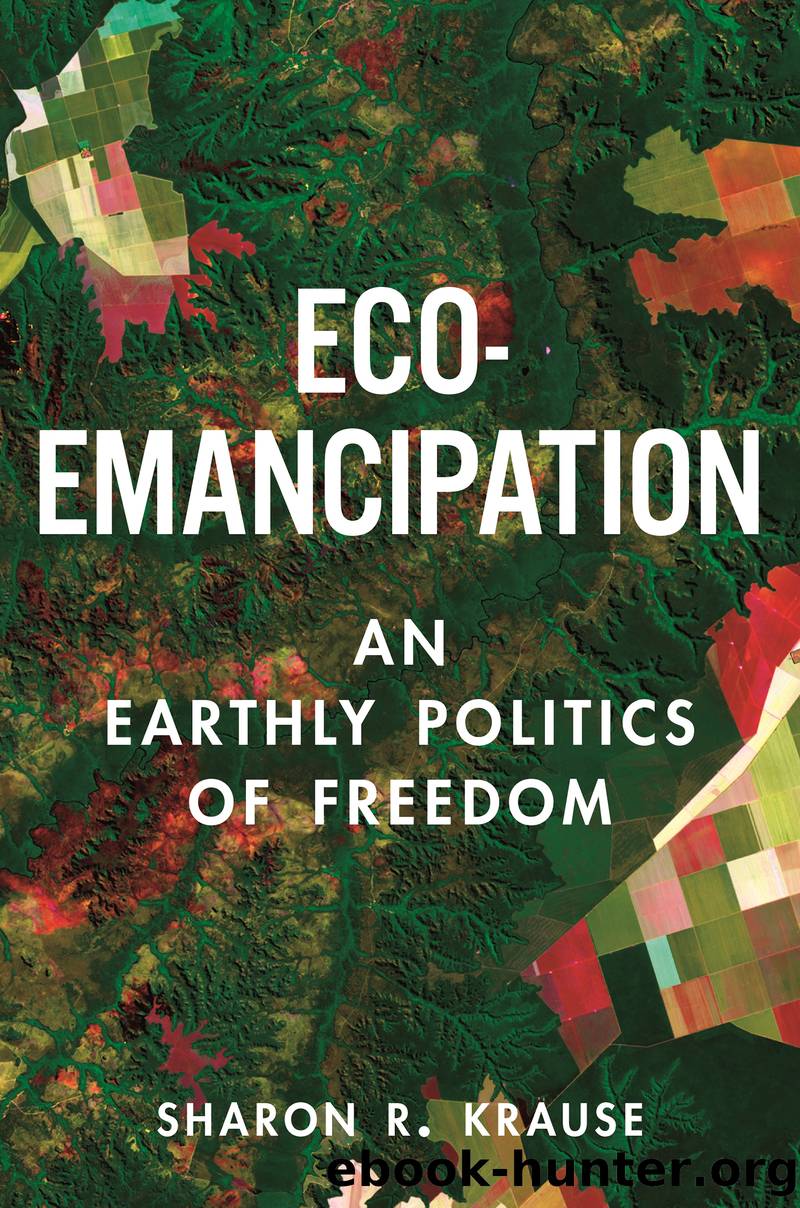
Author:Sharon R. Krause;
Language: eng
Format: epub
Publisher: Princeton University Press
Published: 2023-01-28T00:00:00+00:00
Reconstructing Responsibility
Recent work on responsibility for structural injustice has begun to reimagine responsibility, challenging the dominance of the liability view. As Chad Lavin notes, the liability view rose to predominance in the mid-twentieth century as European and Anglo-American theorists were grappling with events such as the Holocaust and the massacre at Mai Lai.15 Their focus was on establishing grounds for assigning blame in the context of particular events caused by clearly identifiable agents. What Lavin calls âimpersonal conditions of deprivationâ were not the primary concern.16 In the intervening period, issues of structural injustice have come to the fore in political theory as ostensibly democratic societies have been forced to confront their own persistent inequalities and the impersonal dynamics of injustice that help drive them. The upshot, Lavin says, is that contemporary discourse is marked by a significant âshortcoming,â namely, âthe incommensurabilityâ between current âpolitical urgenciesâ and our âdominant conceptions of responsibility.â17 In the decade and a half since Lavinâs book was published, a surge of new work has emerged that is intended to address this shortcoming, rethinking responsibility in the context of injustices that are sustained through large-scale, impersonal social systems, rather than by a clearly identifiable, âcompetent agentâs willed causality.â18
The most influential of the new approaches to responsibility is Iris Marion Youngâs âsocial connection model.â19 The model addresses problems of structural injustice in which unfairness is perpetuated systemically through large-scale economic, political, and social forces instead of through intentional acts of domination by discrete agents. Young uses the global apparel industry as an example, where products are often made by impoverished people in developing countries working under exploitative conditions, while the products are consumed by relatively privileged people in wealthy societies. The consumers do not mean to be unjust, often know little about the labor conditions that produce the goods they purchase, and do not control the system. Yet their purchases help to sustain the system, and in Youngâs view âall those who contribute by their actions to structural processes with some unjust outcomes share responsibility for the injustice.â20 Our responsibility tracks the force of our effects, as Young sees it, and those whose contributing effects carry more weight in bringing about the harm will have more responsibility for it. For example, wealthy people who spend large sums of money on clothing made by sweatshop workers in the developing world play a more significant part in sustaining the exploitation of those workers than do people who buy little. Those wealthy consumers may also be better positioned to purchase from fair trade enterprises, and to use their privilege and resources to press for changes in the industry more broadly.21
This view of responsibility focuses less on blaming people for what they have done in the past than on changing their actions for the future.22 Moreover, although responsibility here applies to individual persons, it calls for coordinated, intersubjective action. Responsibility for justice âis a responsibility I personally bear,â as Young puts it, âbut I do not bear it aloneâ because this responsibility
Download
This site does not store any files on its server. We only index and link to content provided by other sites. Please contact the content providers to delete copyright contents if any and email us, we'll remove relevant links or contents immediately.
| Anthropology | Archaeology |
| Philosophy | Politics & Government |
| Social Sciences | Sociology |
| Women's Studies |
The Secret History by Donna Tartt(19088)
The Social Justice Warrior Handbook by Lisa De Pasquale(12190)
Thirteen Reasons Why by Jay Asher(8910)
This Is How You Lose Her by Junot Diaz(6887)
Weapons of Math Destruction by Cathy O'Neil(6280)
Zero to One by Peter Thiel(5802)
Beartown by Fredrik Backman(5754)
The Myth of the Strong Leader by Archie Brown(5507)
The Fire Next Time by James Baldwin(5446)
How Democracies Die by Steven Levitsky & Daniel Ziblatt(5219)
Promise Me, Dad by Joe Biden(5153)
Stone's Rules by Roger Stone(5088)
A Higher Loyalty: Truth, Lies, and Leadership by James Comey(4964)
100 Deadly Skills by Clint Emerson(4925)
Rise and Kill First by Ronen Bergman(4789)
Secrecy World by Jake Bernstein(4753)
The David Icke Guide to the Global Conspiracy (and how to end it) by David Icke(4720)
The Farm by Tom Rob Smith(4513)
The Doomsday Machine by Daniel Ellsberg(4490)
