Early man and the ocean : a search for the beginnings of navigation and seaborne civilizations by Heyerdahl Thor
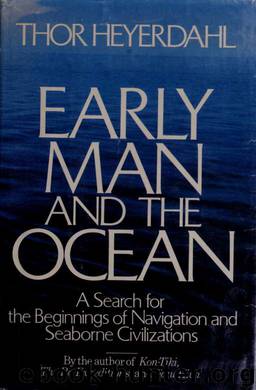
Author:Heyerdahl, Thor
Language: eng
Format: epub
Tags: Maritime anthropology, Seafaring life, Navigation
Publisher: Garden City, N.Y. : Doubleday
Published: 1979-07-31T16:00:00+00:00
parrot, but only navigators can carry live specimens of a short-range jungle bird thousands of miles across an ocean.
The dog in Polynesia is another genetic indicator of human movements. The Polynesian dog, Canis Maori, is a different breed from the wild dingo of Australia, the paria-dog of Southeast Asia, or the husky of the Arctic, and what little is known from skeletal remains found in the Marquesas, skins collected in New Zealand, and descriptions from the early voyagers indicates close genetic relationship to the aboriginal breeds of Mexico and Peru previously mentioned. Whereas we have seen that pigs and chickens spread to Polynesia from Fiji after the isolation of the Maori began, dogs could not have reached Polynesia from Melanesia where they seem to have been absent until the Europeans arrived. Cook's companion, G. Forster, wrote from nuclear Melanesia: "Hogs and common poultry are their domestic animals; to which we have added dogs, by selling them a pair of puppies brought from the Society Islands. They received them with strong signs of extreme satisfaction; but as they called them hogs (puaha), we were convinced that they were entirely new to them." 2
The Maori believe that the dog accompanied the \umara, or sweet potato, on its original voyage from the ancestral fatherland. }. White in The Ancient History of the Maori, His Mythology and Traditions shows that the memory of the dog and the sweet potato goes back to the days before the progenitors of the Maori set out for their final Polynesian home. The legend says that the early ancestors in the fatherland cut down "light-timbered trees, which they dragged together to the source of the River Tohinga. They bound the timber together with vines of the Pirita and ropes, and made a very wide raft (Mo\i)." They also "built a house on the raft, and put much food into it, fern-root, Kumara, and dogs." 3
In his opening of the ethno-botanical symposium at the Tenth Pacific Science Congress in Honolulu in 1961, the chairman, botanist J. Barrau, recommended that the entire evidence pertaining to relationship and spread of Pacific island plants ought to be re-examined in the light of the new evidence that aboriginal raft voyagers could have crossed the ocean gap between South America and Polynesia before the arrival of Europeans.
The account given in the present chapter is an extended version of a
Download
This site does not store any files on its server. We only index and link to content provided by other sites. Please contact the content providers to delete copyright contents if any and email us, we'll remove relevant links or contents immediately.
Crystal Cove by Lisa Kleypas(39247)
Spell It Out by David Crystal(36187)
For the Love of Europe by Rick Steves(14716)
Underground: A Human History of the Worlds Beneath Our Feet by Will Hunt(12187)
Tools of Titans by Timothy Ferriss(8535)
Giovanni's Room by James Baldwin(7478)
The Rosie Project by Graeme Simsion(6553)
Beach Read by Emily Henry(5587)
Perfect Rhythm by Jae(5505)
A Year in the Merde by Stephen Clarke(5491)
Spare by Prince Harry The Duke of Sussex(5301)
The Body: A Guide for Occupants by Bill Bryson(5220)
Endurance: Shackleton's Incredible Voyage by Alfred Lansing(4872)
China Rich Girlfriend by Kwan Kevin(4641)
The Silk Roads by Peter Frankopan(4629)
Machine Learning at Scale with H2O by Gregory Keys | David Whiting(4400)
A Game of Thrones 1 by George R R Martin(4245)
The Motorcycle Diaries by Ernesto Che Guevara(4183)
Alive: The Story of the Andes Survivors by Piers Paul Read(4110)
