Dew Line; Distant Early Warning by Richard Morenus
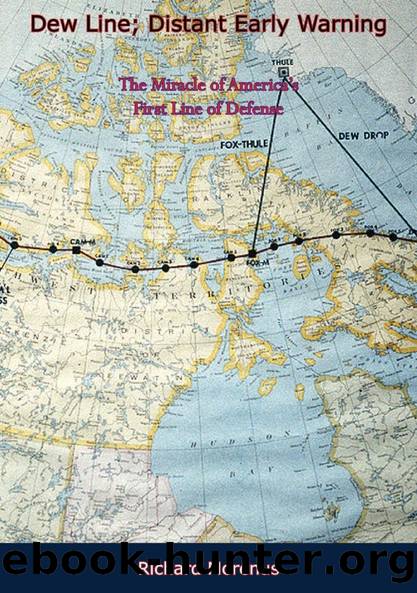
Author:Richard Morenus [Morenus, Richard]
Language: eng
Format: epub
ISBN: 9781014717481
Google: QWGxzgEACAAJ
Publisher: Creative Media Partners, LLC
Published: 2021-09-09T03:08:27+00:00
CHAPTER SEVENâTHE SEALIFT
WHILE THE LABRADOR WAS SLICING and slugging her way through the straits and clearing bays down east, the western Navy convoy of about sixty ships headed north from Seattle. It was practically a duplicate of the eastern convoy. One would serve the western half of the Line, the other the eastern. In this way they hoped to be able to reach every landing site and discharge their essential cargoes before winter would freeze them in.
By comparison it would seem that the eastern ships were going to have an easier time in reaching their objectives, because some of the eastern waters were opened to commercial shipping during the summer. Churchill, Manitoba, is one of the worldâs greatest grain ports, and for the few open weeks of summer the grain-freighters move millions of bushels of Canadaâs wheat across Hudson Bay, out through Hudson Strait and across the Atlantic. This traffic keeps the Strait dear and at least offers an easy entry into the waters of the DEW Line. This gave the eastern convoy that much of a head start, but after that there was not much choice.
The advantage to the eastern convoy was marked by that distance of the established freight lane. The western convoy had no such help, because in the waters north of Alaska and the Northwest Territories there was no commercial reason whatever for opening shipping lanes.
One other reason why the eastern convoy might be favored was that it was at about 60° north latitude, and the western ships were at 70°, almost 1,000 miles farther north. However, both the east and west convoys were well prepared for a rough go.
This western convoy, which left Seattle early in July, contained at least one of practically every type of craft the Navy could float except combat ships. They went prepared for anything the Arctic might throw at them. There were icebreakers, tugs, repair vessels, LSTâs, Victory ships, every type of lighter craft for unloading operations, and a few others. And the convoy took with them a couple of thousand Army men who had been specially trained for this job at Ft. Eustis, Virginia, and assigned to help in the unloading. Equipped and prepared to overcome every conceivable situationâit was rumored that the chief explorer decided at the last moment to take along an Egyptologist as, he explained, âYou never know what youâre going to find around the Poleââthe convoy plowed its way north.
Twenty-eight hundred cold, miserable miles later they passed the Diomede Islands and made their first freight stop at Pt. Barrow. The Bering Strait had been clear of ice, and the forecast eastward into the Beaufort Sea, after making the turn at the tip of Alaska, was for clear sailing and fair weather.
The unloading at Pt. Barrow presented no great difficulty. Freight put ashore here would ultimately be delivered to the sites along the Alaska experimental line by âcatâ train as soon as freeze-up arrived. Supplying the Alaska line had not offered any too difficult problems.
Time was not wasted.
Download
This site does not store any files on its server. We only index and link to content provided by other sites. Please contact the content providers to delete copyright contents if any and email us, we'll remove relevant links or contents immediately.
| Civil War | Operation Desert Storm |
| Veterans | Vietnam War |
The Radium Girls by Kate Moore(12097)
100 Deadly Skills by Clint Emerson(4975)
Rise and Kill First by Ronen Bergman(4842)
The Templars by Dan Jones(4741)
The Doomsday Machine by Daniel Ellsberg(4559)
The Rape of Nanking by Iris Chang(4269)
Killing England by Bill O'Reilly(4046)
Stalin by Stephen Kotkin(4010)
Hitler in Los Angeles by Steven J. Ross(3983)
12 Strong by Doug Stanton(3584)
Hitler's Monsters by Eric Kurlander(3389)
The Code Book by Simon Singh(3257)
Blood and Sand by Alex Von Tunzelmann(3246)
Darkest Hour by Anthony McCarten(3165)
The Art of War Visualized by Jessica Hagy(3050)
Hitler's Flying Saucers: A Guide to German Flying Discs of the Second World War by Stevens Henry(2779)
Babylon's Ark by Lawrence Anthony(2723)
Tobruk by Peter Fitzsimons(2566)
The Second World Wars by Victor Davis Hanson(2555)
