Deconstruction After All by Christopher Norris
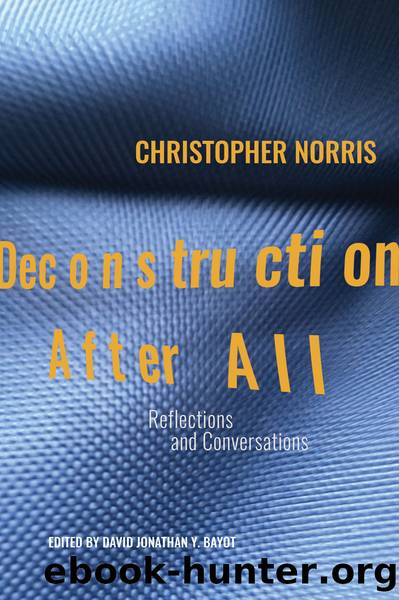
Author:Christopher Norris
Language: eng
Format: epub
Publisher: Independent Publishers Group
Published: 2015-07-14T16:00:00+00:00
5
Deconstruction, Anti-Realism, and Philosophy of Science
Interview with Marianna Papastephanou
Marianna Papastephanou: One of the questions I would like to raise concerns philosophy of science and its implications for philosophy of education. In particular, I would like to ask you whether postmodernism in its deconstructionist form has anything useful to offer to philosophy of education with regard to the teaching of science.
Christopher Norris: Well, I think you have to draw some important distinctions which very often get ignored or elided in this context. First, you need to draw a distinction between postmodernism and deconstruction. I suppose there is a sense—a rather vague and ill-defined sense—in which deconstruction can be seen as a part of the wider postmodernist movement of thought. All the same, I would argue, it is more than just a subbranch of that wider movement or a way of reading texts (philosophical, literary, and other kinds of text) which has developed mainly in response to our current (so-called) “postmodern condition.”
It is worth getting clear about this, I think, since the stakes are quite high in ethical and political as well as in “purely” philosophical terms. Postmodernism amounts—philosophically speaking—to a kind of generalized skepticism, a skepticism with regard to such typecast “modernist” concepts as truth, reason, critique, and other such supposedly outmoded enlightenment values. So, it involves, as Lyotard famously said, an incredulity toward “metanarratives,” toward any way of thinking that implies some idea of truth, progress, enlightened understanding, the exercise of reason as a liberating power, or freedom of moral and intellectual conscience. In other words—as Habermas claims—it represents a very definite and programmatic break with the “philosophical discourse” of enlightenment or the “unfinished project” of modernity. Lyotard is quite explicit about this: we can no longer carry on thinking in those old Kantian-enlightenment terms once we have taken stock of all the melancholy counterevidence—the history of setbacks, ironic reversals, revolutionary hopes betrayed, and so forth—which has gone clean against those old, discredited values and beliefs. So, we had much better accept that we have now lived on (“we” collectively—not just disenchanted postmodern types like Lyotard) into an epoch when the only genuine ethical imperative is to multiply the range of “first-order natural pragmatic narratives” and renounce any appeal to such delusive—he would say coercive, even totalitarian—ideas.
Papastephanou: So, deconstruction is not a skeptical movement of thought, at least not skeptical to the same degree as postmodernism?
Norris: Well, deconstruction is skeptical up to a point, I think. Thus, it raises questions—very searching questions—about truth, knowledge, meaning, and representation. It is also skeptical (again up to a point) about the possibility that we could somehow reassemble or reconstitute historical knowledge in such a way as to speak with any confidence about the progress of human knowledge or the emergence of better, more “enlightened” forms of ethical, political, and social thought. Still, I would want to say—on the evidence of Derrida’s texts—that it doesn’t amount to anything like an outlook of wholesale postmodernist skepticism or a complete renunciation of enlightenment values in the Lyotard fashion.
Download
This site does not store any files on its server. We only index and link to content provided by other sites. Please contact the content providers to delete copyright contents if any and email us, we'll remove relevant links or contents immediately.
4 3 2 1: A Novel by Paul Auster(12516)
The handmaid's tale by Margaret Atwood(7834)
Giovanni's Room by James Baldwin(7439)
Big Magic: Creative Living Beyond Fear by Elizabeth Gilbert(5834)
Asking the Right Questions: A Guide to Critical Thinking by M. Neil Browne & Stuart M. Keeley(5832)
Ego Is the Enemy by Ryan Holiday(5528)
The Body: A Guide for Occupants by Bill Bryson(5181)
On Writing A Memoir of the Craft by Stephen King(4998)
Ken Follett - World without end by Ken Follett(4789)
Adulting by Kelly Williams Brown(4623)
Bluets by Maggie Nelson(4604)
Eat That Frog! by Brian Tracy(4598)
Guilty Pleasures by Laurell K Hamilton(4504)
The Poetry of Pablo Neruda by Pablo Neruda(4169)
Alive: The Story of the Andes Survivors by Piers Paul Read(4078)
Fingerprints of the Gods by Graham Hancock(4050)
White Noise - A Novel by Don DeLillo(4045)
The Book of Joy by Dalai Lama(4041)
The Bookshop by Penelope Fitzgerald(3900)
