Decolonizing Theory by Nigam Aditya;
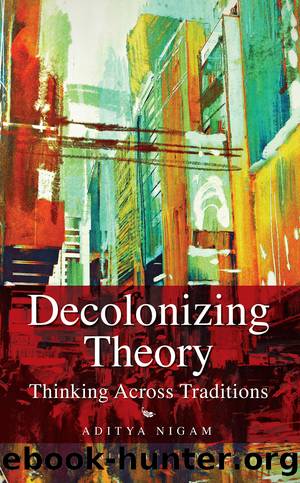
Author:Nigam, Aditya;
Language: eng
Format: epub
Publisher: Bloomsbury Publishing India Pvt. Ltd.
5
Secularism and Subalternity
The Paramodern and the Puranic
After Secularism
The crisis of secularism is not news any longer, given that in India the first salvoes against the secular creed were fired in the mid-1980s, with two very significant interventions by T.N. Madan (1987) and Ashis Nandy (1995), inaugurating a debate that went on for almost two decades.1 Nonetheless, its crisis, and the range of issues it raises, still continues to dog ‘us’ today. By ‘us’, I mean the partisans of the ‘secular’, people who still believe that there might be something that we need to salvage here, and not throw the baby out with the bathwater. Though, increasingly, I have come to believe, if there is anything to be salvaged in it, it is ironically ‘spiritual’—if we can talk of the spirit of secularism in any meaningful sense. Theoretically speaking, we could think of two possible ways of responding to secularism’s ongoing crisis. We could abandon the very term—or at least bracket it—and contemplate other possible ways of thinking of religious ‘tolerance’ or accommodation. Alternatively, we could radically redefine the term, investing it with our own desired meanings ranging from different notions of co-living and coexistence between religious communities to ‘state secularism’ of different kinds. In general, I prefer to hold on to the signs called ‘secularism’ and the ‘secular’ in order to see what kinds of practices are articulated around them, though that is not what I intend to do in this chapter.
In this chapter, I will take secularism’s crisis as my starting point in order to explore one critical question raised by its failure, namely that of premodern or non-modern ways of being (and thinking) that the secular sought to transform, often quite thoughtlessly. Thoughtlessly, because these modes of being were assumed to be passive modes that could simply be transformed into modern ways—to which, it was believed, they would surrender simply because of modernity’s superior knowledge. Thoughtlessly, also because it failed to—and continues to fail to—appreciate the meaning of the ‘spiritual’ in ordinary everyday lives of people. In the Indian context, I call these modes of being the ‘Puranic’ mode, which continues to be widely prevalent in the larger domain that I call the ‘paramodern’. I introduced these terms at the beginning of this book and will elaborate their possible contours at greater length throughout this chapter. For the moment, I want to underline that these modes have displayed great resilience; they have survived continued assaults of the secular-modern to ‘eradicate’ what the latter considered outmoded or archaic ways of ‘thinking’ (as if the former modes resided in some autonomous domain of subjectivity that could be disentangled from ways of being). Indeed, not only have they survived, they have in their own way actively resisted the attempts of the secular-modern to transform them.
The explorations undertaken in this chapter are not meant to be an exercise in what secular-moderns often derisively label ‘romanticizing the past’, for it must be recognized straight away that these are not ‘past’ modes of being
Download
This site does not store any files on its server. We only index and link to content provided by other sites. Please contact the content providers to delete copyright contents if any and email us, we'll remove relevant links or contents immediately.
4 3 2 1: A Novel by Paul Auster(12516)
The handmaid's tale by Margaret Atwood(7834)
Giovanni's Room by James Baldwin(7439)
Big Magic: Creative Living Beyond Fear by Elizabeth Gilbert(5834)
Asking the Right Questions: A Guide to Critical Thinking by M. Neil Browne & Stuart M. Keeley(5832)
Ego Is the Enemy by Ryan Holiday(5528)
The Body: A Guide for Occupants by Bill Bryson(5181)
On Writing A Memoir of the Craft by Stephen King(4998)
Ken Follett - World without end by Ken Follett(4789)
Adulting by Kelly Williams Brown(4623)
Bluets by Maggie Nelson(4604)
Eat That Frog! by Brian Tracy(4598)
Guilty Pleasures by Laurell K Hamilton(4504)
The Poetry of Pablo Neruda by Pablo Neruda(4169)
Alive: The Story of the Andes Survivors by Piers Paul Read(4077)
Fingerprints of the Gods by Graham Hancock(4050)
White Noise - A Novel by Don DeLillo(4045)
The Book of Joy by Dalai Lama(4041)
The Bookshop by Penelope Fitzgerald(3900)
