David's Politics by Abramson Paul R.;
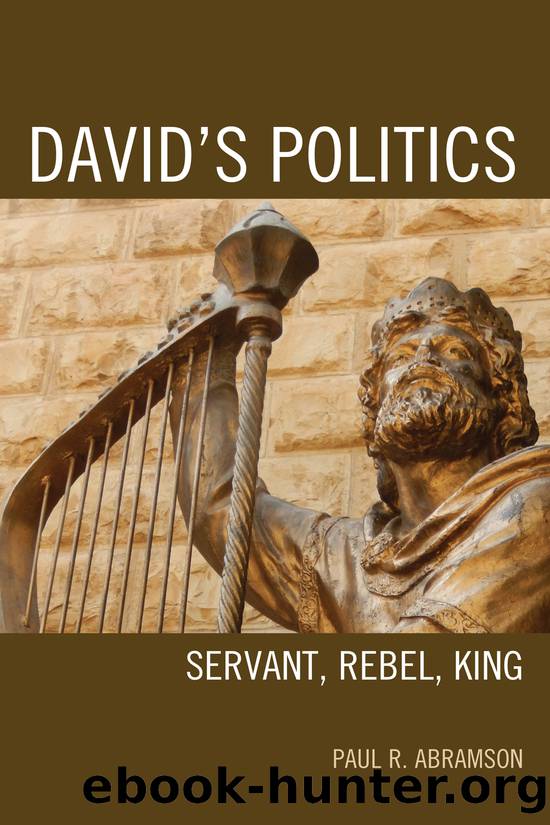
Author:Abramson, Paul R.;
Language: eng
Format: epub
Publisher: Lexington Books/Fortress Academic
Chapter 9
Davidâs Conquests and His Administration
Chapter 8 of 2 Samuel provides a list of Davidâs conquests as well as a brief description of his administration. According to Driver ([1889] [1912] 2014, 279) this chapter provides the âclose of the history of Davidâs public doings.â We are told that âSome time afterward David attacked the Philistines and subdued themâ (2 Sam. 8:1). Alter (1999, 236) argues that the phrase âand it happened thereafterâ . . . âreflects the achronological arrangement of the narrative material at this point.â Bright (2000, 202) argues that the biblical summary of Davidâs conquests (mainly in 2 Samuel 8, but also in chapters 10 and 12) are not presented in chronological order. But if we follow the order presented in 2 Samuel 8, we find that he next defeats the Moabites.
David is draconian. He makes them âlie down on the ground, measured them off with a cord; he measured two lengths of cord for those who were to be put to death, and one length for those who were to be spared. And the Moabites became servants to David and brought tributeâ (2 Sam. 8:2). The text does not explain this harsh treatment, but the Soncino commentary (1949, 232) reminds us that during his rebellion against Saul, David had left his parents in Moab under the protection of its king (1 Sam. 22:4) (see Chapter 4).1 There is a Jewish tradition that the king of Moab had murdered Davidâs parents.2
David then strikes down King Hadazer, son of Rehob of Zobah and restores his monument on the Euphrates, the largest river in western Asia and at its closest point about four hundred miles east of Jerusalem.3 David captures 1,700 horsemen and 20,000 foot soldiers, and an unspecified number of horses. But David hamstrings most of the chariot horses, leaving only enough for 100 chariots (2 Sam. 8:3â4).4 David puts garrisons among the Arameans of Damascus and they become Davidâs servants (2 Sam. 8:6). âThe LORD gave victory to David wherever he wentâ (2 Sam. 8:6). David wins a great deal of spoil in these conquests and he dedicates it to the LORD (2 Sam. 8:11).
David continues his conquests. âDavid won a name for himself. . . . [H]e killed eighteen thousand Edomites in the Valley of Salt,â (2 Sam. 8:13) whose location is disputable. âHe put garrisons in Edom; throughout all Edom he put garrisons, and all the Edomites became Davidâs servants.. And the LORD gave victory to David wherever he wentâ (2 Sam. 8:14). Although the biblical account exaggerates the extent of Davidâs empire, Howard (1993, 161) correctly argues that Davidâs reputation was built upon his military victories.. As David says in Joseph Hellerâs (1984, 256) novel, God Knows, âI was as proud as a peacock, for I had taken a kingdom the size of Vermont, and created an empire as large as the state of Maine!â To make these conquests and to subjugate the conquered territories, David needs to reorganize his army and Herzog and Gichon (2002, 109â116) describe these changes.
Download
This site does not store any files on its server. We only index and link to content provided by other sites. Please contact the content providers to delete copyright contents if any and email us, we'll remove relevant links or contents immediately.
Professional Troublemaker by Luvvie Ajayi Jones(29668)
Empire of the Sikhs by Patwant Singh(23089)
Twilight of the Idols With the Antichrist and Ecce Homo by Friedrich Nietzsche(18638)
Plagued by Fire by Paul Hendrickson(17416)
The Sun and Her Flowers by Rupi Kaur(14526)
Norse Mythology by Gaiman Neil(13372)
A Journey Through Charms and Defence Against the Dark Arts (Harry Potter: A Journey Throughâ¦) by Pottermore Publishing(9276)
Fangirl by Rainbow Rowell(9259)
Adultolescence by Gabbie Hanna(8929)
Wonder by R.J. Palacio(8584)
Tools of Titans by Timothy Ferriss(8402)
Becoming Supernatural by Dr. Joe Dispenza(8223)
How to Bang a Billionaire by Alexis Hall(8160)
Wonder by R. J. Palacio(8115)
Crystal Healing for Women by Mariah K. Lyons(7932)
The Road Less Traveled by M. Scott Peck(7605)
The Lost Art of Listening by Michael P. Nichols(7507)
The Witchcraft of Salem Village by Shirley Jackson(7277)
The Institute by Stephen King(7043)
