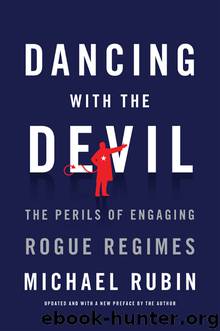
Dancing with the Devil by Michael Rubin
Author:Michael Rubin [Rubin, Michael]
Language: eng
Format: epub
ISBN: 9781594037986
Publisher: Encounter Books
Courting Clinton
Bush’s election defeat in 1992 diminished Saddam’s willingness to make further concessions, since he considered Democrats to be weaker. In one of his first interviews as president, in fact, Bill Clinton signaled flexibility, saying, “If [Saddam] wants a different relationship with the United States and the United Nations, all he has to do is change his behavior.”63 Clinton quickly backtracked amidst a congressional uproar. “There is no difference in policy,” he clarified. “I have no intention of normalizing relations with [Saddam].”64
To woo the new president, Saddam turned to Ramsey Clark, who had been Carter’s intermediary to Khomeini and was a champion of radical causes. “I simply believe that we can pave the way for building new relations based on mutual respect and the exchange of legitimate interests regardless to what has happened,” Saddam said.65 It appeared to work. On March 27, 1993, Secretary of State Warren Christopher announced that the United States would “depersonalize” the conflict and would drop the demand that Saddam step down before lifting sanctions.66 Rather than meet concession with concession, Baghdad doubled down on its defiance.
In April 1993, George H. W. Bush traveled to Kuwait to commemorate its liberation. Kuwaiti authorities rounded up a cell that was plotting to kill him with a car bomb. Two months later, Clinton responded with a cruise missile strike on the Iraqi Intelligence Service headquarters.
Iraq, meanwhile, not only refused to meet its postwar Security Council obligations, but again sent its forces to the Kuwaiti border, on October 7, 1994, apparently testing U.S. mettle. Christopher publicly noted that the United States had “adequate authority” in existing Security Council resolutions to attack Iraq again. “Next time we’ll probably not wait. We will take action, strong action, against him,” Christopher declared.67 Facing a credible military threat, Iraq backed down and did not threaten its southern neighbor anymore.
Hostage diplomacy again brought Iraqi and U.S. officials face to face. In March 1995, Iraqi security forces seized two American defense contractors who strayed into Iraqi territory from Kuwait. Sentenced by an Iraqi court to eight years, they served 114 days before Bill Richardson, a congressman from New Mexico, flew to Baghdad to retrieve them. While American media lauded Richardson, his trip was not without cost: Saddam used it to depict Iraq as strong and America as weak. “President Saddam Hussein told Richardson that he accepts the pleas by Bill Clinton, the Congress and American people,” the Iraqi News Agency reported.68
Clinton’s Iraq policy was dominated by sanctions and inspections. Iraq resisted both. Speaking in the Senate, Biden implied that diplomacy must have a timeline and that the White House must gauge an adversary’s sincerity. “Vigorous diplomacy has been pursued over the past three months, but, thus far, Saddam Hussein has shown that he has no interest in a peaceful solution on anything other than his own terms,” he said. “We cannot allow this tyrant to prevail over the will of the international community.”69 Congressional doubts about the Clinton administration’s backbone led to the passage of the Iraq Liberation Act, which called for the United States to support regime change.
Download
This site does not store any files on its server. We only index and link to content provided by other sites. Please contact the content providers to delete copyright contents if any and email us, we'll remove relevant links or contents immediately.
| Arms Control | Diplomacy |
| Security | Trades & Tariffs |
| Treaties | African |
| Asian | Australian & Oceanian |
| Canadian | Caribbean & Latin American |
| European | Middle Eastern |
| Russian & Former Soviet Union |
The Secret History by Donna Tartt(19002)
The Social Justice Warrior Handbook by Lisa De Pasquale(12177)
Thirteen Reasons Why by Jay Asher(8874)
This Is How You Lose Her by Junot Diaz(6857)
Weapons of Math Destruction by Cathy O'Neil(6249)
Zero to One by Peter Thiel(5767)
Beartown by Fredrik Backman(5718)
The Myth of the Strong Leader by Archie Brown(5482)
The Fire Next Time by James Baldwin(5409)
How Democracies Die by Steven Levitsky & Daniel Ziblatt(5200)
Promise Me, Dad by Joe Biden(5130)
Stone's Rules by Roger Stone(5065)
A Higher Loyalty: Truth, Lies, and Leadership by James Comey(4937)
100 Deadly Skills by Clint Emerson(4900)
Rise and Kill First by Ronen Bergman(4761)
Secrecy World by Jake Bernstein(4727)
The David Icke Guide to the Global Conspiracy (and how to end it) by David Icke(4685)
The Farm by Tom Rob Smith(4489)
The Doomsday Machine by Daniel Ellsberg(4474)
