Critic in the Modern World by Ley James;
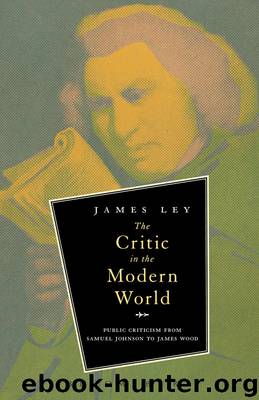
Author:Ley, James;
Language: eng
Format: epub
Publisher: Bloomsbury Publishing
5
‘I do like the West and wish it would stop declining’1
Lionel Trilling (1905–1975)
No discussion of Lionel Trilling can avoid the vexed term liberal. It is a word that evokes much of his criticism’s variousness, possibility, complexity and difficulty. For Trilling, writing at the mid-point of the twentieth century, it had come to signify the mainstream of political thought. ‘In the United States at this time’, he announces in the preface to his best-known book The Liberal Imagination, ‘liberalism is not only the dominant but even the sole intellectual tradition. For it is the plain fact that nowadays there are no conservative or reactionary ideas in general circulation.’2 His own measured stance in the face of this dominance was to be critical but not hostile. He was a liberal, but considered it his duty to interrogate the moral and intellectual assumptions of the concept, to challenge its complacencies, arguing that ‘a criticism which has at heart the interests of liberalism might find its most useful work not in confirming liberalism in its sense of general rightness but rather in putting under some degree of pressure the liberal ideas and assumptions of the present time’.3
This disinterested stance was, in certain respects, influenced by the example of Matthew Arnold, about whom Trilling wrote a definitive critical biography, but its basic orientation had been articulated seven years earlier in Trilling’s admiring study of E. M. Forster, published in 1943, in which he first used the phrase ‘the liberal imagination’. Forster, he argued, ‘stands in particular relation to what, for want of a better word, we may call the liberal tradition, that loose body of middle class opinion which includes such ideas as progress, collectivism and humanitarianism’.4 Though Forster is committed to these broadly liberal notions and his novels are tendentious in their support, his comic manner is nevertheless ‘deeply at odds with the liberal mind’; indeed, he is ‘at war with the liberal imagination’. This is to Forster’s credit, suggests Trilling, because
if liberalism has a single weakness, it is an inadequacy of imagination: liberalism is always being surprised. There is always then liberal work to do over again because disillusionment and fatigue follow hard on surprise, and reaction never hopes, despairs or suffers amazement. Liberalism likes to suggest its affinity with science, pragmatism and the method of hypothesis, but in actual conduct it requires ‘ideals’ and absolutes.5
Trilling’s diagnosis of liberalism’s paradoxical nature suggests something of the dialectical tension that animates his writing, a tension implicit in his juxtaposition of the terms liberal and imagination. For Trilling, the crux of liberalism, understood broadly as a social and political tendency rather than as a body of doctrine, lies with the moral and psychological questions it raises. His assertion, as surprising as it is sweeping, about the absence of any other intellectual tradition – his claim that there are no conservative or reactionary ideas – is comprehensible only if one takes into account that he is using the word idea in an unusual and very specific sense.
An
Download
This site does not store any files on its server. We only index and link to content provided by other sites. Please contact the content providers to delete copyright contents if any and email us, we'll remove relevant links or contents immediately.
4 3 2 1: A Novel by Paul Auster(12359)
The handmaid's tale by Margaret Atwood(7739)
Giovanni's Room by James Baldwin(7309)
Asking the Right Questions: A Guide to Critical Thinking by M. Neil Browne & Stuart M. Keeley(5745)
Big Magic: Creative Living Beyond Fear by Elizabeth Gilbert(5733)
Ego Is the Enemy by Ryan Holiday(5400)
The Body: A Guide for Occupants by Bill Bryson(5067)
On Writing A Memoir of the Craft by Stephen King(4923)
Ken Follett - World without end by Ken Follett(4712)
Adulting by Kelly Williams Brown(4558)
Bluets by Maggie Nelson(4540)
Eat That Frog! by Brian Tracy(4507)
Guilty Pleasures by Laurell K Hamilton(4430)
The Poetry of Pablo Neruda by Pablo Neruda(4084)
Alive: The Story of the Andes Survivors by Piers Paul Read(4013)
White Noise - A Novel by Don DeLillo(3998)
Fingerprints of the Gods by Graham Hancock(3982)
The Book of Joy by Dalai Lama(3965)
The Bookshop by Penelope Fitzgerald(3833)
