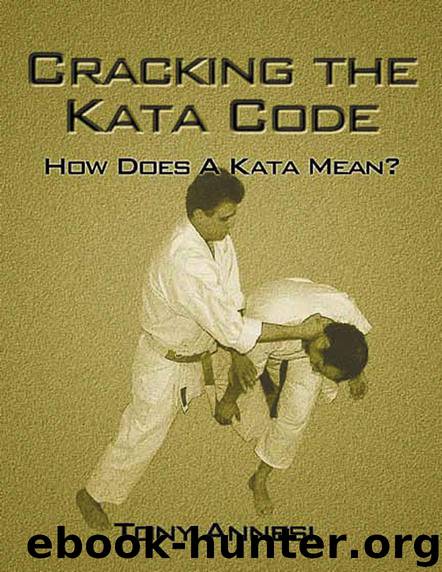
Cracking the Kata Code: How Does A Kata Mean? by Annesi Tony
Author:Annesi, Tony [Annesi, Tony]
Language: eng
Format: azw3
Publisher: Bushido-kai Publications
Published: 2016-04-20T04:00:00+00:00
KATA AS LITERATURE
The parts of a kata, like a work of literature, are composed, unsurprisingly
enough, by a beginning, a middle, and an end. What is surprising is that most
karate practitioners consider the middle to be the kata. They tend to ignore the
preparation, bow, and ready position of the beginning as well as the withdrawal,
closing, and ready position at the end. Would you be happy reading a novel without a “hook” in the first chapter and without a satisfactory resolution
in the final chapter?
A well-conceived kata progresses with one main character and many
antagonists. It achieves semi-climaxes (often punctuated by kiai or yells that
“unify the spirit”). It often bursts open with something that grabs one’s attention. It has the main climax occur near but often not at the end, thus creating space for the aftermath, postscript, “extro”, denouement, or resolution. This suggests that a well-crafted kata was made for performing. In a way it was. Kata was structured so an unintentional “audience” of eavesdroppers would see the sequence as having no greater meaning than a solo dance. Kata was made to appear like a performance; as importantly, kata had to help its practitioner remember the sequence so he had a complete message to decode. In Japanese and Okinawan systems, a kata is usually verbally “announced”. This was the beginning of the beginning. The name of the kata could set the mood for the feel of the kata. Also, the name combined with the pattern, could more easily help one remember the theme and the plot. (In Chinese forms, the salutation and opening posture was a cypher to the stylistic origins of the form. Without this little label, the message might not carry the same weight. Robert Trias theorized that the opening postures of kata were mudras, hand positions that convey a symbolic meaning.5)
Like classic literature, kata has many levels of depth and can be
analyzed both by novices in junior high (isn’t that where you first read
Shakespeare?) as well as experienced students in graduate school. Some types of literary analysis can be applied to kata, as well.
Most people know the general plot of Romeo and Juliet if not from a high school reading then from the Franco Zeffirelli film or any number of other productions. The names of the protagonists have become a universal symbols for star-crossed lovers and for the impetuosity of youth. However, one can investigate the play for its political statement, for its psychological insights, for its structure, as well as for its theme.
In 1969, I was teaching this tragedy to a class of high school sophomores who not only disliked Shakespeare out of principle (no sophomore in high school is allowed to like Shakespeare), but also detested the idea of reading (especially reading aloud) words from a mushy, gushy play about (yeccch!) lovers! I had to catch their interest and make them understand that the bard was not writing just a mushy, gushy play, but was also quite aware of humor (sometimes off-color), violence, done with more drama than Barbarella (then newly released with a semi-nude Jane Fonda) could possibly produce.
Download
This site does not store any files on its server. We only index and link to content provided by other sites. Please contact the content providers to delete copyright contents if any and email us, we'll remove relevant links or contents immediately.
Shoe Dog by Phil Knight(5391)
The Rules Do Not Apply by Ariel Levy(5088)
Walking by Henry David Thoreau(4075)
How to Read Water: Clues and Patterns from Puddles to the Sea (Natural Navigation) by Tristan Gooley(3577)
I'll Give You the Sun by Jandy Nelson(3553)
Running Barefoot by Amy Harmon(3515)
Crazy Is My Superpower by A.J. Mendez Brooks(3504)
How to Read Nature by Tristan Gooley(3458)
How Music Works by David Byrne(3376)
The Boy, the Mole, the Fox and the Horse by Charlie Mackesy(3313)
The Fight by Norman Mailer(3075)
Cuba by Lonely Planet(2745)
Seducing Cinderella by Gina L. Maxwell(2698)
Accepted by Pat Patterson(2437)
Going Long by Editors of Runner's World(2432)
The Unfettered Mind: Writings from a Zen Master to a Master Swordsman by Takuan Soho(2386)
Backpacker the Complete Guide to Backpacking by Backpacker Magazine(2318)
The Happy Runner by David Roche(2305)
Trail Magic by Trevelyan Quest Edwards & Hazel Edwards(2268)
