Cotton Cultivation and Child Labor in Post-Soviet Uzbekistan by Bhat Bilal;
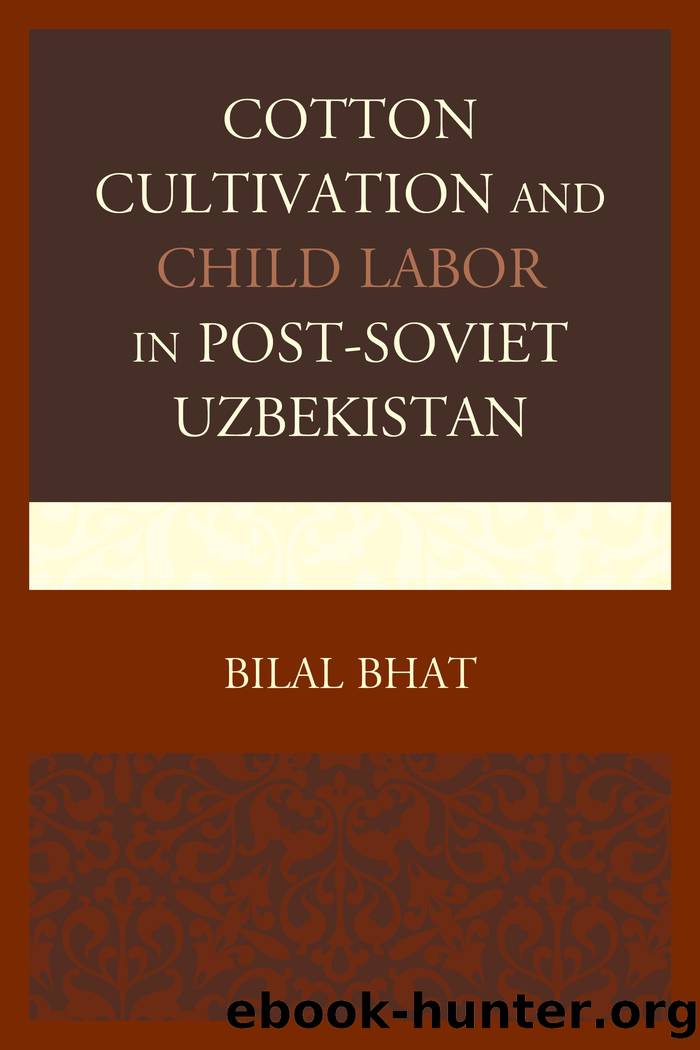
Author:Bhat, Bilal;
Language: eng
Format: epub
Tags: undefined
Publisher: Lexington Books
Published: 2012-08-15T00:00:00+00:00
National Legislation
In terms of domestic law, child labor in Uzbekistan contravenes several items of national legislation. Article 37of the Constitution prohibits the use of any form of forced labor. The 1991 Law on the Foundations of State Youth Policy stipulates that âit is not permitted to attract school and university students to work during the learning process, except in cases when such work corresponds to their chosen specialty and is a form of apprenticeship, or cases of voluntary collective or individual work in time free from schooling. Such labor is accepted on the condition of properly concluded contracts in accordance to labor and civic laws.â The Law on Guarantees of the Right of Child to Labor adopted in 2007 states that a person younger than eighteen years of age is considered to be a child. The right to employment may be exercised from sixteen years onward, and in some cases (with the consent of parents and during periods free from study) from fourteen years on. At the same time, the state guarantees the labor rights for persons younger than eighteen years by providing the necessary conditions for combining work with compulsory education (Article 20). Article 20makes clear stipulations concerning the conditions under which children may be permitted to work including (1) Every child has the right to work, free choice of the type of activity and profession, fair labor conditions in accordance to his age, state of health, and professional training in accordance with the procedure prescribed by the law. (2) Application for a job is permitted from the age of sixteen. (3) Persons who reach the age of fifteen can be accepted for a job by written consent of either parents or guardians. (4) To prepare the children for work it is permitted to recruit the pupils of secondary schools, academic lyceums, and professional colleges to carry out an easy job, that does not harm their health and growth, does not infringe upon the educational process, is free from school hoursâupon reaching the age of fourteen by written consent of either of parents or guardians. Article 7of the Labor Code of the Republic of Uzbekistan on âProhibition of forced laborâ clearly states that forced labor, namely a compulsion to work under the threat of any punishment (including as a means to ensure labor discipline) is prohibited except when it is executed on the basis of legal acts on military or alternative services, in a state of emergency, as a result of a court verdict coming into force or other cases envisaged by the legislation. Article 241of the Labor Code, also prohibits the use of children for any work that may damage their health, security, and morality. The government of Uzbekistan points out that these provisions are in full compliance with the international legal acts on protection of childrenâs rights and, in particular, the 1989 Convention of the Right of the Child. However, there is a widespread international concern in relation to the actual implementation of these laws.
The research delineates
Download
This site does not store any files on its server. We only index and link to content provided by other sites. Please contact the content providers to delete copyright contents if any and email us, we'll remove relevant links or contents immediately.
| Anthropology | Archaeology |
| Philosophy | Politics & Government |
| Social Sciences | Sociology |
| Women's Studies |
The Secret History by Donna Tartt(19092)
The Social Justice Warrior Handbook by Lisa De Pasquale(12191)
Thirteen Reasons Why by Jay Asher(8912)
This Is How You Lose Her by Junot Diaz(6889)
Weapons of Math Destruction by Cathy O'Neil(6281)
Zero to One by Peter Thiel(5802)
Beartown by Fredrik Backman(5756)
The Myth of the Strong Leader by Archie Brown(5509)
The Fire Next Time by James Baldwin(5448)
How Democracies Die by Steven Levitsky & Daniel Ziblatt(5219)
Promise Me, Dad by Joe Biden(5154)
Stone's Rules by Roger Stone(5088)
A Higher Loyalty: Truth, Lies, and Leadership by James Comey(4964)
100 Deadly Skills by Clint Emerson(4927)
Rise and Kill First by Ronen Bergman(4790)
Secrecy World by Jake Bernstein(4753)
The David Icke Guide to the Global Conspiracy (and how to end it) by David Icke(4720)
The Farm by Tom Rob Smith(4514)
The Doomsday Machine by Daniel Ellsberg(4490)
