Conventional Deterrence by John J. Mearsheimer
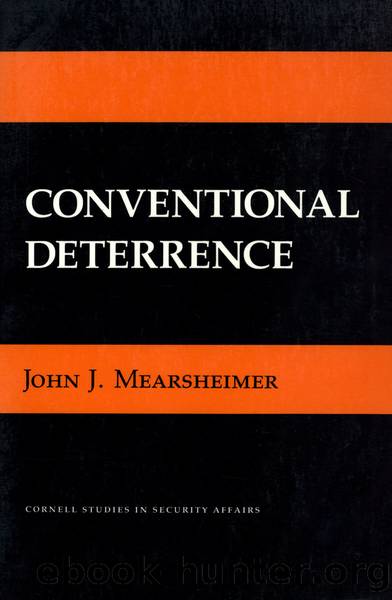
Author:John J. Mearsheimer
Language: eng
Format: epub, mobi, azw3
Publisher: Cornell University Press
Published: 2016-11-26T00:00:00+00:00
Conclusion
To appreciate more fully the fate of deterrence in the Middle East, it is necessary to place the 1973 Egyptian attack in a broader context. Specifically, we must examine Egyptian policy before the 1967 war and in the years between 1967 and 1973.
Between the cease-fire of 1949 and the weeks immediately preceding the 1967 war, Egypt did not consider going to war against Israel. In the early days of May 1967, when Nasser began moving large numbers of troops across the Canal, the available evidence indicates that he did not intend to provoke a war.204 It soon became clear to Nasser and his lieutenants, however, that their actions were very likely to lead to a war with Israel. They recognized that continued escalation of the crisis would provoke an Israeli strike. Nevertheless, they continued to escalate the crisis. The Egyptians actually welcomed an Israeli attack because they were confident that they could stop it and could inflict heavy losses on the Israelis.
There are a number of important parallels between Egyptian behavior in this crisis and in 1973. In neither case is there any evidence that the Egyptians thought that they could take the offensive against Israel and could score a decisive victory. The Egyptians have had a long-standing respect for Israeli military prowess. In both cases the Egyptians considered their strong suit to be defensive warfare, or more specifically, holding fixed positions. The Egyptians did, of course, take limited offensive action in 1973 before assuming the defensive.205 Nevertheless, there are more similarities than differences between Egyptian military strategy in 1967 and in 1973.
In a strict definitional sense, it would be inaccurate to label the 1967 Egyptian plan a limited aims strategy. After all, the Egyptians did not take the offensive, and they did not capture any Israeli territory. They did, however, move large numbers of forces into an area that adjoined Israel and had hitherto been free of large troop formations. This offensive act was not altogether unlike crossing the Canal in 1973. Then, having moved deep into the Sinai, the Egyptians assumed defensive positions to await an Israeli attack. In 1967, as in 1973, the Egyptians wanted to avoid engagements in which Egyptian forces were on the offensive. Instead, the objective was to create a situation in which the Israelis would suffer significant casualties in their futile efforts to dislodge the Egyptians from their well-entrenched positions. It is clear that Egypt’s strategy in 1967 bears marked resemblance to the limited aims strategy employed in 1973.
Although the Egyptians were dealt a staggering military defeat in 1967, they remained convinced that some form of military action against Israel was necessary. They were, in fact, under significant political pressure to find a way to use the military instrument against Israel.206 That the Egyptians had to resort to the war of attrition is evidence that they were deterred from starting a conventional war. As a result of the 1967 war, Israel had created a situation in which the Egyptians would not dare provoke another conventional war.
Download
Conventional Deterrence by John J. Mearsheimer.mobi
Conventional Deterrence by John J. Mearsheimer.azw3
This site does not store any files on its server. We only index and link to content provided by other sites. Please contact the content providers to delete copyright contents if any and email us, we'll remove relevant links or contents immediately.
| Elections & Political Process | Ideologies & Doctrines |
| International & World Politics | Political Science |
| Public Affairs & Policy | Specific Topics |
| United States |
The Secret History by Donna Tartt(18996)
The Social Justice Warrior Handbook by Lisa De Pasquale(12176)
Thirteen Reasons Why by Jay Asher(8873)
This Is How You Lose Her by Junot Diaz(6855)
Weapons of Math Destruction by Cathy O'Neil(6248)
Zero to One by Peter Thiel(5762)
Beartown by Fredrik Backman(5707)
The Myth of the Strong Leader by Archie Brown(5479)
The Fire Next Time by James Baldwin(5409)
How Democracies Die by Steven Levitsky & Daniel Ziblatt(5199)
Promise Me, Dad by Joe Biden(5127)
Stone's Rules by Roger Stone(5065)
A Higher Loyalty: Truth, Lies, and Leadership by James Comey(4937)
100 Deadly Skills by Clint Emerson(4898)
Rise and Kill First by Ronen Bergman(4757)
Secrecy World by Jake Bernstein(4726)
The David Icke Guide to the Global Conspiracy (and how to end it) by David Icke(4683)
The Farm by Tom Rob Smith(4484)
The Doomsday Machine by Daniel Ellsberg(4472)
