Contemporary U.S.-Latin American Relations: Cooperation or Conflict in the 21st Century? by unknow
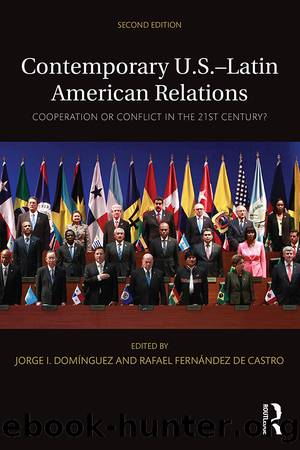
Author:unknow
Language: eng
Format: epub
ISBN: 9781136962615
Goodreads: 17585054
Publisher: Routledge
Published: 2010-07-01T00:00:00+00:00
8 U.S.âPeruvian Relations
Cooperation within the International System of the Twenty-First Century
Cynthia McClintock
In the twenty-first century, bilateral cooperation between Peru and the United States has been robust.1 The relationships between the governments of Alejandro Toledo (2001â2006), Alan GarcÃa (2006â2011), and Ollanta Humala (2011â2016) and the respective U.S. administrations have been among the closest of any Latin American governments with the United States. Overall, during these 15 years, Peru and the United States were in agreement on the two most salient issues: economic openness and security. There was also considerable agreement on additional important issues: democracy and climate change.
The degree of cooperation between Peru and the United States was surprising because of the changes in the international system described in Chapter 1: the system was no longer unipolar. Although the United States remained the most important power in the hemisphere, it was increasingly rivaled by China. Previously, in the 1960s, Peru had struggled with the U.S. governmentâs defense of the International Petroleum Companyâs interests in Peru and, from the late 1970s into the 1990s, it had struggled with its dependence on the International Monetary Fund. Further, the capacity of the United States to engage with Latin America eroded as its attention shifted to the Middle East and Asia and as partisan divisions and executive-legislative conflict intensified. In Peru, a new U.S. Ambassador was appointed in June 2013 but awaited U.S. Senate confirmation for a year before finally arriving in Lima.
At the same time, the international capacity of many Latin American countries, including Peru, increased. Despite Peruâs cooperation with the United States, it was independently assessing and pursuing its own interests â in other words, its foreign-policy making was âpragmatic.â2 Peruâs capacity to assess and pursue its own interests independently of U.S. preferences was facilitated by its establishment of diverse alliances. Peruâs economic ties with China were strengthening dramatically, and its economic and political ties with various Latin American countries were improving as well. As one Peruvian foreign-policy expert said: âPeru is with everyone and with no one.â3
The degree of cooperation between Peru and the United States was also surprising because Peru was not a Latin American country that would have been considered likely to have a friendly relationship with the United States in the twenty-first century. Traditionally, inequality in Peru was severe â a problem that had propelled its neighbors Ecuador and Bolivia into ALBA (the Bolivarian Alliance for the Peoples of our America, sponsored by the late Venezuelan president, Hugo Chávez), which balanced against U.S. power. Into the 1990s, Peruâs ideological left had been among the strongest in Latin America and the relationship between the United States and Peru had often been acrimonious.
Why, then, did Peru partner with the United States when numerous Latin American countries did not? The answer lies in both the structure of economic opportunities available to Peru in the twenty-first century and in the agency of both Peruvian and U.S. leaders.
This chapter first explores the increase in Peruâs capacity and prestige. The two subsequent sections describe the
Download
This site does not store any files on its server. We only index and link to content provided by other sites. Please contact the content providers to delete copyright contents if any and email us, we'll remove relevant links or contents immediately.
| Arms Control | Diplomacy |
| Security | Trades & Tariffs |
| Treaties | African |
| Asian | Australian & Oceanian |
| Canadian | Caribbean & Latin American |
| European | Middle Eastern |
| Russian & Former Soviet Union |
The Secret History by Donna Tartt(19052)
The Social Justice Warrior Handbook by Lisa De Pasquale(12187)
Thirteen Reasons Why by Jay Asher(8893)
This Is How You Lose Her by Junot Diaz(6877)
Weapons of Math Destruction by Cathy O'Neil(6264)
Zero to One by Peter Thiel(5786)
Beartown by Fredrik Backman(5737)
The Myth of the Strong Leader by Archie Brown(5499)
The Fire Next Time by James Baldwin(5431)
How Democracies Die by Steven Levitsky & Daniel Ziblatt(5215)
Promise Me, Dad by Joe Biden(5141)
Stone's Rules by Roger Stone(5081)
A Higher Loyalty: Truth, Lies, and Leadership by James Comey(4954)
100 Deadly Skills by Clint Emerson(4921)
Rise and Kill First by Ronen Bergman(4779)
Secrecy World by Jake Bernstein(4741)
The David Icke Guide to the Global Conspiracy (and how to end it) by David Icke(4702)
The Farm by Tom Rob Smith(4502)
The Doomsday Machine by Daniel Ellsberg(4484)
