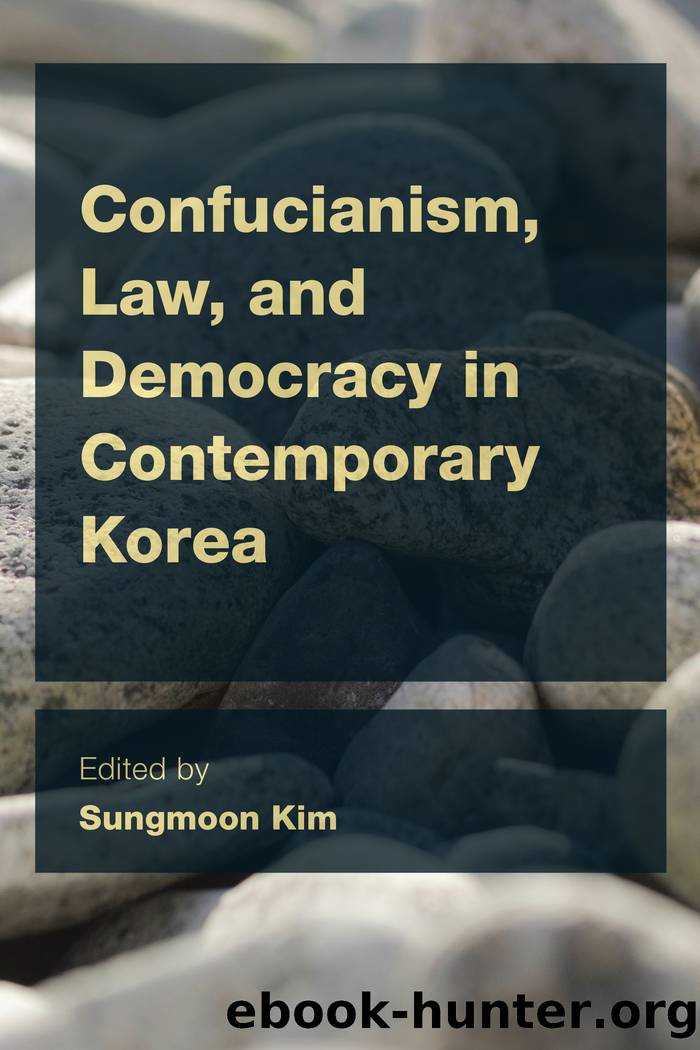
Confucianism, Law, and Democracy in Contemporary Korea by Kim Sungmoon;
Author:Kim, Sungmoon;
Language: eng
Format: epub
Tags: undefined
Publisher: Rowman & Littlefield Unlimited Model
Published: 2012-08-15T00:00:00+00:00
The Daughtersâ Rebellion: The Case
Background
In 1999, the clan organization of the Samaenggong Branch of the Lee Clan from the ancestral seat of Yongâin distributed among its members dividends resulting from a sale of the clanâs land property.[9] According to its internal regulations predicated on traditional Confucian patrilineal clan law (c. zongfa å®æ³), governed by Zhu Xiâs Family Ritual (c. Jiali 家禮), which admits only adult men as full members in the capacity of sons, the association gave adult male members 150 million won (approximately US$150,000) and male members under the age of 20, regarded as associate members, between 16.5 and 55 million won (approximately between US$15,000 and $50,000) each. Though not recognized as âformalâ members in light of clan law, female members of the clan, namely unmarried daughters as well as daughters-in-law, who are responsible for, among other things, preparing the food for family rituals and clan activities, also each received 2.2 million won (approximately US$2,000) and 3.3 million won (approximately US$3,000) respectively, not in terms of dividends, which are only given to formal members, but in terms of âinheritance.â[10] In the course of distributing the clanâs wealth, however, married daughters (i.e., the clanâs daughters who had married members of another clan) were completely excluded based on the traditional patriarchal Confucian custom that regards daughters as âoutsidersâ upon marriage (in Korean words, châulgaoein åºå«å¤äºº).[11]
Infuriated, more than a hundred married daughters openly protested the clan councilâs decision and demanded their âdueâ share as members of the clan, pointing to the clan associationâs somewhat equivocal definition of membership as pertaining to âany descendant of the Samaenggong branch when one comes of age.â In the face of unflagging protests from the married daughters, the clan council eventually offered each married daughter 2.2 million won (approximately US$2,000), also in terms of inheritance, hence not recognizing their formal membership. However, this decision fell far short of assuaging the anger and frustration of the protestors, who soon found out that the clanâs daughters-in-law had received more money than they did. As one of the participants in this protest expressed later, what frustrated them the most was not so much the amount of money but the clanâs patriarchal tradition that systematically discriminated against the married daughters simply because they were women (and admitted womenâs partial membership only in their capacity as the wives of the clanâs sons).[12] Recognizing that verbal protests would not be sufficient to gain formal acceptance into the clan association as members, in 2000, some of these women brought the case to the district court, asking the court to adjudicate the legality of the clanâs stipulations regarding membership. After losing in both district and appellate courts, five of the married daughters from Samaenggong, together with three of the married daughters from the HyeryÅnggong branch of the Shim Clan from ChâÅngsong, who had suffered the same defeats in lower courts, appealed to the Supreme Court. After a long deliberation accompanied by a public hearing, the first of its kind in the history of Korean jurisprudence,
Download
This site does not store any files on its server. We only index and link to content provided by other sites. Please contact the content providers to delete copyright contents if any and email us, we'll remove relevant links or contents immediately.
| Anthropology | Archaeology |
| Philosophy | Politics & Government |
| Social Sciences | Sociology |
| Women's Studies |
The Secret History by Donna Tartt(19052)
The Social Justice Warrior Handbook by Lisa De Pasquale(12187)
Thirteen Reasons Why by Jay Asher(8893)
This Is How You Lose Her by Junot Diaz(6877)
Weapons of Math Destruction by Cathy O'Neil(6264)
Zero to One by Peter Thiel(5786)
Beartown by Fredrik Backman(5737)
The Myth of the Strong Leader by Archie Brown(5499)
The Fire Next Time by James Baldwin(5431)
How Democracies Die by Steven Levitsky & Daniel Ziblatt(5215)
Promise Me, Dad by Joe Biden(5141)
Stone's Rules by Roger Stone(5081)
A Higher Loyalty: Truth, Lies, and Leadership by James Comey(4954)
100 Deadly Skills by Clint Emerson(4921)
Rise and Kill First by Ronen Bergman(4779)
Secrecy World by Jake Bernstein(4741)
The David Icke Guide to the Global Conspiracy (and how to end it) by David Icke(4706)
The Farm by Tom Rob Smith(4502)
The Doomsday Machine by Daniel Ellsberg(4484)
