Confucianism in Contemporary Chinese Politics by Zhang Shanruo Ning;
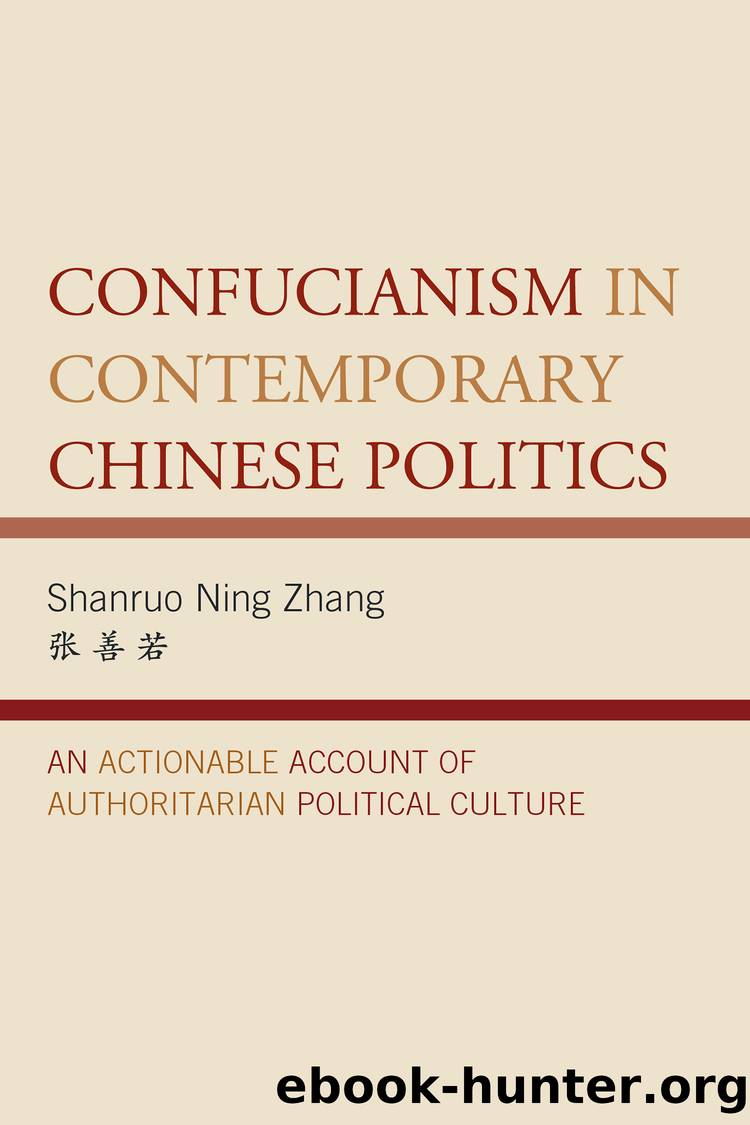
Author:Zhang, Shanruo Ning; [Zhang, Shanruo Ning]
Language: eng
Format: epub
Publisher: Lexington Books
Published: 2016-08-15T00:00:00+00:00
Judicial Corruption: Predicament of Moralistic Rule
On June 17, 2009, Mr. Yang Jinzhu, a lawyer practicing in Hunan Province, published an open letter to Mr. Zhang Wenxian, Head of Jilin Province Supreme Court, in response to Mr. Zhangâs comments three months earlier regarding the newly enacted regulations from the Supreme Court which forbid âinappropriate social relations between judges and lawyers.â In his interpretation, Mr. Zhang noted âit is indeed the case that some lawyers take advantage of their relations with the judges as classmates, friends, and acquaintances to build guanxi with the judges . . . a small number of lawyers have ulterior motives for developing such relations and (help) their clients to bribe the judges through them.â41 In the open letter, Mr. Yang took offense that Mr. Zhang seemed to blame the lawyers for judicial corruption in China. In a media interview following this incident, Mr. Zhang explained his view and experiences with the issue of judge-lawyer relations. When he was a law professor at Jilin University in the early 1990s, Zhang also worked part-time as a lawyer. His experiences made him realize that âit was very hard to draw and keep a firm line between the judges and the lawyers because of their personal relationsâ and the moral obligations embedded in such relations. After the institutionalization of the legal qualifying exams, many lawyers and judges in the same town used to be classmates, a strong basis for guanxi networking. One incident was so alarming that Zhang decided to quit practicing law altogether. Zhang was representing a client in a civil lawsuit and the judge was a former student of his. After the court sessions, the judge, half-jokingly, yet out of his moral obligation to always show respect and deference to oneâs teacher, said, âTeacher, you made such a terrific argument. Why donât you write the court decisions as well?â âI have a lot of students in the legal field in Jilin,â Zhang reasoned, and the personal relationships would always be lurking in the background. He discussed the âgood old daysâ in the early 1990s with a touch of nostalgia: âthings were very different then. People didnât go around looking for guanxi so desperately, asking everybody whether they know someone in the court.â42
The âcollaborativeâ relationship between judges and lawyers has become so blatant and widespread that âjudicial corruptionâ has become a heatedly debated topic in both media and academia in China. The publicâs suspicion of illegitimate collaboration between judges and lawyers is so high that Mr. Xiao Yang, Head of Chinaâs Supreme Court, surmised: âwhen people do not get automatically suspicious seeing a lawyer and a judge walking together, we would finally begin to have some confidence that the lawyer-judge relationship is indeed ânormalââ(Xie 2005). In March 2004, the Supreme Court and the Ministry of Legal Affairs (å¸æ³é¨) jointly launched âThe Stipulations on Regulating the Relationship between Lawyers and Judges in order to Protect Legal Justice.â The key strategy was to set up a âquarantine spaceâ between lawyers and judges (Xie 2005).
Download
This site does not store any files on its server. We only index and link to content provided by other sites. Please contact the content providers to delete copyright contents if any and email us, we'll remove relevant links or contents immediately.
| Anthropology | Archaeology |
| Philosophy | Politics & Government |
| Social Sciences | Sociology |
| Women's Studies |
The Secret History by Donna Tartt(19053)
The Social Justice Warrior Handbook by Lisa De Pasquale(12187)
Thirteen Reasons Why by Jay Asher(8893)
This Is How You Lose Her by Junot Diaz(6877)
Weapons of Math Destruction by Cathy O'Neil(6265)
Zero to One by Peter Thiel(5786)
Beartown by Fredrik Backman(5737)
The Myth of the Strong Leader by Archie Brown(5500)
The Fire Next Time by James Baldwin(5431)
How Democracies Die by Steven Levitsky & Daniel Ziblatt(5215)
Promise Me, Dad by Joe Biden(5141)
Stone's Rules by Roger Stone(5081)
A Higher Loyalty: Truth, Lies, and Leadership by James Comey(4954)
100 Deadly Skills by Clint Emerson(4921)
Rise and Kill First by Ronen Bergman(4779)
Secrecy World by Jake Bernstein(4741)
The David Icke Guide to the Global Conspiracy (and how to end it) by David Icke(4709)
The Farm by Tom Rob Smith(4502)
The Doomsday Machine by Daniel Ellsberg(4484)
