Communicating Catholicism by Maier Craig T.;
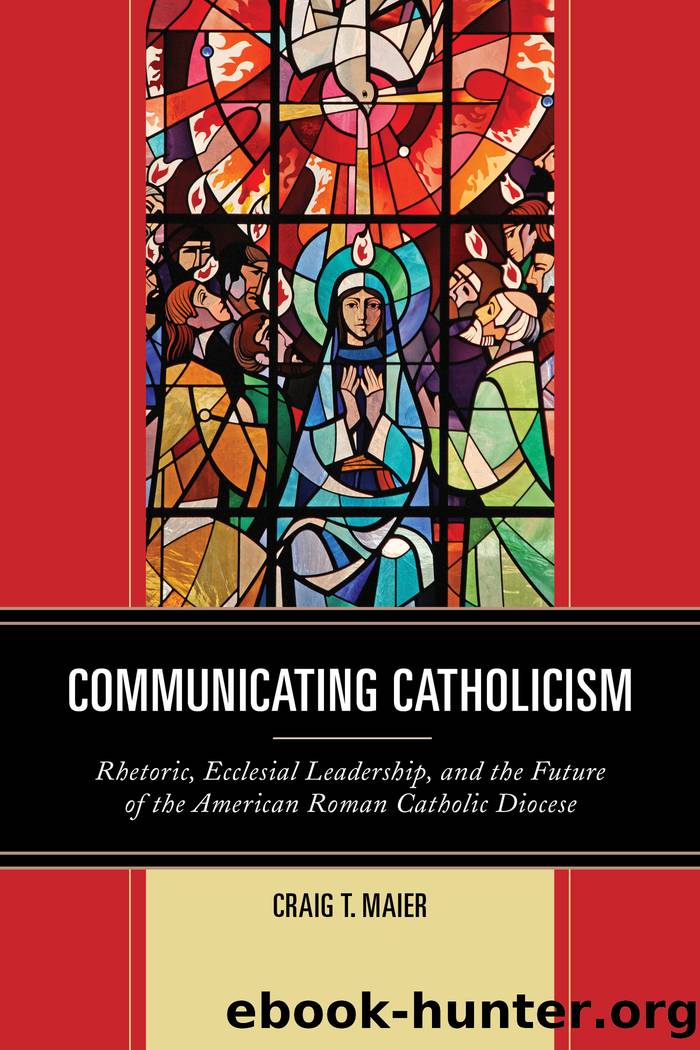
Author:Maier, Craig T.;
Language: eng
Format: epub
Tags: undefined
Publisher: Fairleigh Dickinson University Press
Published: 2012-08-15T00:00:00+00:00
Part II
The Response of Ecclesial Leadership
In the first part of this book, I sought to create a foundation for the study of ecclesial leadership as a rhetorical phenomenon. I began by situating American Catholic dioceses within a multifaceted rhetorical situation that requires them to expand their conceptual repertoire. Within this context, diocesan institutional rhetoric emerges as the communicative confluence of three discursive streams: evangelization, through which a diocese challenges people to live a life of faith in an increasingly secular society; cooperation, through which a diocese builds relationships among organizations and institutions inside and outside of the Church; and decision-making, through which a diocese creates appropriate forums to gather information and make choices that enable the life of the Church to continue. But even if it understands its rhetorical situation, and even if it succeeds in evangelizing persons, building relationships, and making wise choices, a diocese can never forget the fundamental responsibilities of the theological stewardship of the Catholic faith and the pastoral care of persons. Without these responsibilities, without these roots, diocesan institutional rhetoric loses its distinctive character and human face.
âPart II: The Response of Ecclesial Leadershipâ begins to respond to the challenges and opportunities present in the moment of postmodernity. Michael J. Hyde (2006) has observed that the call of the momentâthe âWhere art thou?â that brings communicative life into beingâis always incomplete without a rhetorical response, in which persons are invited to meet those challenges and opportunities with a âHere I am!â Such a response, however, requires both discernment and courage. Though I recognize that dioceses do face important challenges, I will strive in this section to recognize postmodernity not as a time of despair but as a time of potential, potential that Richard John Neuhaus (1987) has described through the metaphor of the Catholic Moment. In chapter 4, âThe Historicity of a Catholic Moment,â I use Neuhausâs work to understand the potential for ecclesial leadership that exists in contemporary American society. Then, in chapter 5, âDiocesan Institutional Rhetoric and Administrative Play,â I describe an administrative style through which dioceses can respond to the emergence of Catholic Moments, and in chapter 6, âThe Joy of Ecclesial Leadership,â I invite dioceses to engage postmodernity as a time of pastoral richnessâand even joy.
Chapter 4
Download
This site does not store any files on its server. We only index and link to content provided by other sites. Please contact the content providers to delete copyright contents if any and email us, we'll remove relevant links or contents immediately.
Professional Troublemaker by Luvvie Ajayi Jones(29668)
Empire of the Sikhs by Patwant Singh(23089)
Twilight of the Idols With the Antichrist and Ecce Homo by Friedrich Nietzsche(18638)
Plagued by Fire by Paul Hendrickson(17416)
The Sun and Her Flowers by Rupi Kaur(14526)
Norse Mythology by Gaiman Neil(13372)
A Journey Through Charms and Defence Against the Dark Arts (Harry Potter: A Journey Throughâ¦) by Pottermore Publishing(9276)
Fangirl by Rainbow Rowell(9259)
Adultolescence by Gabbie Hanna(8929)
Wonder by R.J. Palacio(8584)
Tools of Titans by Timothy Ferriss(8402)
Becoming Supernatural by Dr. Joe Dispenza(8223)
How to Bang a Billionaire by Alexis Hall(8160)
Wonder by R. J. Palacio(8115)
Crystal Healing for Women by Mariah K. Lyons(7933)
The Road Less Traveled by M. Scott Peck(7605)
The Lost Art of Listening by Michael P. Nichols(7507)
The Witchcraft of Salem Village by Shirley Jackson(7277)
The Institute by Stephen King(7043)
