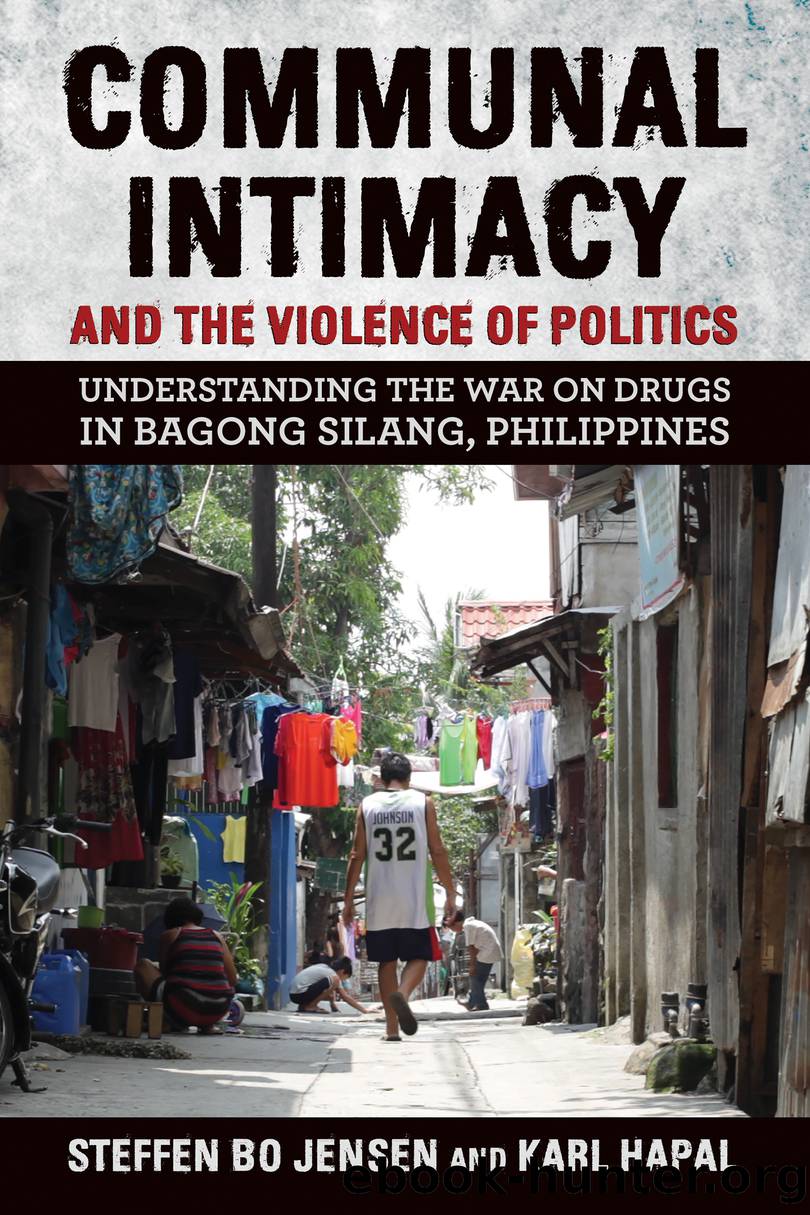
Communal Intimacy and the Violence of Politics by Steffen Bo Jensen;Karl Hapal;
Author:Steffen Bo Jensen;Karl Hapal;
Language: eng
Format: epub
Publisher: Lightning Source Inc. (Tier 3)
In the excerpt, Inday goes back and forth between her pakikisama and that of her husband. This relates to the domestic sphere or conflicts. Her husbandâs pakikisama resulted from his gambling and drinking, and how he shared with those around him. He worked outside the area and only came home once in a while, when he would spend his money on himself and his neighbors. Inday, on the other hand, confronted him to stop what she considered his wasting of scarce resources that could go toward sustaining the household, including paying for expensive school tuition. This made her appear to the neighbors as someone without pakikisama while she stressed the abusive relationship and argued that pakikisama was also about respect for the other people. This was not a perception of pakikisama that was widely accepted at that time, and Indayâs relationship with the path walk was strained. However, as an illustration of the negotiated and unstable character of pakikisama, it seemed that fortunes shifted one year later, as Maricel had lost her privileged position in the path walk while Inday had improved her status. This was to a large extent due to changes in the political life of Bagong Silang. In the barangay elections in 2010, Captain Padilla lost the election to Kuya Inar (Brother Inar). As we describe in chapter 2, this meant that purok leaders were replaced and Maricel lost her position. Parallel to this, the new captain initiated a consultative forum where Inday managed to involve herself. These changes disadvantaged Maricel and gave Inday new political options that she pursued with vigor. This case illustrates several features about pakikisama that are useful to our understanding of communal life. Although pakikisama is seen as a fundamental (essential) characteristic of communal life or personal quality in Bagong Silang by scholars as well as people living there, it is also a highly unstable signifier, subjected to local political struggles, in which it is employed as one of the central elements in determining insiders from outsiders.19
Indayâs explanation of her husbandâs ability to do pakikisama also illustrates the extent to which the concept is gendered and, as Felipe Jocano (1976) suggests in his seminal study, Slum as a Way of Life, generational. Jocano notes that the concept is used to calm down young people when humiliated by older ones (âGet along with him/her, s/he is oldâ [199]). In Indayâs comment we also note that in many instances pakikisama is tied to practices outside the household in relation to neighbors, be that consumption of alcohol, gambling, or political ties, which are often male activities. She, on the other hand, emphasizes respect and proper comportment. This means that although pakikisama is employed by both men and women, there is a specific gender dimension to it, as there is a potential tension between the prerogative of pakikisama and household survival. At the same time, pakikisama is viewed as essential also to household survival. It is these contradictions that emerged in the conflict between Maricel, Inday, and Indayâs husband.
Download
This site does not store any files on its server. We only index and link to content provided by other sites. Please contact the content providers to delete copyright contents if any and email us, we'll remove relevant links or contents immediately.
| Anthropology | Archaeology |
| Philosophy | Politics & Government |
| Social Sciences | Sociology |
| Women's Studies |
The Secret History by Donna Tartt(19053)
The Social Justice Warrior Handbook by Lisa De Pasquale(12187)
Thirteen Reasons Why by Jay Asher(8894)
This Is How You Lose Her by Junot Diaz(6877)
Weapons of Math Destruction by Cathy O'Neil(6267)
Zero to One by Peter Thiel(5789)
Beartown by Fredrik Backman(5737)
The Myth of the Strong Leader by Archie Brown(5500)
The Fire Next Time by James Baldwin(5431)
How Democracies Die by Steven Levitsky & Daniel Ziblatt(5216)
Promise Me, Dad by Joe Biden(5144)
Stone's Rules by Roger Stone(5081)
A Higher Loyalty: Truth, Lies, and Leadership by James Comey(4954)
100 Deadly Skills by Clint Emerson(4921)
Rise and Kill First by Ronen Bergman(4780)
Secrecy World by Jake Bernstein(4741)
The David Icke Guide to the Global Conspiracy (and how to end it) by David Icke(4709)
The Farm by Tom Rob Smith(4502)
The Doomsday Machine by Daniel Ellsberg(4484)
