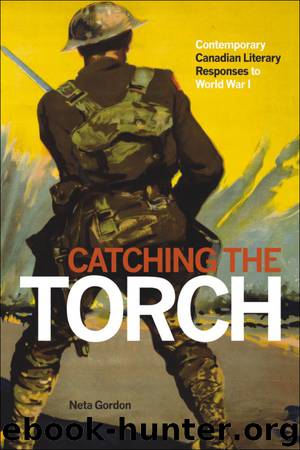
Catching the Torch by Neta Gordon
Author:Neta Gordon
Language: eng
Format: epub
Publisher: Wilfrid Laurier University Press
Published: 2014-03-10T16:00:00+00:00
The Artist and the Witness: Jane Urquhart’s The Underpainter and The Stone Carvers
The crucial difference between the use of historical data in postmodern pastiche and Urquhart’s use of history as “inspiration” for two fundamentally realistic novels is in the site of ambivalence. The transparent and often playful juxtaposition of fact and fiction in postmodern pastiche both signals authorial hesitancy and invites readerly skepticism regarding the stability of the historical record. Rather than presuming that facts can speak for themselves, postmodern writers call attention to their ambivalence about such a notion through instances of self-conscious fictionality. In highlighting the control he or she has over historical material, however, the postmodern writer will simultaneously announce that such an exercise of control is essentially meaningless because of the pains taken to make the procedure highly visible and therefore unfixed. That is to say, by emphasizing the re-creation process and, more importantly, the fact that this process is always subject to further playful modification, postmodern fiction absolves itself from the potentially damaging effects of deploying historical data to any particular purpose.
In contrast, the narrator of The Underpainter, Austin Fraser, both focalizes the stories of others and uses those stories in his paintings; Urquhart’s version of Allward in The Stone Carvers is similarly concerned with how to deploy art so as to transcend historical specificity. Fraser and Allward thus replicate the artistic liberty that Urquhart admits to in her acknowledgements, her procedure of controlling history through fiction, and fact through art. Urquhart is unconvinced that experiential distance—especially as it is signalled by the self-conscious literariness in postmodern fiction—necessarily gives rise to a more stable ideological position or a more disinterested depiction of the horrors of war. Both of her First World War novels examine the grounds and functions of outsider renderings, questioning both the authority often granted to artistic reconstructions of experience over experience itself and the ambivalent role of the artist as a commemorator and exploiter of war. Furthermore, the novels interrogate what the operation of commemoration through art does to the witness, especially the witness who may want to forget what he or she has seen. Urquhart, then, is ambivalent not about the idea of the stable record but about the very re-creation process on which historiographic metafiction depends. In The Underpainter and The Stone Carvers, she turns her attention to the artist whose work derives from the experiences of others; both novels confront the pitfalls of such an artistic approach by employing a realistic mode that eschews the playful use of the historical document in favour of a more generalized historical setting. Urquhart seeks to challenge the superiority granted by Cobley, Kuester, and Colavincenzo to the reconstruction that is fundamental to artistic rendering, especially renderings alluding to circumstances about which the artist has no first-hand knowledge.
Unlike Cumyn, Urquhart avoids representing the subaltern experience. As an American, Austin Fraser—protagonist of The Underpainter—has no link to the war except through two Canadians: George Kearns, a china painter he befriends during his visits to Davenport,
Download
This site does not store any files on its server. We only index and link to content provided by other sites. Please contact the content providers to delete copyright contents if any and email us, we'll remove relevant links or contents immediately.
4 3 2 1: A Novel by Paul Auster(12372)
The handmaid's tale by Margaret Atwood(7755)
Giovanni's Room by James Baldwin(7325)
Asking the Right Questions: A Guide to Critical Thinking by M. Neil Browne & Stuart M. Keeley(5757)
Big Magic: Creative Living Beyond Fear by Elizabeth Gilbert(5754)
Ego Is the Enemy by Ryan Holiday(5413)
The Body: A Guide for Occupants by Bill Bryson(5080)
On Writing A Memoir of the Craft by Stephen King(4929)
Ken Follett - World without end by Ken Follett(4722)
Adulting by Kelly Williams Brown(4565)
Bluets by Maggie Nelson(4547)
Eat That Frog! by Brian Tracy(4525)
Guilty Pleasures by Laurell K Hamilton(4439)
The Poetry of Pablo Neruda by Pablo Neruda(4097)
Alive: The Story of the Andes Survivors by Piers Paul Read(4018)
White Noise - A Novel by Don DeLillo(4001)
Fingerprints of the Gods by Graham Hancock(3991)
The Book of Joy by Dalai Lama(3972)
The Bookshop by Penelope Fitzgerald(3843)
