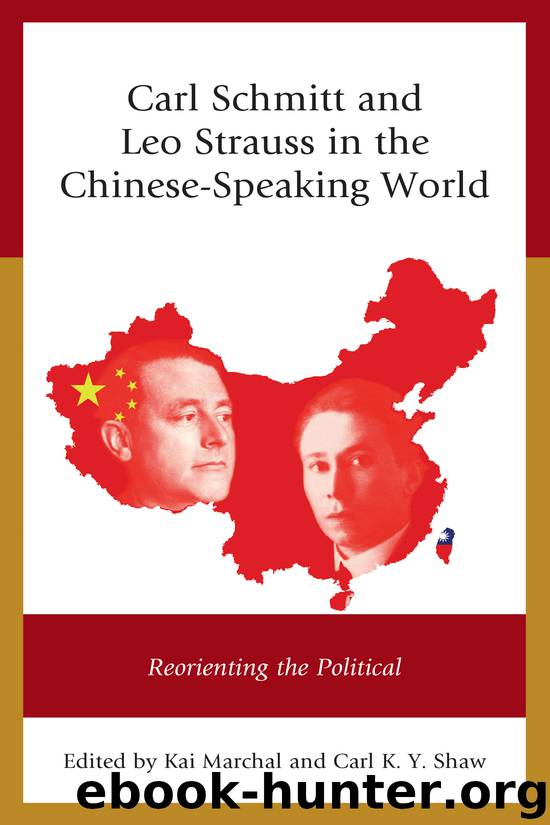
Carl Schmitt and Leo Strauss in the Chinese-Speaking World by Marchal Kai; Shaw Carl K. Y.; Bluhm Harald & Carl K. Y. Shaw
Author:Marchal, Kai; Shaw, Carl K. Y.; Bluhm , Harald & Carl K. Y. Shaw
Language: eng
Format: epub
Publisher: Lexington Books
Part III
LEO STRAUSS IN THE CHINESE-SPEAKING WORLD
Chapter 8
Leo Strauss’s Critique of the Political in a Sinophone Context
Christopher Nadon
It is difficult for Western scholars to understand the Sinophone world’s interest in Leo Strauss and its connection to Carl Schmitt, not least of all due to our inability to read Chinese. The problem is further complicated by the controversy that surrounds Strauss in the United States and Europe, as well as now in China.1 I think it is fair to say that Strauss, who himself expressed doubts about the possibility of establishing liberal democracy even in post-war Germany (Strauss 2007b; Tarcov 2006), would have been surprised at being held responsible for providing the inspiration for an imperialist “neo-conservative” plan to spread liberal democracy to the Arab world by means of the U.S. invasion of Iraq in 2003 (see e.g., Atlas 2003; Frachon and Vernet 2003; Xenos 2007). Nor could he likely have anticipated that as an anti-Communist, his works would at the same time be translated, published, and popularized in a China still governed by its Communist Party, linked by Chinese liberals to the writings of Carl Schmitt, and considered by these same liberals as a stumbling block to the establishment there of liberal democratic politics (L. Zhou 2009; Zheng 2013; Lilla 2010).
The reception of Strauss in the United States, Europe, and interestingly Taiwan, had little if any connection to Carl Schmitt.2 Within these essentially liberal regimes, Strauss was understood as a scholarly critic of the relativistic and potentially nihilistic principles of value pluralism, a partisan of absolute truths, as well as an advocate of reading the “Great Books” as one means to ameliorate the leveling effects of liberal democracy.3 Indeed, in 1988, when Heinrich Meier published Carl Schmitt, Leo Strauss und “Der Begriff des Politischen”: Zu einem Dialog unter Abwesenden to remind us of the importance of the exchange for both parties, he did so also to leverage the already existing interest in Schmitt in the direction of the then rather more obscure Strauss (Meier 1988; 1995). In China, however, the connection between Strauss and Schmitt has been quite close from the start. This is due in large part to their both being introduced within Chinese intellectual circles by Liu Xiaofeng (Davies 2007, 143). A Westernizing liberal in the 1980s, and a “cultural Christian” in the 1990s, Liu came to study Strauss out of an initial interest in Schmitt which was then deflected by Meier’s work (Liu 2013a, 20).4 Since that encounter, Liu’s thought is considered by some to have taken an anti-liberal and anti-Western turn (Davies 2007, 143–46). He has certainly left behind “cultural Christianity.” Yet before attributing that alleged turn to the combined and malign influence of Schmitt and Strauss, we should keep in mind that the work of Strauss that kindled Liu’s interest is in fact a critique of Schmitt (Meier 1995, 87). If Strauss does in fact share some elements of Schmitt’s “anti-liberalism,” it might well be on grounds that differ from Schmitt’s—grounds that also have quite different implications for practical politics (Meier 1995, 41, 47).
Download
This site does not store any files on its server. We only index and link to content provided by other sites. Please contact the content providers to delete copyright contents if any and email us, we'll remove relevant links or contents immediately.
| Anthropology | Archaeology |
| Philosophy | Politics & Government |
| Social Sciences | Sociology |
| Women's Studies |
The Secret History by Donna Tartt(19053)
The Social Justice Warrior Handbook by Lisa De Pasquale(12187)
Thirteen Reasons Why by Jay Asher(8894)
This Is How You Lose Her by Junot Diaz(6877)
Weapons of Math Destruction by Cathy O'Neil(6266)
Zero to One by Peter Thiel(5787)
Beartown by Fredrik Backman(5737)
The Myth of the Strong Leader by Archie Brown(5500)
The Fire Next Time by James Baldwin(5431)
How Democracies Die by Steven Levitsky & Daniel Ziblatt(5216)
Promise Me, Dad by Joe Biden(5141)
Stone's Rules by Roger Stone(5081)
A Higher Loyalty: Truth, Lies, and Leadership by James Comey(4954)
100 Deadly Skills by Clint Emerson(4921)
Rise and Kill First by Ronen Bergman(4780)
Secrecy World by Jake Bernstein(4741)
The David Icke Guide to the Global Conspiracy (and how to end it) by David Icke(4709)
The Farm by Tom Rob Smith(4502)
The Doomsday Machine by Daniel Ellsberg(4484)
