Capitalism versus Socialism: What Does the Bible Have to Say? by Simpson Thomas D
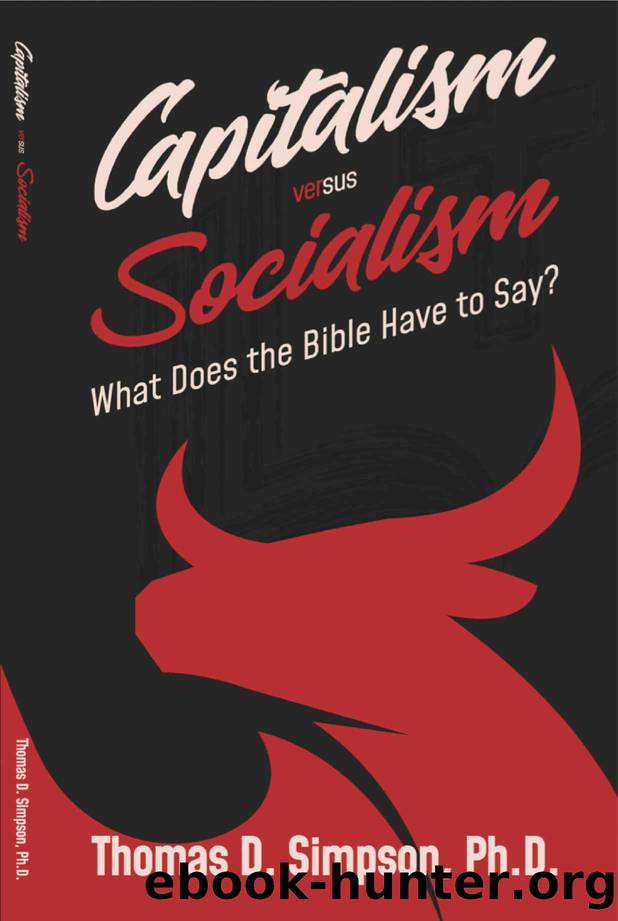
Author:Simpson, Thomas D
Language: eng
Format: epub
ISBN: 9781734815627
Publisher: Thomas D. Simpson
Published: 2020-04-29T16:00:00+00:00
QUESTIONS FOR THE DINNER TABLE
Have your views on socialism changed from reading this chapter? If so, how have they changed?
What, in practice, is equality in the distribution of income? Are socialist systems able to achieve such equality?
Does socialism impinge on personal freedom? Is this good or bad?
What’s meant by the statement that socialist systems short-circuit the role of the Invisible Hand? Is this good or bad?
CHAPTER 4
Communism and Fascism
BACKGROUND
Ironically, both communism and fascism (including Nazism) have described themselves as forms of socialism, although in the minds of many they’re considered to be polar opposites. Moreover, some see an unbridled market-based—capitalist—economy as a cousin to a fascist economy. However, about the only thing that they have in common is private ownership of property.
Both communism and fascism are linked to controversial ideologies. As a consequence, both stir up strong emotions.
As noted, communist and fascist systems differ importantly on private ownership of property. In a fascist system, much of the property used in production of goods and services is privately owned. But, unlike a market-based system, producers in a fascist system don’t have much control over their property and what and how much they produce. Under communism, property is collectively (state) owned. In both, a state-planning agency plays a key role in directing production.
Communism has seen itself as a global movement and, thus, tends to be outwardly focused. It seeks an international alliance or comradeship of workers. In contrast, fascism is nationalistic and inwardly focused and sees the nation state as the ultimate entity. It looks with suspicion on those outside its borders. Moreover, German Nazism viewed the German people to be a super (Aryan) race. It viewed the responsibility of the German government to preserve this race in its purest form.
COMMUNISM
Socioeconomic principles. Communism is linked to Karl Marx and his writings in the Communist Manifesto (1848) and Das Kapital (1867). He frequently collaborated with a friend and colleague, Friedrich Engels. Around the mid-1800s, a group of radicals had been promoting communism as a form of socialism, and Marx acted as spokesman and brought coherence to the thinking of the group. In his writings, Marx provided the intellectual underpinnings for this movement.29
Marx saw the prevailing capitalist system as having an inherent bitter class conflict between the owners of capital (capitalists or bourgeoisie) and their workers. Indeed, he viewed this in the context of Hegelian dialectic: workers (the proletariat) would rise up against their capitalist oppressors and seize control.30 This would usher in an end to private property and introduce a dictatorship of the proletariat, which would be a prelude to a classless communist utopia. The communist utopia would be characterized by “From each according to his abilities, to each according to his needs.” During the transition to this classless communist paradise, human nature would be fundamentally transformed from being self-focused (greed) to being focused on the greater good for the community as a whole.
Download
This site does not store any files on its server. We only index and link to content provided by other sites. Please contact the content providers to delete copyright contents if any and email us, we'll remove relevant links or contents immediately.
| Anthropology | Archaeology |
| Philosophy | Politics & Government |
| Social Sciences | Sociology |
| Women's Studies |
The Secret History by Donna Tartt(19377)
The Social Justice Warrior Handbook by Lisa De Pasquale(12265)
Thirteen Reasons Why by Jay Asher(9054)
This Is How You Lose Her by Junot Diaz(7004)
Weapons of Math Destruction by Cathy O'Neil(6409)
Zero to One by Peter Thiel(5897)
Beartown by Fredrik Backman(5878)
The Myth of the Strong Leader by Archie Brown(5587)
The Fire Next Time by James Baldwin(5542)
How Democracies Die by Steven Levitsky & Daniel Ziblatt(5295)
Promise Me, Dad by Joe Biden(5208)
Stone's Rules by Roger Stone(5155)
A Higher Loyalty: Truth, Lies, and Leadership by James Comey(5043)
100 Deadly Skills by Clint Emerson(4993)
Rise and Kill First by Ronen Bergman(4862)
Secrecy World by Jake Bernstein(4825)
The David Icke Guide to the Global Conspiracy (and how to end it) by David Icke(4796)
The Doomsday Machine by Daniel Ellsberg(4583)
The Farm by Tom Rob Smith(4574)
