Can We Talk about Race?: And Other Conversations in an Era of School Resegregation by Tatum Beverly
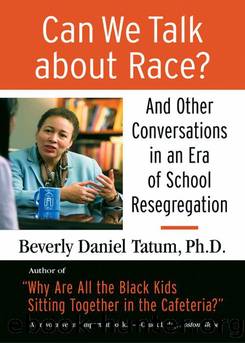
Author:Tatum, Beverly [Tatum, Beverly]
Language: eng
Format: epub
ISBN: 9780807032831
Publisher: Beacon Press
Published: 2008-04-01T00:00:00+00:00
Many students, like many teachers, believe their intelligence (or lack of it) is a fixed, unchanging characteristic. Years of family members, friends, and teachers remarking, “What a smart boy/girl you are!” certainly reinforces this personal theory of intelligence. The alternate view of intelligence as changeable—as something that can be developed—is less commonly fostered, but can be. The educator Verna Ford has summed up this alternate theory for use with young children quite succinctly: “Think you can—work hard—get smart.”44 Research by the educational psychologist Carol Dweck suggests that those young people who hold a belief in fixed intelligence see academic setbacks as an indicator of limited ability. They are highly invested in appearing smart, and consequently avoid those tasks that might suggest otherwise. Rather than exerting more effort to improve their performance, they are likely to conclude, “I’m not good at that subject” and move on to something else. Students who have the view of intelligence as malleable are more likely to respond to academic setbacks as a sign that more effort is needed, and then exert that effort. They are more likely to face challenges head-on rather than avoid them in an effort to preserve a fixed definition of oneself as “smart.”45 The theory of intelligence as malleable—something that expands as the result of effective effort—fosters an academic resilience that serves its believers well.
The researchers Joshua Aronson, Carrie Fried, and Catherine Good wondered if a personal theory of intelligence as malleable might foster a beneficial academic resilience for students of color vulnerable to stereotype threat. Specifically, they speculated that if Black students believed that their intellectual capacity was not fixed but expandable through their own effort, the negative stereotypes that others hold about their intellectual ability might be less damaging to their academic performance. To introduce this alternative view of intelligence, they designed a study in which Black and White college students were recruited to serve as pen-pal mentors to disadvantaged elementary school students. The task of the college students was to write letters of encouragement to their young mentees, urging them to do their best in school. However, one group of college students was instructed to tell their mentees to think of intelligence as something that was expandable through effort, and in preparation for writing the letters, they were given compelling information, drawn from contemporary research in psychology and neuroscience, about how the brain itself could be modified and expanded by new learning. The real subjects of the study, however, were the college students, not their pen pals. Although the letter writing was done in a single session, the college students exposed to the malleable theory of intelligence seemed to benefit from exposure to the new paradigm. Both Black and White students who learned about the malleability of intelligence improved their grades more than did students who did not receive this information. The benefit was even more striking for Black students, who reported enjoying academics more, saw academics as more important, and had significantly higher grades at the end
Download
This site does not store any files on its server. We only index and link to content provided by other sites. Please contact the content providers to delete copyright contents if any and email us, we'll remove relevant links or contents immediately.
| Anthropology | Archaeology |
| Philosophy | Politics & Government |
| Social Sciences | Sociology |
| Women's Studies |
Born to Run: by Christopher McDougall(7121)
The Leavers by Lisa Ko(6945)
iGen by Jean M. Twenge(5408)
Sapiens by Yuval Noah Harari(5366)
Spare by Prince Harry The Duke of Sussex(5178)
The Kite Runner by Khaled Hosseini(5170)
Machine Learning at Scale with H2O by Gregory Keys | David Whiting(4295)
Bullshit Jobs by David Graeber(4179)
Never by Ken Follett(3937)
Goodbye Paradise(3799)
Livewired by David Eagleman(3765)
Fairy Tale by Stephen King(3370)
A Dictionary of Sociology by Unknown(3074)
Harry Potter 4 - Harry Potter and The Goblet of Fire by J.K.Rowling(3061)
The Social Psychology of Inequality by Unknown(3018)
The Club by A.L. Brooks(2919)
Will by Will Smith(2911)
0041152001443424520 .pdf by Unknown(2843)
People of the Earth: An Introduction to World Prehistory by Dr. Brian Fagan & Nadia Durrani(2729)
