Can a City Be Sustainable? by The Worldwatch Institute
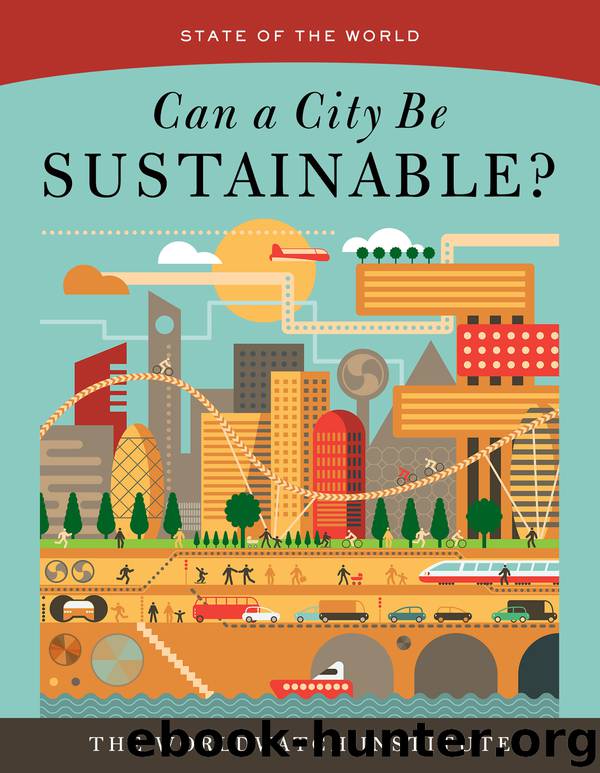
Author:The Worldwatch Institute
Language: eng
Format: epub
Publisher: Island Press
Published: 2016-04-29T04:00:00+00:00
Geoffrey Davison is Senior Deputy Director of the Terrestrial Branch of the National Biodiversity Centre, and Ang Wei Ping is Deputy Director of the Policy & Planning Division—both at the National Parks Board of Singapore.
CHAPTER 13
Source Reduction and Recycling of Waste
Michael Renner
As more people move to urban areas and as consumption levels rise, cities are producing ever-growing volumes of waste. In 2012, worldwide flows of municipal solid waste (MSW, known more commonly as trash or garbage) totaled some 1.3 billion tons, a figure that could rise to 2.2 billion tons per year by 2025. Much of this waste ends up in landfills, which generate serious air and water pollution and contribute to greenhouse gas emissions. MSW is the third largest source of human-caused methane emissions, and the open burning and transport of waste release significant amounts of black carbon particulates and carbon dioxide (CO2). Leachate from landfills contaminates groundwater and poses a risk of vector-borne disease.1
Cities generate large volumes of waste because they are home to high concentrations of people. But many other factors—from lifestyle choices to systems of production—influence how much waste, and what kind of waste, is generated. As Mark Roseland observes in his book Toward Sustainable Communities: Solutions for Citizens and Their Governments, “the dilemma for local governments is that the most desirable options in the waste management hierarchy . . . are behavioral choices that are largely outside of [the city’s] realm.”2
Although the consumption choices of city residents are an important factor in waste generation, larger, unsustainable patterns of production and consumption exist across entire economies. Much of the responsibility lies with corporate decision makers, who see opportunities for making a profit by urging people to buy more “stuff” and by manufacturing overly packaged, short-lived products that cannot easily be repaired—all without having to shoulder the financial and other consequences of such strategies. National governments can take steps to curb these practices through laws that minimize unnecessary packaging, eco-taxes that discourage wasteful practices, and mandatory “take-back” regulations that compel manufacturers to re-assume responsibility for products at the end of their useful lives (thus creating an incentive to design products in more-sustainable ways).
Michael Renner is a senior researcher at the Worldwatch Institute and Codirector of the State of the World 2016 report.
Because municipalities generally are in charge of waste collection, it is in their economic and environmental self-interest to take action to reduce the waste streams entering landfills—and thus to limit the share of their own budgets absorbed by waste-management operations. Cities alone may not be able to act on the full range of policies needed, given the roles played by national governments and corporations. But they need to be conscious of the sustainability “hierarchy” of options—ranging from conventional waste collection and disposal, to waste-to-energy plants (which reduce the burden on landfills but generate their own problems, such as emitting dioxin when they burn chlorinated plastic), to “source separation” by individual consumers or at centralized facilities so that recycling and composting, as well as reuse and refurbishing of materials, become viable.
Download
This site does not store any files on its server. We only index and link to content provided by other sites. Please contact the content providers to delete copyright contents if any and email us, we'll remove relevant links or contents immediately.
| Anthropology | Archaeology |
| Philosophy | Politics & Government |
| Social Sciences | Sociology |
| Women's Studies |
The Secret History by Donna Tartt(19375)
The Social Justice Warrior Handbook by Lisa De Pasquale(12265)
Thirteen Reasons Why by Jay Asher(9054)
This Is How You Lose Her by Junot Diaz(7004)
Weapons of Math Destruction by Cathy O'Neil(6407)
Zero to One by Peter Thiel(5897)
Beartown by Fredrik Backman(5878)
The Myth of the Strong Leader by Archie Brown(5586)
The Fire Next Time by James Baldwin(5541)
How Democracies Die by Steven Levitsky & Daniel Ziblatt(5295)
Promise Me, Dad by Joe Biden(5208)
Stone's Rules by Roger Stone(5155)
A Higher Loyalty: Truth, Lies, and Leadership by James Comey(5043)
100 Deadly Skills by Clint Emerson(4993)
Rise and Kill First by Ronen Bergman(4862)
Secrecy World by Jake Bernstein(4825)
The David Icke Guide to the Global Conspiracy (and how to end it) by David Icke(4794)
The Doomsday Machine by Daniel Ellsberg(4583)
The Farm by Tom Rob Smith(4574)
