Boundaries with Teens by Henry Cloud; John Townsend
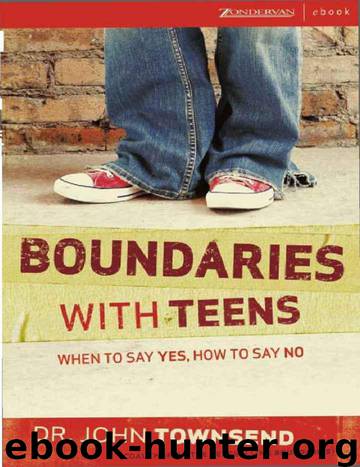
Author:Henry Cloud; John Townsend
Language: eng
Format: mobi
Published: 2012-01-03T16:45:09+00:00
Aggressive Behavior
What can be more upsetting to a parent than to have your own kid, who is now living in an adult body, be physically aggressive against you or someone else? Behavior like this is both surreal and frightening. Kids are supposed to be smaller and weaker than their parents so that the parents can protect them. What tables have been turned upside down so that you must now protect yourself from your child?
Defining the Problem
Unfortunately, aggression in teens has become a significant problem.
Violence in the form of fighting and bullying occurs in schools, neighborhoods, public arenas, and sports stadiums. Aggressive behavior in adolescents ranges from the not so severe, such as yelling or throwing items, to the extremely severe and dangerous, such as the Columbine tragedy. While boys perform the majority of aggressive acts, girls are also becoming more aggressive. These are not excuses, for not all teens are overaggressive. Rather, these are realities you must be aware of.
The problem is understandable when you look at the factors involved: a body almost as strong as an adult's; raging emotions difficult to harness; the adolescent urge to push against all limits; and cultural and peer acceptance of violence. It's like striking a match to kerosene.
A lot of aggression occurs when parents aren't around, and you can't monitor your teen when you aren't around. So, in addition to intervening directly when your teen is aggressive in your presence, you will also need to do as much prevention as possible and to set up workable consequences and helps for those times you find out about the aggressiveness.
Left to their own devices, aggressive teens don't mature into balanced grown-ups. They risk becoming raging adults, with all the relational and career problems that go along with that. You will most likely have to do some things that your teen won't like. But the good news is that you can have a significant impact, helping your adolescent resolve and mature past hurtful behaviors.
Handling the Problem
What to do with aggression? You must act. Here are some guiding principles.
Draw a line. You must not be vague about aggression. The aggressive teen is pushing against limits, and often is unaware, or unconcerned, about what is okay and what is not. The more aggressive and out of control the teen, the stricter and clearer you must be.
Be clear with your teen that aggressive behavior is unacceptable and will not be tolerated. For example, you should ban: yelling at an adult throwing things hitting and other forms of physical aggression threatening violence taking intimidating physical stances (getting in someone's face with threatening gestures) carrying weapons
Establish clear consequences. Most aggressive behavior is impulsive rather than thought out. For that reason, you don't solve the problem by simply explaining to teens why you don't want them being violent. They will likely need to experience negative consequences, which will, in turn, build in them a future orientation of "What will happen next time I do this?”
So let your teen know that any aggressive behavior will result in strict limits.
Download
This site does not store any files on its server. We only index and link to content provided by other sites. Please contact the content providers to delete copyright contents if any and email us, we'll remove relevant links or contents immediately.
Professional Troublemaker by Luvvie Ajayi Jones(29643)
Empire of the Sikhs by Patwant Singh(23062)
Twilight of the Idols With the Antichrist and Ecce Homo by Friedrich Nietzsche(18608)
Plagued by Fire by Paul Hendrickson(17393)
The Sun and Her Flowers by Rupi Kaur(14497)
Norse Mythology by Gaiman Neil(13320)
A Journey Through Charms and Defence Against the Dark Arts (Harry Potter: A Journey Throughâ¦) by Pottermore Publishing(9264)
Fangirl by Rainbow Rowell(9216)
Adultolescence by Gabbie Hanna(8904)
Wonder by R.J. Palacio(8558)
Tools of Titans by Timothy Ferriss(8350)
Becoming Supernatural by Dr. Joe Dispenza(8188)
How to Bang a Billionaire by Alexis Hall(8131)
Wonder by R. J. Palacio(8090)
Crystal Healing for Women by Mariah K. Lyons(7916)
The Road Less Traveled by M. Scott Peck(7576)
The Lost Art of Listening by Michael P. Nichols(7482)
The Witchcraft of Salem Village by Shirley Jackson(7244)
The Institute by Stephen King(7016)
