Blue Labour by Geary Ian; Pabst Adrian; Williams Rowan
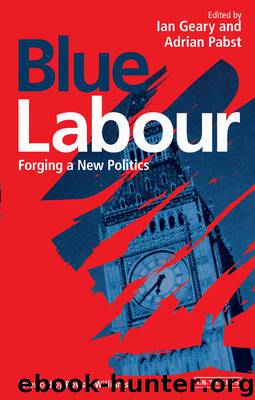
Author:Geary, Ian; Pabst, Adrian; Williams, Rowan
Language: eng
Format: epub
Tags: politics, current affairs, economics, capitalism, liberalism, conservatism, general election, Labour Party
Publisher: I. B. Tauris & Company, Limited
Is there a case for high levels of immigration?
What about the more conventional case for high levels of immigration: that it benefits receiving countries as well as the immigrants? No sensible person is opposed to immigration tout court. It is a matter of how much and how it is managed, and how it affects the national political community. For the nation state to have any meaning it must in the democratic era ‘belong’ to existing citizens: on important matters citizens must have special rights over non-citizens. That means immigration must be managed with the interests of existing citizens in mind. The question is: what are those interests? And what kind, and what level, of immigration should it translate into?
Looked at year on year the numbers arriving in Britain seem tiny. But according to the Office of National Statistics (ONS), persistent immigration at around the current rate sees the UK population rising from 62.3 million in 2010 to 81.5 million in 2060 – an increase of 19.2 million. In the absence of migration, the ONS projects that the population would only rise to 64 million by 2060.
In several European countries the immigrant and ethnic minority population is rising to 20 or 25 per cent in the next few years. Many large towns in Europe are already around 40 per cent minority – Birmingham, Malmö, Marseilles. In Britain, the capital city is already ‘majority minority’ along with three others: Slough, Leicester and Luton.
The arrival of the rich and the skilled and the inventive has long brought blessings to this land. Unskilled immigration brings its benefits too. There is no doubting the dynamism of many young migrants, and their willingness to do dirty or under-rewarded jobs (like caring for the elderly) that few natives want. But these benefits would have to be large and demonstrable to justify the cultural and social disruption caused by the rapid, large-scale immigration we have experienced in recent years. And they are not. Almost all the economic analyses of mass immigration in recent years have found that the effect on employment, wages, fiscal balance and per capita growth is small, either positively or negatively.
Moreover, existing British citizens not only have very different experiences of immigration, depending on where they live, they also have very different economic interests arising from it. Employers, big and small, and better-off people tend to benefit from imported labour that is usually relatively cheaper and higher quality than the domestic equivalent. And many millions of us as consumers have enjoyed lower prices for cleaners or for redecorating our houses in recent years.
Immigrants themselves benefit, of course. They would not endure the pain and disruption of uprooting unless there were very clear gains in security or comfort. But national social contracts still matter and low-skilled locals (often recent migrants themselves) face greater competition both in the labour market and in public services. And as they are more likely to live in areas of high immigrant settlement too, they might face a sense of displacement and competition in three different areas of life: neighbourhood, work and state services.
Download
This site does not store any files on its server. We only index and link to content provided by other sites. Please contact the content providers to delete copyright contents if any and email us, we'll remove relevant links or contents immediately.
| Anthropology | Archaeology |
| Philosophy | Politics & Government |
| Social Sciences | Sociology |
| Women's Studies |
The Secret History by Donna Tartt(19092)
The Social Justice Warrior Handbook by Lisa De Pasquale(12191)
Thirteen Reasons Why by Jay Asher(8912)
This Is How You Lose Her by Junot Diaz(6889)
Weapons of Math Destruction by Cathy O'Neil(6281)
Zero to One by Peter Thiel(5802)
Beartown by Fredrik Backman(5756)
The Myth of the Strong Leader by Archie Brown(5509)
The Fire Next Time by James Baldwin(5447)
How Democracies Die by Steven Levitsky & Daniel Ziblatt(5219)
Promise Me, Dad by Joe Biden(5154)
Stone's Rules by Roger Stone(5088)
A Higher Loyalty: Truth, Lies, and Leadership by James Comey(4964)
100 Deadly Skills by Clint Emerson(4926)
Rise and Kill First by Ronen Bergman(4790)
Secrecy World by Jake Bernstein(4753)
The David Icke Guide to the Global Conspiracy (and how to end it) by David Icke(4720)
The Farm by Tom Rob Smith(4514)
The Doomsday Machine by Daniel Ellsberg(4490)
