Becoming Christian by Britton Dennis Austin;
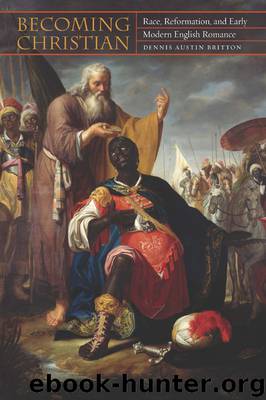
Author:Britton, Dennis Austin;
Language: eng
Format: epub
Publisher: Fordham University Press
5. Reproducing Christians
Salvation, Race, and Gender on the Early Modern English Stage
Behind the racial and religious themes of Othello there lurks an uneasiness about romantic relationships between non-European men and European women.1 Early modern English comedies and tragicomedies, however, suggest that the English had less of a problem with romantic relationships between European men and infidel women. These types of relationships were staged often, in plays such as Greene’s Orlando Furioso (circa 1590) and The Comical History of Alphonsus, King of Aragon (circa 1590); Shakespeare’s The Merchant of Venice; Fletcher’s The Island Princess (1621); and Massinger’s The Renegado (1623/4) and The Emperor of the East (1632). In these plays there is either an implicit understanding of or an explicit reference to the infidel woman’s conversion to Christianity. The frequency of interreligious and interracial relationships in early modern English comedy gains greater significance when we realize that no English comedy (to my knowledge) staged a relationship between a non-European man and a European woman.2 Moreover, whereas numerous infidel women convert to Christianity on the early modern English stage, relatively few infidel men convert—only (again, to my knowledge) Corcut in Greene’s Selimus, Emperor of the Turks and Joffer in part 2 of Thomas Heywood’s Fair Maid of the West (and possibly, though less certainly, Shakespeare’s Shylock in The Merchant of Venice).
This chapter considers the dynamic interplay of race, gender, and romance’s infidel-conversion motif in early modern English tragicomedy. On the one hand, the frequent appearance of the infidel-conversion motif in comedies demonstrates the English stage’s adaptation of Catholic romance’s union of baptism and marriage as sacraments that work in tandem to confer Christian identity. On the other hand, the persistent gendering of eligibility for conversion—women far more than men—and the tendency of these comedies to veer toward tragedy register concerns about the reproduction of Christian identity. The stage’s dictates concerning what kinds of relationships can achieve comedic resolutions reflects the confluence of early modern medical understandings of human reproduction and a Protestant view of marriage and child-rearing as the chief means of reproducing Christian identity; in both cases the female body was a critical site of investigation as early moderns attempted to understand what a mother contributed both biologically and spiritually to her children.
Protestant theology and early modern understandings of sexual reproduction converged in three ways: one, in describing the role of the male seed in creating a child’s identity; two, in articulating a belief that women could be redeemed through childbirth; and three, in asserting that marriage and sexual reproduction were the chief means of producing Christian identity. This triad reinforced the developing system of racialized religious identity in England and delimited the kinds of romantic relationships that early modern English comedy could acceptably accommodate. The triad further demonstrates, as Joyce Green MacDonald has shown, that in early modern England the “raced body [is] a sexual body, so that the social aspects of sexual behavior—including but not limited to procreation, monogamy, infidelity, and the inheritance of property and goods—have been simultaneously racialized.
Download
This site does not store any files on its server. We only index and link to content provided by other sites. Please contact the content providers to delete copyright contents if any and email us, we'll remove relevant links or contents immediately.
4 3 2 1: A Novel by Paul Auster(12363)
The handmaid's tale by Margaret Atwood(7750)
Giovanni's Room by James Baldwin(7316)
Asking the Right Questions: A Guide to Critical Thinking by M. Neil Browne & Stuart M. Keeley(5751)
Big Magic: Creative Living Beyond Fear by Elizabeth Gilbert(5749)
Ego Is the Enemy by Ryan Holiday(5411)
The Body: A Guide for Occupants by Bill Bryson(5075)
On Writing A Memoir of the Craft by Stephen King(4925)
Ken Follett - World without end by Ken Follett(4719)
Adulting by Kelly Williams Brown(4564)
Bluets by Maggie Nelson(4542)
Eat That Frog! by Brian Tracy(4518)
Guilty Pleasures by Laurell K Hamilton(4437)
The Poetry of Pablo Neruda by Pablo Neruda(4089)
Alive: The Story of the Andes Survivors by Piers Paul Read(4017)
White Noise - A Novel by Don DeLillo(3999)
Fingerprints of the Gods by Graham Hancock(3985)
The Book of Joy by Dalai Lama(3968)
The Bookshop by Penelope Fitzgerald(3843)
