Barbarous Antiquity by Jacobson Miriam;
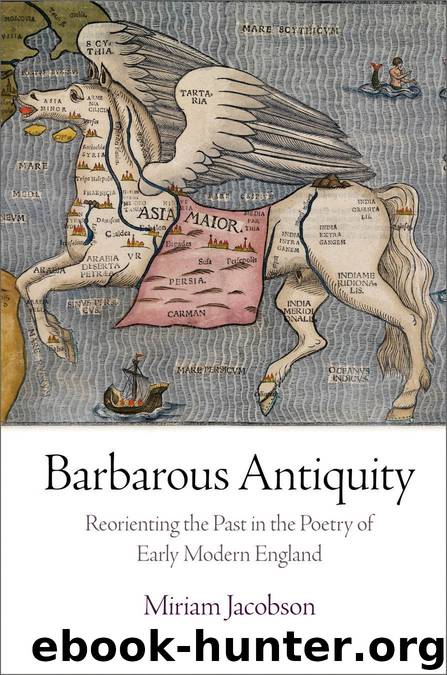
Author:Jacobson, Miriam;
Language: eng
Format: epub
Publisher: University of Pennsylvania Press, Inc.
Published: 2014-04-13T04:00:00+00:00
Two Hero and Leanders
Published in 1598, five years after Christopher Marlowe’s death, Hero and Leander narrates an ancient Greek myth of lovers living on either side of the Hellespont (now called Dardanelles, located in western Turkey). Hero and Leander is usually treated as a narrative poem—a playful Ovidian epyllion, or erotopaignon—written by Christopher Marlowe. But for early modern readers, it was a longer poem with a tragic outcome, as stated on the title page of the second edition of 1598: “begun” by Marlowe and “finished” by George Chapman.1 Marlowe’s poem, first printed alone in 1598, tells the story of ancient lovers separated by the Hellespont, a story that ends after their second parting but before their watery deaths. It was assumed unfinished, but later that year, Paul Linley printed an edition of the poem appending George Chapman’s continuation (twice the length of Marlowe’s original text), and the eight editions that followed until 1637 continued to be printed as a Marlowe-Chapman joint effort. By 1609, the poems were printed as one continuous text, omitting Chapman’s dedicatory material that broke the text in two. And Chapman continued his work with Hero and Leander, publishing the first English translation of the sixth-century Byzantine poet Grammaticus Musaeus’s version of the Hero and Leander story under the title The Divine Poem of Musaeus (1616).2
At first glance, the two parts of the epyllion contrast starkly: Marlowe’s rhetorically playful pansexual comedy of young love seems unprepared for Chapman’s somber moral tragedy. Where Marlowe celebrates insouciant desire, Chapman has the gods brutally chastise his protagonists for indulging in premarital sex. In Marlowe’s text, Hero’s nakedness lights her chamber like a second sunrise; in Chapman’s, her shameful blushes darken the room. In Marlowe’s part, the god Neptune courts Leander; in Chapman’s, heterosexual deities fiercely regulate morality: while the goddess Ceremony lectures Leander on the social necessity of marriage, a sadistic Venus frightens the chastity back into Hero by whipping one of her swans senseless.
Nevertheless, both Marlowe’s and Chapman’s poems reconfigure the classical literary past in early modern geographic and mercantile terms. In both texts, the bodies and spaces of the characters are charged with references to England’s newly established but precarious mercantile trade in the East. For Marlowe, the boundaries of empire are permeable and dynamic. Marlowe’s Hellespont is a fluid, synchronic space, at once ancient and modern, European and Eastern. The dominant imagery of historical and geographical fluidity in Marlowe’s poem is also that of sexual fluidity, illustrated by a symbolic vocabulary of nacreous, orient pearls. In Marlowe’s Hellespont, the bottom of the sea glitters with gold, abalone, coral, and pearl, available for anyone to seize—anyone who can reach them without drowning, that is. Marlowe’s amorous Neptune treats water-borne Leander as one such gem, making this free-trade zone a bit more like a “rough trade” zone. For Chapman, the boundaries between West and East and past and present are similarly fluid and shifting, but they are also consistently contested and renegotiated.
Chapman’s use of exotic imports presents a more anxious view of empire than Marlowe’s.
Download
This site does not store any files on its server. We only index and link to content provided by other sites. Please contact the content providers to delete copyright contents if any and email us, we'll remove relevant links or contents immediately.
4 3 2 1: A Novel by Paul Auster(12405)
The handmaid's tale by Margaret Atwood(7773)
Giovanni's Room by James Baldwin(7354)
Big Magic: Creative Living Beyond Fear by Elizabeth Gilbert(5780)
Asking the Right Questions: A Guide to Critical Thinking by M. Neil Browne & Stuart M. Keeley(5779)
Ego Is the Enemy by Ryan Holiday(5455)
The Body: A Guide for Occupants by Bill Bryson(5103)
On Writing A Memoir of the Craft by Stephen King(4948)
Ken Follett - World without end by Ken Follett(4740)
Adulting by Kelly Williams Brown(4582)
Bluets by Maggie Nelson(4565)
Eat That Frog! by Brian Tracy(4546)
Guilty Pleasures by Laurell K Hamilton(4455)
The Poetry of Pablo Neruda by Pablo Neruda(4113)
Alive: The Story of the Andes Survivors by Piers Paul Read(4037)
White Noise - A Novel by Don DeLillo(4019)
Fingerprints of the Gods by Graham Hancock(4009)
The Book of Joy by Dalai Lama(3996)
The Bookshop by Penelope Fitzgerald(3857)
