Assata Taught Me by Murch Donna;
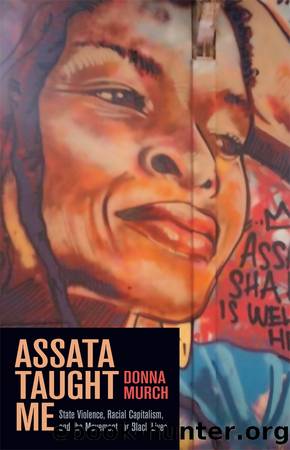
Author:Murch, Donna;
Language: eng
Format: epub
Publisher: Haymarket Books
*âPaying for Punishmentâ originally appeared in the Boston Review (2016). Reprinted with permission.
CHAPTER 8
HOW RACE MADE THE OPIOID CRISIS
In March 2018, President Donald Trump delivered a forty-minute speech about the crisis of addiction and overdose in New Hampshire. Standing before a wall tiled with the words âOpioids: The Crisis Next Door,â Trump blankly recited the many contributors to the current drug epidemic, including doctors, dealers, and manufacturers. Trump droned on mechanically until he reached a venomous crescendo about Customs and Border Protectionâs seizure of 1,500 pounds of fentanyl. He brightened as he shifted focus to three of his most hated enemies, first blaming China and Mexico for saturating the United States with deadly synthetic opioids, then moving seamlessly to what he considered one of the great internal threats: âMy administration is also confronting things called âsanctuary cities,ââ Trump declared. âEnding sanctuary cities is crucial to stopping the drug addiction crisis.â1
Like so many of Trumpâs proclamations, this rhetoric is sheer political fantasy. Our ideas of drug useâwhich kinds are legal, and which are notâare steeped in the metalanguage of race. Since the late 1990s, yearly rates of overdose deaths from legal âwhite marketâ opioids have consistently exceeded those from heroin. According to the Centers for Disease Control and Prevention, between 1999 and 2017, opioid overdoses killed nearly four hundred thousand people with 68 percent of those deaths linked to prescription medications.2 Moreover, as regulators and drug companies tightened controls on diversion and misuse after 2010, the American Society of Addiction Medicine determined that at least 80 percent of ânew heroin users started out misusing prescription pain killers.â Some data sets point to even higher numbers. In response to a 2014 survey of people undergoing treatments for opioid addiction, 94 percent of people surveyed said that they turned to heroin because prescription opioids were âfar more expensive and harder to obtain.â3
In the face of these statistics, the claim that the opioid crisis is the product of Mexican and Central American migrationârather than the deregulation of Big Pharma and the failures of a private health care systemâis not only absurd but also insidious. It substitutes racial myth for fact, thereby rationalizing an ever-expanding machinery of punishment while absolving one of the most lucrative, and politically influential, business lobbies in the United States. This paradoxical relationship between a racialized regime of illegal drug prohibition and a highly commercial, laissez-faire approach to prescription pharmaceuticals cannot be understood without recourse to how racial capitalism has structured pharmacological markets throughout US history. The linguistic convention of âwhiteâ and âblackâ markets points to how steeped our ideas of licit and illicit are in the metalanguage of race.4
Historically, the fundamental division between âdopeâ and âmedicineâ has been the race and class of users. The earliest salvos in the US domestic drug wars can be traced to anti-opium ordinances in late nineteenth-century California as Chinese laborers poured into the state during the railroad building boom. In 1914 the federal government passed the Harrison Narcotics Act, which taxed and regulated opiates and coca products.
Download
This site does not store any files on its server. We only index and link to content provided by other sites. Please contact the content providers to delete copyright contents if any and email us, we'll remove relevant links or contents immediately.
The Secret History by Donna Tartt(19086)
The Social Justice Warrior Handbook by Lisa De Pasquale(12190)
Thirteen Reasons Why by Jay Asher(8909)
This Is How You Lose Her by Junot Diaz(6885)
Weapons of Math Destruction by Cathy O'Neil(6279)
Zero to One by Peter Thiel(5801)
Beartown by Fredrik Backman(5752)
The Myth of the Strong Leader by Archie Brown(5507)
The Fire Next Time by James Baldwin(5442)
How Democracies Die by Steven Levitsky & Daniel Ziblatt(5218)
Promise Me, Dad by Joe Biden(5153)
Stone's Rules by Roger Stone(5087)
A Higher Loyalty: Truth, Lies, and Leadership by James Comey(4960)
100 Deadly Skills by Clint Emerson(4924)
Rise and Kill First by Ronen Bergman(4788)
Secrecy World by Jake Bernstein(4752)
The David Icke Guide to the Global Conspiracy (and how to end it) by David Icke(4717)
The Farm by Tom Rob Smith(4507)
The Doomsday Machine by Daniel Ellsberg(4490)
