Ascent to the Good by William H. F. Altman;
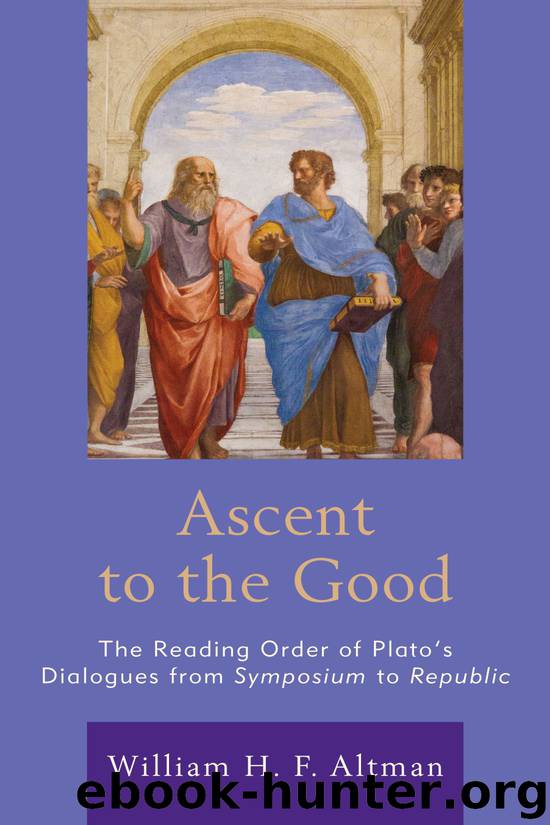
Author:William H. F. Altman;
Language: eng
Format: epub
Publisher: Rowman & Littlefield Publishing
§10. GORGIAS AND THE SHORTER WAY
Given that W. H. Thompson’s had been published in 1871,164 E. R. Dodds had good reason to imagine that his 1959 commentary on Gorgias would hold the field for the next hundred years but it was not to be. As “a revised text with introduction and commentary,” and brimming with sufficient classical erudition to balance its debts to the ultra-modern Nietzsche,165 it is best understood as apparently and self-consciously archaic, forcing comparison with the great Plato commentaries of Victorian and Edwardian England. Vlastos, whose path-breaking Introduction to Protagoras it cites,166 hailed it in 1967 as the best commentary on a Platonic dialogue since Cornford’s on Timaeus,167 but the comparison proved to be inapt and even ironic. To begin with, Cornford’s commentary is a self-consciously modern work, as innovative in format as that of Dodds is conservative.168 More importantly, no other Anglophone commentary on Timaeus has appeared since 1937 whereas Oxford University Press would publish Irwin’s commentary on Gorgias in 1979. And despite the sincerity of his praise for Dodds, it was the Socratist sea change that Vlastos himself had inspired—Irwin was his student—that created the pressing need for a rival commentary only twenty years later.
Between Vlastos and the even more radical Socratists who follow him, Irwin is unique and commensurately valuable for keeping his attention focused on Plato, and thus on Plato’s complicated relationship with Socratism. This focus is ultimately responsible for the Gorgias commentary, and it is easy to see in both Plato’s Moral Theory and Plato’s Ethics that it is his awareness of the troubling relationship between Protagoras and Gorgias that made the latter of particular interest to him.169 By taking the hedonic calculus in Protagoras at face-value and refusing to entertain any doubts about the Socratic Paradox no matter how objectionable he himself found it to be, Vlastos had advanced further along the path first marked out by Aristotle in making that dialogue the bedrock of “the philosophy of Socrates”; as part of PTI, Irwin will travel that path even farther. But since Irwin is genuinely interested in Plato, and thus in how the Socrates of Republic 4 could have emerged from the Socrates of Protagoras—neither Vlastos nor the most radical Socratists were particularly interested in this problem and thus offered simplistic solutions to it—he turns to Gorgias intent on finding answers and as a result his valuable commentary raises critical questions.170
The most obvious discrepancy between Protagoras and Gorgias involves the express denial of the GP Equation in the latter, and Irwin emphasizes this in his commentary’s Introduction,171 as he had already done in Plato’s Moral Theory.172 But here Irwin—who as a charter member of PTI naturally upholds a deadpan reading of Protagoras173—does not advance beyond Dodds, who had already cited the authority of Vlastos for rejecting the claim that “the [hedonist] assumption is made merely for the sake of argument.”174 It is rather in the attention Irwin pays to the Socratic Paradox (SP) that the influence of a Vlastos-inspired Socratism becomes visible.
Download
This site does not store any files on its server. We only index and link to content provided by other sites. Please contact the content providers to delete copyright contents if any and email us, we'll remove relevant links or contents immediately.
4 3 2 1: A Novel by Paul Auster(12546)
The handmaid's tale by Margaret Atwood(7856)
Giovanni's Room by James Baldwin(7467)
Big Magic: Creative Living Beyond Fear by Elizabeth Gilbert(5856)
Asking the Right Questions: A Guide to Critical Thinking by M. Neil Browne & Stuart M. Keeley(5856)
Ego Is the Enemy by Ryan Holiday(5568)
The Body: A Guide for Occupants by Bill Bryson(5212)
On Writing A Memoir of the Craft by Stephen King(5014)
Ken Follett - World without end by Ken Follett(4816)
Adulting by Kelly Williams Brown(4645)
Bluets by Maggie Nelson(4638)
Eat That Frog! by Brian Tracy(4629)
Guilty Pleasures by Laurell K Hamilton(4536)
The Poetry of Pablo Neruda by Pablo Neruda(4189)
Alive: The Story of the Andes Survivors by Piers Paul Read(4098)
Fingerprints of the Gods by Graham Hancock(4076)
The Book of Joy by Dalai Lama(4065)
White Noise - A Novel by Don DeLillo(4058)
The Bookshop by Penelope Fitzgerald(3911)
