Armenian Christianity Today by Alexander Agadjanian;
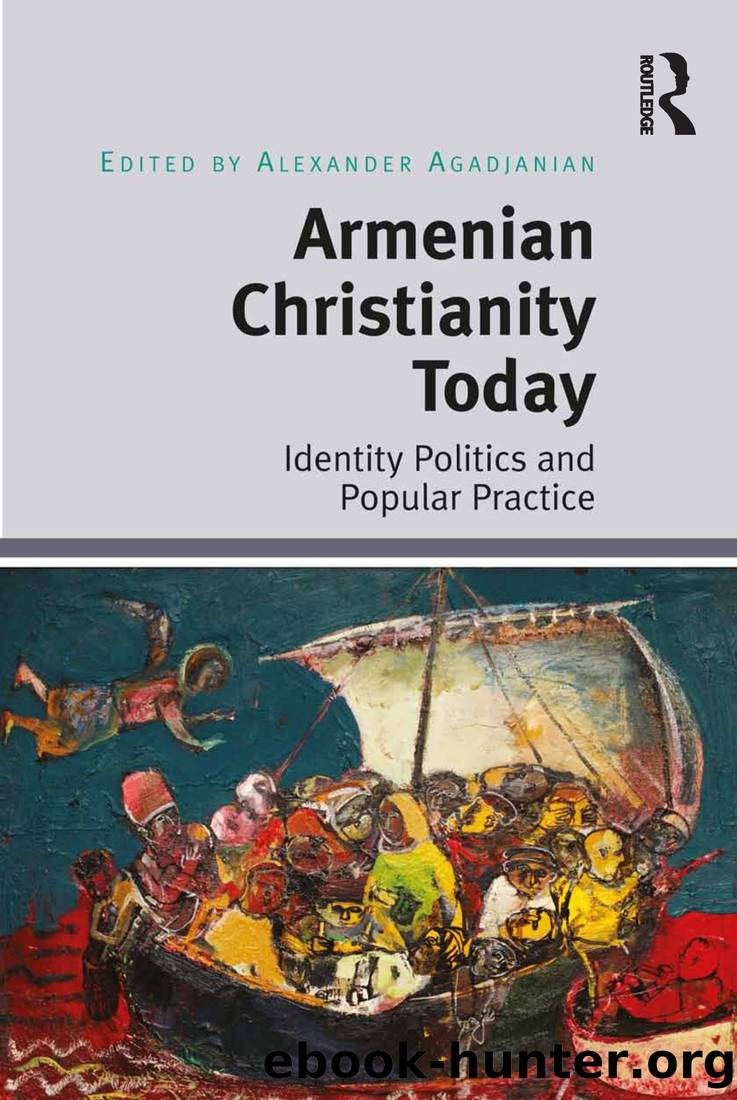
Author:Alexander Agadjanian; [Agadjanian;, Alexander]
Language: eng
Format: epub
ISBN: 9781317178569
Publisher: Taylor & Francis (Unlimited)
Published: 2016-09-15T00:00:00+00:00
Conclusion
Judging from the history of the last few decades, we can conclude that relations between the two Catholicosates have been quite delicate and sometimes explosive, and that careless approaches may lead to clashes and alienation among the Armenian centers in the diaspora and their representatives. The rapprochement of the two Catholicosates was precluded by the political factor, the agenda of the Armenian Revolutionary Party (Dashnaktsutyun), which drove a serious wedge between Soviet Armenia and the diaspora. This situation continued in part even after Armenia gained her independence. The result was that diaspora Armenians had no way of fully assessing the restoration of independent Armenia and remained spiritually isolated from the new Republic. And, as we mentioned the Dashnaktsutyun party continued the policy it adopted during the Cold War, impeding the improvement of EtchmiadzinâCilicia relations.
Although the relationship between the two centers was friendly but remote during the first decades of Soviet rule, after the mid-1950s it quickly worsened. From 1956 to 1988 there were no relations between them at all, a situation which was also conditioned by the political factor. But after the Spitak earthquake in 1988 the ice broke, and thanks to the efforts of Catholicos Vazgen I and the Cilician Catholicos Garegin II relations were re-established, and became even better when the latter became Catholicos Garegin I of Etchmiadzin in 1995. Peace, friendship and unity during the period from 1988 to 2001 were the result of objective and subjective reasons. The objective reasons were the earthquake and the assistance provided by the Cilician See, as well as the collapse of Soviet Union, which led to the facilitation of relations between the Sees. The subjective reason was political: the initiative taken by the first president of Armenia Levon Ter-Petrosyan to assist in the election of Garegin I. However, after the election of Garegin II Nersisyan in Etchmiadzin in 1999, the relationship became more complex and ambiguous. It was mostly conditioned by power conflicts (over the Canadian diocese of Cilicia, for example) and by the issue of hierarchy, as Etchmiadzin periodically emphasized its primacy. The political factor was also vitally important, since the Dashnaktsutyun party always impeded the close cooperation between Etchmiadzin and Cilicia, trying to retain its power and authority in the Cilician See and in the diaspora as a whole.
The diaspora dimension is, in the final analysis, truly crucial. Most of the financial resources for both Catholicosates come from the diaspora. The division of the diaspora supports the differentiation of the components of Armenian identity because the terms âArmenians of Armeniaâ and âArmenians of the diasporaâ and the meanings imputed to them often contradict each other. The ecclesiastical centers also have a role in fomenting this contradiction. The âArmenians of Armeniaâ are mostly regarded as belonging to the Etchmiadzin hierarchy and the âArmenians of the diasporaâ to the House of Cilicia; and the followers of the two Catholicosates often do not have regular contact with each other. Such issues are especially evident in the Armenian diaspora in America, where the various divisions of Armenian identity are deeper and uniquely different.
Download
This site does not store any files on its server. We only index and link to content provided by other sites. Please contact the content providers to delete copyright contents if any and email us, we'll remove relevant links or contents immediately.
Professional Troublemaker by Luvvie Ajayi Jones(29663)
Empire of the Sikhs by Patwant Singh(23086)
Twilight of the Idols With the Antichrist and Ecce Homo by Friedrich Nietzsche(18635)
Plagued by Fire by Paul Hendrickson(17413)
The Sun and Her Flowers by Rupi Kaur(14518)
Norse Mythology by Gaiman Neil(13368)
A Journey Through Charms and Defence Against the Dark Arts (Harry Potter: A Journey Throughâ¦) by Pottermore Publishing(9276)
Fangirl by Rainbow Rowell(9254)
Adultolescence by Gabbie Hanna(8927)
Wonder by R.J. Palacio(8582)
Tools of Titans by Timothy Ferriss(8396)
Becoming Supernatural by Dr. Joe Dispenza(8217)
How to Bang a Billionaire by Alexis Hall(8156)
Wonder by R. J. Palacio(8113)
Crystal Healing for Women by Mariah K. Lyons(7931)
The Road Less Traveled by M. Scott Peck(7603)
The Lost Art of Listening by Michael P. Nichols(7506)
The Witchcraft of Salem Village by Shirley Jackson(7276)
The Institute by Stephen King(7038)
