Arendt's Judgment by Schwartz Jonathan Peter;
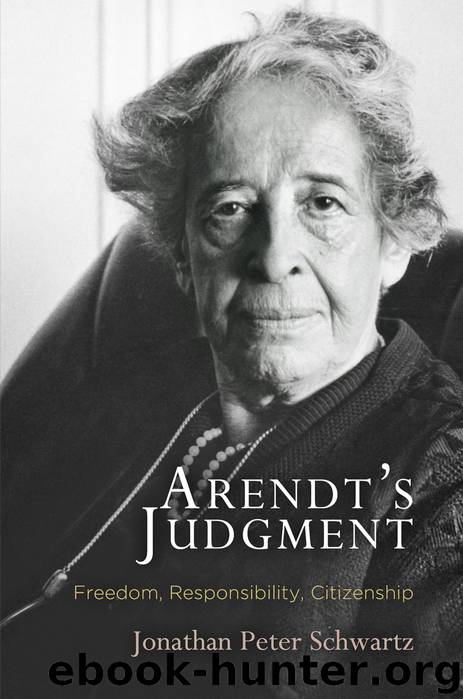
Author:Schwartz, Jonathan Peter;
Language: eng
Format: epub
Publisher: University of Pennsylvania Press, Inc.
Published: 2016-07-24T16:00:00+00:00
5
Arendt’s Theory of Judgment
In Chapter 4, I explored Arendt’s account of the formidable political pathologies inherent in modernity. I now want to argue that she understood her theory of judgment to be her fundamental response to this modern predicament. As I have been claiming throughout this study, Arendt believed the modern situation required an authentic form of political philosophy. How does her theory of judgment make this authentic political philosophy possible? The core of Arendt’s account of judgment revolved around an attempt to clarify the nature of the phenomenon of common sense and to understand the fundamental role it has in political reflection. The notion of common sense is ancient, extending at least as far back as Aristotle, and probably even further to the Greek sophists. As a widespread colloquial expression, one naturally assumes its meaning is vacuous; yet, the concept has been widely used in numerous languages both past and present, and in nearly all cases indicates a similar phenomenon, one taken seriously by philosophers and statesmen alike in the history of Western political thought. Almost always associated with what Aristotle called “prudence,” it seems to denote a kind of worldly wisdom cultivated through natural insight, practical experience, and humanistic education. Arendt virtually always described common sense the same way: It was an intuitive feeling for worldliness, a “sixth sense … that fits us into, and thereby makes possible, a common world.”1
The question of common sense runs like a red thread throughout her mature writings. What defined political and non-sovereign forms of existence for Arendt had to do with whether a functioning common sense related the individuals of a particular world together. The modern failure of common sense dominates The Origins of Totalitarianism, providing its central explanatory element.2 While less often explicitly discussed in The Human Condition, it remained pivotal to the book’s ultimate argument, which revolved around Arendt’s account of the modern turn from common sense toward technical rationality, or “common-sense reasoning,” as she called it, leading to a politics of the human animal species that prioritized labor and hyperconsumption.3 This attempt to replace common sense with “common-sense reasoning” is her central explanation for the introduction of elements of necessity into politics. We saw in the Chapter 4 how the rise of process thinking and the undermining of the traditional Western world led to an erosion of common sense and the appeal to commonsense reasoning, while in Chapter 3, we saw that it was the philosophers’ alienation from common sense that led them to establish the tradition of political thought on the model of a sovereign form of political judgment.4
As we’ve seen, the inability of the revolutionaries to escape the tradition of political thought’s sovereign model of judgment was a necessary ingredient in the worst instances of modern tyranny. The tradition of political thought had been unable to offer the revolutionaries what they were truly seeking: a renewal of human freedom in the modern world. Instead, it led to a conception of political action that theorized the act
Download
This site does not store any files on its server. We only index and link to content provided by other sites. Please contact the content providers to delete copyright contents if any and email us, we'll remove relevant links or contents immediately.
The Secret History by Donna Tartt(19469)
The Social Justice Warrior Handbook by Lisa De Pasquale(12293)
Thirteen Reasons Why by Jay Asher(9118)
This Is How You Lose Her by Junot Diaz(7056)
Weapons of Math Destruction by Cathy O'Neil(6466)
Zero to One by Peter Thiel(5951)
Beartown by Fredrik Backman(5938)
The Myth of the Strong Leader by Archie Brown(5623)
The Fire Next Time by James Baldwin(5582)
How Democracies Die by Steven Levitsky & Daniel Ziblatt(5322)
Promise Me, Dad by Joe Biden(5229)
Stone's Rules by Roger Stone(5190)
A Higher Loyalty: Truth, Lies, and Leadership by James Comey(5087)
100 Deadly Skills by Clint Emerson(5023)
Rise and Kill First by Ronen Bergman(4890)
Secrecy World by Jake Bernstein(4878)
The David Icke Guide to the Global Conspiracy (and how to end it) by David Icke(4850)
The Doomsday Machine by Daniel Ellsberg(4619)
The Farm by Tom Rob Smith(4611)
