Are the Lips a Grave? by Huffer Lynne
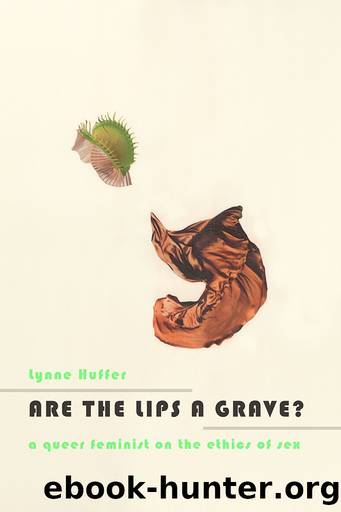
Author:Huffer, Lynne [Huffer, Lynne]
Language: eng
Format: epub
Publisher: Perseus Books, LLC
Published: 2013-11-15T00:00:00+00:00
6
Queer Lesbian Silence
Colette Reads Proust
In considering how to situate the topic of this chapterââQueer Lesbian SilenceââI keep thinking back to a poster I used to have hanging on my office door, year after year, to commemorate LGBT people with a âDay of Silence.â The poster encouraged us to promote awareness of the silence imposed on lesbian, gay, bisexual, and transgender people by refusing to speak for an entire day. âWhy do you use silence to end silence?â the poster asked. It went on to deplore the silencing that homophobia and heterosexism create in our society, arguing for the increased voice and visibility of queers.
Along similar lines, Adrienne Rich reminds us in her poem, âCartographies of Silence,â about the lives lost in the carefully constructed silences of history:
Silence can be a plan
rigorously executed
the blueprint to a life
It is a presence
it has a history a form
Do not confuse it
with any kind of absence.1
I begin this chapter with an invocation of silence as a way of signaling the paradox of queer lesbianism simultaneously made legible and marginalized by a speech-inciting sexual dispositif: mediatized versions of lesbianism notwithstanding (think Ellen DeGeneres or lesbian chic), to speak about lesbianism is to speak about silence. Indeed, it could be that the most faithful tribute to lesbian existence would be not to redeploy a machinery of cultural representation that never seems to get it right but, rather, as the poster suggests, to use silence to end silence. And yet, even our symbolic moments of silence usually feel ânot quite right.â My feelings about a âDay of Silenceâ were always vexed, and I think they pointed to that quality of ânot quite rightnessâ that is a hallmark of representation itself and includes silence as representation. As Rich so eloquently puts it: Silence âis a presence/It has a history a form,â yet cannot be fully rendered.
That said, itâs also important to remember that speech and silence do not exist in a vacuum, but rather as the temporally shifting effects of a process of reading in time. In the context of this book, I engage lesbian silence in a queer feminist, postidentitarian landscape that no longer quite knows what to do with this word lesbian, whose complementary relation to its brother term, gay, reveals the asymmetrical logic of gender identified by Beauvoir, where gay occupies the position of both the positive and the neutral.2 Following Beauvoirâs logic, lesbian âis the negative, to such a point that any determination is imputed to her as a limitation, without reciprocity.â3 Refracted through the lens of different readers in different times, pursuing this asymmetrical figure of negativity is more than a project of reclamationâmore than a geological excavation where falsity is replaced with truth and silence is replaced with the voice of identity and the restoration of an agency whose source is Lesbos, Sappho, or even the separatist movements of the 1970s. Rather, I conceive of this project of engaging the queer lesbian in the context of silence as a process that brings into
Download
This site does not store any files on its server. We only index and link to content provided by other sites. Please contact the content providers to delete copyright contents if any and email us, we'll remove relevant links or contents immediately.
Twisted Games: A Forbidden Royal Bodyguard Romance by Ana Huang(4034)
The Push by Ashley Audrain(2705)
Den of Vipers by K.A Knight(2704)
Win by Harlan Coben(2667)
Echo by Seven Rue(2248)
Baby Bird by Seven Rue(2224)
Beautiful World, Where Are You: A Novel by Sally Rooney(2181)
A Little Life: A Novel by Hanya Yanagihara(2157)
Iron Widow by Xiran Jay Zhao(2127)
Leave the World Behind by Rumaan Alam(2100)
Midnight Mass by Sierra Simone(2017)
Bridgertons 2.5: The Viscount Who Loved Me [Epilogue] by Julia Quinn(1796)
Undercover Threat by Sharon Dunn(1791)
The Four Winds by Hannah Kristin(1775)
Sister Fidelma 07 - The Monk Who Vanished by Peter Tremayne(1671)
The Warrior's Princess Prize by Carol Townend(1632)
Snowflakes by Ruth Ware(1602)
Dark Deception by Rina Kent(1570)
Facing the Mountain by Daniel James Brown(1556)
