And what about Human Rights? by Bahman Nirumand
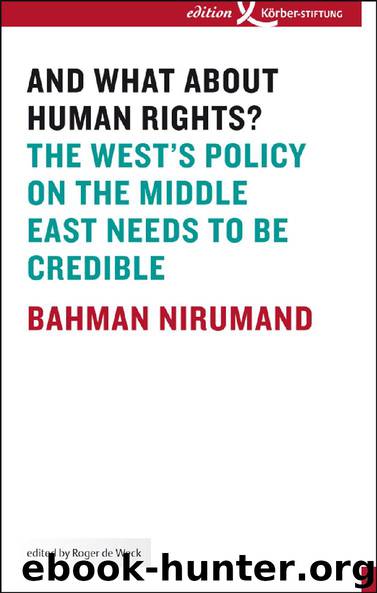
Author:Bahman Nirumand
Language: eng
Format: epub
ISBN: 978-3-89684-377-7
Publisher: edition Körber-Stiftung, Hamburg 2012
Saudi Arabia, the West’s Closest Ally
Let us take the case of Saudi Arabia. It is difficult to deny the fact that Saudi Arabia is right at the top of the list of countries in which human rights abuses are an everyday occurrence, and that it is in every respect a backward country which is light years away from democracy and the rule of law. Moreover, Saudi Arabia is a hotbed of radical Islamism and terrorism. Most of the assailants on 11 September 2001 in New York and Washington came from Saudi Arabia. The Saudi royal family supported the Taliban in Afghanistan until they were ousted. In order to demonstrate that it is a leading power in the Islamic world Saudi Arabia has set up a global network of Islamic organizations. Seeing that they had an unlimited supply of petrodollars at their disposal, the Saudis began in the 1960s to provide financial assistance to Islamic groups, organizations and movements in other states (and also in non-Islamic countries). 1962 saw the foundation of the “Muslim World League,” an organization that was supposed to provide an alternative to Arab nationalism. The Saudis financed religious publications which were also distributed in Europe and the US; they built mosques; and they founded Qur’an schools. There are about 2,000 Qur’an schools around the world which were solely or mainly founded with Saudi money, and they are places in which fundamentalist ideas were able to thrive and prosper. Thus a network of organizations and ideological outposts came into being, and it often spawned political and militant activities that had little or nothing to do with the will and intentions of the donors. As we have seen, the Saudis, acting in conjunction with the US and Pakistan, set up a number of military organizations which participated in the holy war against the Soviet invasion forces in Afghanistan. This was the nucleus of both the Taliban and al-Qaeda.
Are states which subscribe to human rights, democracy and freedom allowed to befriend this country and work together with it? The answer given by the West is quite simple. Yes, they may, if it is in their economic and geostrategic interests.
After the 1979 revolution the West was no longer able to use Iran as its policeman in the Gulf region, and thus the US and Saudi Arabia started to establish a new security network. About 30,000 US military advisors were sent to Saudi Arabia as early as 1980. Saudi petrodollars made it possible to put in place a very modern military infrastructure and logistics system, though to all intents and purposes these could be operated only by US military personnel. At the same time there was an increase in the number of new American bases in the region. The alliance between the US and Saudi Arabia was a gigantic project and probably one of the largest ever implemented by a great power and a developing country. Although it is difficult to imagine, the fact of the matter is that since the 1940s Saudi Arabia has invested about US$200 trillion in its armed forces.
Download
This site does not store any files on its server. We only index and link to content provided by other sites. Please contact the content providers to delete copyright contents if any and email us, we'll remove relevant links or contents immediately.
| Anthropology | Archaeology |
| Philosophy | Politics & Government |
| Social Sciences | Sociology |
| Women's Studies |
The Secret History by Donna Tartt(19477)
The Social Justice Warrior Handbook by Lisa De Pasquale(12297)
Thirteen Reasons Why by Jay Asher(9130)
This Is How You Lose Her by Junot Diaz(7060)
Weapons of Math Destruction by Cathy O'Neil(6482)
Zero to One by Peter Thiel(5953)
Beartown by Fredrik Backman(5950)
The Myth of the Strong Leader by Archie Brown(5631)
The Fire Next Time by James Baldwin(5592)
How Democracies Die by Steven Levitsky & Daniel Ziblatt(5333)
Promise Me, Dad by Joe Biden(5237)
Stone's Rules by Roger Stone(5196)
A Higher Loyalty: Truth, Lies, and Leadership by James Comey(5092)
100 Deadly Skills by Clint Emerson(5032)
Rise and Kill First by Ronen Bergman(4907)
Secrecy World by Jake Bernstein(4892)
The David Icke Guide to the Global Conspiracy (and how to end it) by David Icke(4854)
The Doomsday Machine by Daniel Ellsberg(4627)
The Farm by Tom Rob Smith(4614)
