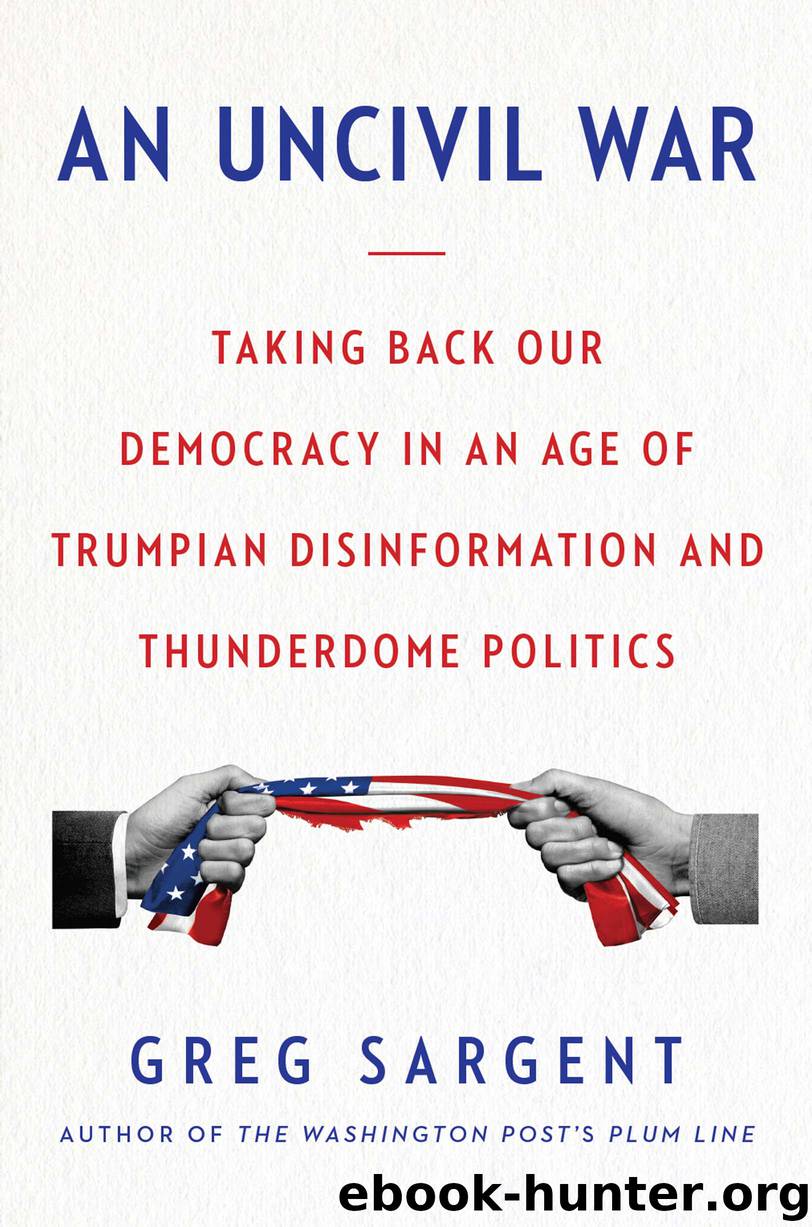
An Uncivil War by Greg Sargent
Author:Greg Sargent
Language: eng
Format: epub
Publisher: HarperCollins
Published: 2018-08-26T16:00:00+00:00
Can Journalism Adapt?
One salutary recent development has been that some news organizations have embarked on an increasingly aggressive up-front effort to signal to readers when politicians—particularly Trump—try to mislead or lie to them. Cable news networks have more regularly taken to labeling statements as “false” right in their chyrons (the caption superimposed over the lower part of a video image) as they air footage of politicians making those statements, so viewers almost instantly learn they’re being deceived. (It’s worth noting that social media tends to amplify this effect: Ordinary viewers and other journalists sometimes tweet out visual screen captures of such chyrons, further informing those who might encounter the lie in question at a later point.) And multiple big news organizations have begun to label politicians’ statements as false right in their headlines far more often than in the past. For example, during the controversy over the Trump administration’s policy of separating immigrant children from their families at the border, the president repeatedly lied about who was to blame. One of the New York Times’ lead stories on this was headlined “Trump Repeats Falsehood That Democrats Are to Blame for Separating Migrant Families.”32 There have been many such examples.
It’s notable that such labeling comes more naturally to news outlets that came of age in the internet era. BuzzFeed News, for instance, has adopted a policy of calling out falsehoods in headlines, which by itself is not original, but what’s particularly interesting about its approach is that it is grounded in an appreciation of the specific perils of the current moment. “The importance of headlines is arguably even greater now in the social media era, because a lot of people are in passive consumption mode,” Craig Silverman, the media editor at BuzzFeed News, told me. “When people see stuff on social media, what they often see is only the headlines. If you are restating claims that are false or misleading in headlines, you are spreading misinformation. And social media is pouring gasoline on that fire.”33
This is a crucial insight, and while things have gotten better in recent months, it remains one that plenty of traditional journalists and news organizations still refuse to take seriously enough. You constantly see headlines on news organizations’ websites that blare forth a politician’s false, dubious, or unsupported claims without informing readers that those claims are, well, false or dubious or unsupported. Often it requires reading deep into a story to discover it when there is even any corrective at all. The same goes for news organizations’ Twitter feeds—tweets alerting readers to breaking news regularly transmit false claims with no correctives in the tweets themselves. It is a great irony of this moment that, by broadcasting forth Trump’s lies—while declining to inform readers that they are just that, or by burying the truth deep within its accompanying articles—the news organizations that Trump regularly derides actually are spreading a species of fake news—that is, fake news authored by Trump himself. There is little doubt that a deceiver as
Download
This site does not store any files on its server. We only index and link to content provided by other sites. Please contact the content providers to delete copyright contents if any and email us, we'll remove relevant links or contents immediately.
| Anthropology | Archaeology |
| Philosophy | Politics & Government |
| Social Sciences | Sociology |
| Women's Studies |
The Secret History by Donna Tartt(19103)
The Social Justice Warrior Handbook by Lisa De Pasquale(12197)
Thirteen Reasons Why by Jay Asher(8919)
This Is How You Lose Her by Junot Diaz(6894)
Weapons of Math Destruction by Cathy O'Neil(6284)
Zero to One by Peter Thiel(5808)
Beartown by Fredrik Backman(5767)
The Myth of the Strong Leader by Archie Brown(5513)
The Fire Next Time by James Baldwin(5454)
How Democracies Die by Steven Levitsky & Daniel Ziblatt(5225)
Promise Me, Dad by Joe Biden(5157)
Stone's Rules by Roger Stone(5091)
A Higher Loyalty: Truth, Lies, and Leadership by James Comey(4966)
100 Deadly Skills by Clint Emerson(4931)
Rise and Kill First by Ronen Bergman(4797)
Secrecy World by Jake Bernstein(4756)
The David Icke Guide to the Global Conspiracy (and how to end it) by David Icke(4723)
The Farm by Tom Rob Smith(4517)
The Doomsday Machine by Daniel Ellsberg(4493)
