America in the World by Robert B. Zoellick
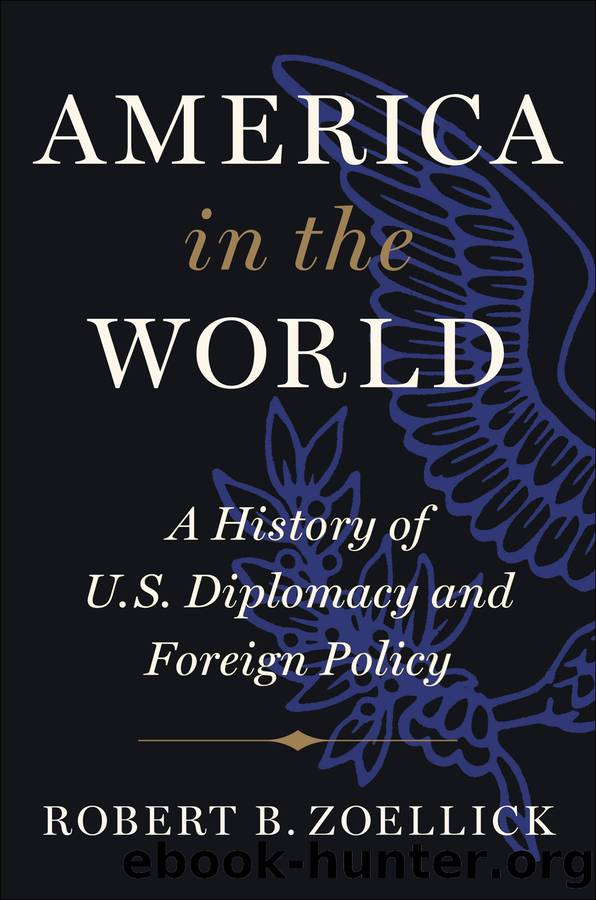
Author:Robert B. Zoellick [ZOELLICK, ROBERT B.]
Language: eng
Format: epub
Publisher: Grand Central Publishing
Published: 2020-08-04T00:00:00+00:00
CHAPTER 12
Vannevar Bush
Inventor of the Future
Three Big Ideas
In July 1945, as Americans were turning from the imperatives of war to the uncertainties of peace, Dr. Vannevar Bush advanced three ideas that shaped the nation’s security for the rest of the century. He wrote two as designs for the future, although for very different audiences. The third involved an immense blast in New Mexico.
Bush titled his first paper “Science, the Endless Frontier.” It was a thirty-four-page introduction to dry committee reports published by the Government Printing Office. The papers—and Bush’s introduction—responded to an inquiry from the late President Roosevelt (prompted by Bush) about lessons learned from scientific-governmental cooperation during wartime.1
As Bush recalled many years later, in late 1944 FDR had called Bush into his office to ask, “What’s going to happen to science after the war?” Bush replied, “It’s going to fall flat on its face.” Roosevelt countered, “What are we going to do about it?” To which Bush answered, “We better do something damn quick.”2
Bush’s public paper was the start of a big “something.” His title invoked the quintessential American image of pioneers. He called for governmental funding of basic research in peacetime—in partnership with universities and industry—to discover “a largely unexplored hinterland” of science. For well over a century, Americans had defined their frontiers in geographical terms. For many foreign policy experts, the fashion of geopolitics trained diplomatic eyes on continental heartlands, rimlands, and maritime states. Bush offered another perspective on power and influence: “Scientific progress is one essential key to our security as a nation, to our better health, to more jobs, to a higher standard of living, and to our cultural progress.”3
Bush urged the creation of a new National Research Foundation (NRF) as an independent agency outside the federal government to encourage “freedom of inquiry.” The NRF, guided by an expert board and small staff, would direct contracts and grants to “colleges, universities, and research institutes, in both medicine and the natural sciences.”4
Bush’s call to action eventually led to the creation of the National Science Foundation. More important, his initiative—and the success of his wartime work—led to the construction of a military-industrial-academic network that gave the United States an unmatched technological edge in world affairs.
Bush’s second publication that summer of 1945 was an article in the July edition of the Atlantic titled “As We May Think.” Bush described a machine of the future, a “memex,” to “give man access to and command the inherited knowledge of the ages.” In stark contrast with Bush’s idea of an organized public-private research and development complex, the memex would empower individuals through a desktop screen that opened a portal to a universe of information. Bush’s visionary machine would be a personalized aid to memory, a gateway for research, and a device to help automate thought through a “trail” of mental associations. He even imagined what became known as file sharing and hypertext links. At a time when the world had only begun to consider the possibilities of huge computers—much less smaller ones—Bush was anticipating a new era of information technology accessible to the public.
Download
This site does not store any files on its server. We only index and link to content provided by other sites. Please contact the content providers to delete copyright contents if any and email us, we'll remove relevant links or contents immediately.
| Anthropology | Archaeology |
| Philosophy | Politics & Government |
| Social Sciences | Sociology |
| Women's Studies |
The Secret History by Donna Tartt(19477)
The Social Justice Warrior Handbook by Lisa De Pasquale(12297)
Thirteen Reasons Why by Jay Asher(9129)
This Is How You Lose Her by Junot Diaz(7060)
Weapons of Math Destruction by Cathy O'Neil(6481)
Zero to One by Peter Thiel(5953)
Beartown by Fredrik Backman(5950)
The Myth of the Strong Leader by Archie Brown(5631)
The Fire Next Time by James Baldwin(5592)
How Democracies Die by Steven Levitsky & Daniel Ziblatt(5333)
Promise Me, Dad by Joe Biden(5237)
Stone's Rules by Roger Stone(5196)
A Higher Loyalty: Truth, Lies, and Leadership by James Comey(5092)
100 Deadly Skills by Clint Emerson(5032)
Rise and Kill First by Ronen Bergman(4907)
Secrecy World by Jake Bernstein(4892)
The David Icke Guide to the Global Conspiracy (and how to end it) by David Icke(4854)
The Doomsday Machine by Daniel Ellsberg(4627)
The Farm by Tom Rob Smith(4614)
