Against Decolonisation by Olfmi Tw ;
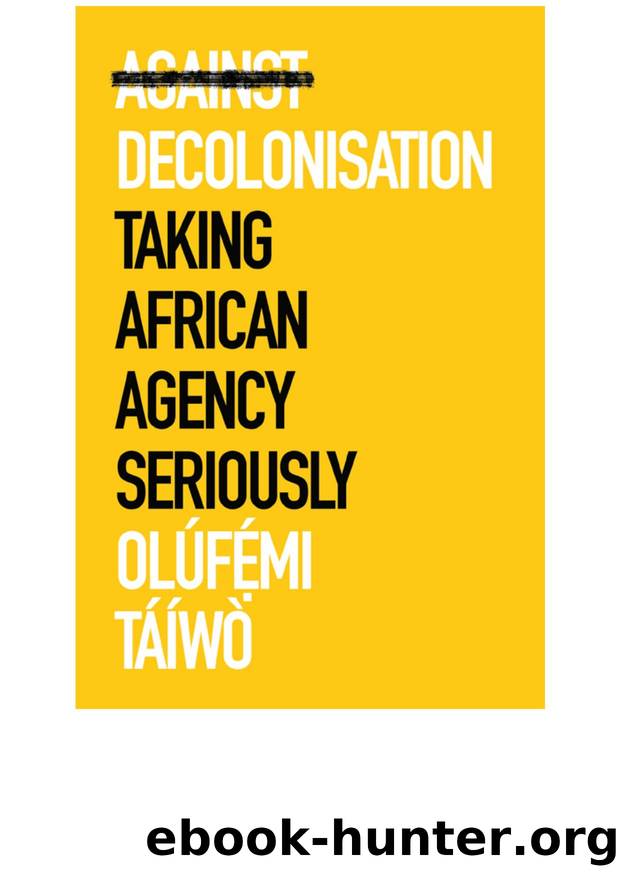
Author:Olfmi Tw ; [;, Olfmi Tw]
Language: eng
Format: epub
ISBN: 9781787386921
Publisher: LightningSource
Published: 2022-06-24T00:00:00+00:00
4
DECOLONISE THIS!
TAKING HISTORY AND AGENCY SERIOUSLY
Liberty is not unilateral. It does not merely mean freedom from European domination.
Ousmane Sembène1
I have argued in previous chapters that putting colonisation at the centre of ex-colonised lives is historically suspect and has the unintended consequence of making less legible, if not rendering completely invisible, the autonomous lives (despite colonisation) led by the colonised even while colonialism lasted. It eviscerates the lives they led before colonialism was imposed on them, and the lives they have crafted since they threw off the colonial yoke. Opposing this does not mean a denial of the impact of colonialism on the life, times and thoughts of the colonised. But it surely means, and I cannot emphasise this enough, refusing to define the colonised strictly by the colonial experience, however profound colonialismâs impact may have been on them. Hence, I insist that the ultimate problem with decolonisation discourse is its oft-unapprehended failure to take seriously the complexity of African agency and the many ways it has grappled with both colonialism and its legacyâranging from wholesale embrace of colonially derived languages, ideas, institutions, processes and practices to attempts at wholesale rejection of the same. We need to engage with this complexity. In this final chapter, I focus on a problem in political science and political philosophy that is often zeroed in on by African and Africanist scholars in their strident call for decolonisation: the central political philosophical problem of who ought to rule when not all can rule, and the related question of the fate and career of liberal representative democracy and the form of governance it underwrites on the continent. Consistent with the tenor of the rest of this work, I direct our attention to a problem that goes to the heart of the decolonising discourse but can be shown to have little, if anything, to do with colonisation. If we do not buy into the idea of the near permanence of colonialism and its continuing impact more than half a century after independenceâi.e., if we accept that decolonisation1 has been wonâthe discourse about the fate of the state, questions of legitimacy and suchlike must be beyond the ken of decolonisation2.
The importance of complexity and the agency of the ex-colonised cannot be overstressed. Many aspects of life in contemporary Africa are intimately connected with material and ideational structures that are framed by the dominance of modern governance, legitimated by and founded on the consent of the governed. What is even more significant is the repeated elision in discourse and in practice of the underlying metaphysical grounds of the modern state: the principle of subjectivity, the centrality and inviolate status of the individual. While the state and its allied institutions like the judiciary are built on this principle, some areas of life continue to be structured by other, not necessarily compatible, ideas and associated beliefsâranging from at what age girls can marry to what rites widows must undergo at the passing of their husbands, to age-grade memberships that are not voluntarily chartered.
Download
This site does not store any files on its server. We only index and link to content provided by other sites. Please contact the content providers to delete copyright contents if any and email us, we'll remove relevant links or contents immediately.
| Arms Control | Diplomacy |
| Security | Trades & Tariffs |
| Treaties | African |
| Asian | Australian & Oceanian |
| Canadian | Caribbean & Latin American |
| European | Middle Eastern |
| Russian & Former Soviet Union |
The Secret History by Donna Tartt(19035)
The Social Justice Warrior Handbook by Lisa De Pasquale(12183)
Thirteen Reasons Why by Jay Asher(8885)
This Is How You Lose Her by Junot Diaz(6873)
Weapons of Math Destruction by Cathy O'Neil(6261)
Zero to One by Peter Thiel(5784)
Beartown by Fredrik Backman(5734)
The Myth of the Strong Leader by Archie Brown(5495)
The Fire Next Time by James Baldwin(5426)
How Democracies Die by Steven Levitsky & Daniel Ziblatt(5211)
Promise Me, Dad by Joe Biden(5141)
Stone's Rules by Roger Stone(5080)
A Higher Loyalty: Truth, Lies, and Leadership by James Comey(4947)
100 Deadly Skills by Clint Emerson(4915)
Rise and Kill First by Ronen Bergman(4776)
Secrecy World by Jake Bernstein(4739)
The David Icke Guide to the Global Conspiracy (and how to end it) by David Icke(4697)
The Farm by Tom Rob Smith(4501)
The Doomsday Machine by Daniel Ellsberg(4482)
