Against Borders: The Case for Abolition by Gracie Mae Bradley & Luke de Noronha
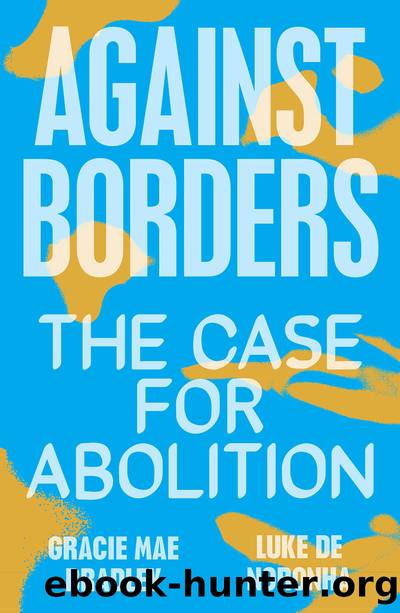
Author:Gracie Mae Bradley & Luke de Noronha [Bradley, Gracie Mae & Noronha, Luke de]
Language: eng
Format: epub
Tags: Political Science, Public Policy, Immigration, Human Rights, Political Ideologies, Communism; Post-Communism & Socialism
ISBN: 9781839761959
Google: akBQEAAAQBAJ
Publisher: Verso Books
Published: 2022-07-19T22:07:25+00:00
Prevent, Policing, and Rooting Out the Enemies
Clearly, the War on Terror has provided cover for the extension of state powers to exclude, denationalise, detain and deport. These deeply troubling patterns suggest that even fairly timid arguments in defence of liberal principles â separation of powers, due process rights, respect for fundamental civil liberties â now seem quite radical, in the context of perpetual war and everyday securitisation. These patterns also reaffirm the need to build connections between different struggles against state racism â against violent borders, punitive criminal justice, counter-terrorism, and war in general â and to build solidarity between groups variously racialised as internal outsiders: Muslims, migrants, overpoliced and criminalised young black people, and so on. The treatment of Muslim communities and those racialised as Muslim in the context of counter-terrorism mirrors the targeting of migrants in important ways, providing fertile ground for mutual solidarity. This is especially clear in the synergies between the UKâs counter-radicalisation policy, Prevent, and the âhostile environmentâ immigration policy.
Launched in 2006, Prevent has been a key part of the governmentâs counter-terrorism strategy. It aims âto stop people becoming terrorists or supporting terrorismâ, and forms part of the four Ps strategy: Prevent, Pursue, Protect and Prepare.11 Prevent attempts to combat âradicalisationâ before people are enlisted into formal terrorist organisations, and therefore involves collecting intelligence about the beliefs and ideologies of people who are not involved in criminal activity â predominantly British Muslims. Initially, this information was gathered by schools, youth projects and religious and voluntary groups, either under pressure from the police or as a condition of the £140 million government funding attached to Prevent.12 Many organisations and public bodies did not want to participate in the controversial programme, and so the government placed it on a statutory footing through the Counter-Terrorism and Security Act 2015. This meant that every local authority, educational institution and NHS trust now had a legal duty to âhave due regard to the need to prevent people from being drawn into terrorismâ.13
In this new regime, everybody is compelled to look out for and report on signs of radicalisation. This has seen young school children reported to Prevent for inane comments, and has had a chilling effect on student politics. For example, signs of religiosity, critique of British imperialism or support for Palestine have led to reporting and surveillance. The government defined extremism in the Prevent strategy as âvocal or active opposition to our fundamental values, including democracy, the rule of law, individual liberty and mutual respect and tolerance of different faiths and beliefsâ.14 Clearly, the vagueness of âour fundamental valuesâ offers wide scope for varied interpretation.
The âhostile environmentâ, on the other hand, involves denying undocumented migrants access to fundamental services, including healthcare, legal employment, housing, education, a driving licence and a bank account. Like Prevent, the policy deputises public officials and gatekeepers to enforce these punitive policies, in this instance checking immigration status to help root out âillegal immigrantsâ. Everyone is checking and being checked â when they rent a
Download
This site does not store any files on its server. We only index and link to content provided by other sites. Please contact the content providers to delete copyright contents if any and email us, we'll remove relevant links or contents immediately.
The Secret History by Donna Tartt(19051)
The Social Justice Warrior Handbook by Lisa De Pasquale(12187)
Thirteen Reasons Why by Jay Asher(8893)
This Is How You Lose Her by Junot Diaz(6877)
Weapons of Math Destruction by Cathy O'Neil(6264)
Zero to One by Peter Thiel(5786)
Beartown by Fredrik Backman(5737)
The Myth of the Strong Leader by Archie Brown(5498)
The Fire Next Time by James Baldwin(5431)
How Democracies Die by Steven Levitsky & Daniel Ziblatt(5213)
Promise Me, Dad by Joe Biden(5141)
Stone's Rules by Roger Stone(5081)
A Higher Loyalty: Truth, Lies, and Leadership by James Comey(4952)
100 Deadly Skills by Clint Emerson(4920)
Rise and Kill First by Ronen Bergman(4779)
Secrecy World by Jake Bernstein(4740)
The David Icke Guide to the Global Conspiracy (and how to end it) by David Icke(4701)
The Farm by Tom Rob Smith(4502)
The Doomsday Machine by Daniel Ellsberg(4484)
